Websites · November 20, 2026
Building a treatment center website for families

By Zac Spencer
The search that starts after the dishes are done
Thanksgiving ends, the cousins drive home, and somebody stays up with a phone. Maybe a brother noticed his sister left the table four times. Maybe a mother finally said out loud what everyone at dinner had been avoiding. (That scene is illustrative, though in our experience it's a pretty familiar shape for a December call.) The person searching for treatment that night usually isn't the person who needs it.
Most sites are written to the patient. A treatment center website for families has a second front door, built for the parent, spouse, or sibling who is reaching out for someone else. That visitor shows up with different questions, starting with whether they're even allowed to make this call and ending, a few weeks later, with "why won't anyone tell me how he's doing?"
If the site never answers those, the family member has to guess, and a lot of them guess they're in the wrong place. This post covers how to build that section and how it connects to admissions. Our general treatment center website post covers the visitor in crisis; this one is about the person calling on someone's behalf.
Give the family member their own path
Start with the forms and the admissions page, because that's where a family member decides whether to reach out.
The smallest useful change is one question near the top of the contact form: "Who are you reaching out for?" with two answers, "Myself" and "Someone I care about." It costs one tap. Admissions learns who is on the other end before calling back, which changes the whole first minute of that call, and the family member sees that people in their position are expected here.
Keep the loved-one branch short. Ask for the family member's name and how to reach them. Make the loved one's details optional, and ask your compliance lead what the form should collect about a third party at all. A parent filling out a form at midnight shouldn't feel like they're filing a report on their son.
Add a contact-preference question too: call, text, or email, and whether a voicemail is okay. A family member may share a phone or an inbox with the person they're worried about. We went deeper on that in HIPAA-compliant texting for admissions.
On the admissions page, give the family path its own block with a plain label, something like "Calling about a loved one?" Put a click-to-call button there and a link to a page written for them. If you run an insurance verification form, say clearly that a family member can start it, and what they'll need from the other person's insurance card.
One technical note belongs here. These form pages are the last place an ad pixel should be firing. If your site sends form events to Meta or Google, read our post on HIPAA tracking pixels before you add a field that says "my daughter."
What happens on the call, written down
Family members are often scared of the call itself. They worry they'll say the wrong thing, or that admissions will ask questions they can't answer about someone else's drinking or drug use.
Write the call down. A short page (or a section of the family hub) can walk through it in plain steps: you'll talk with an admissions coordinator, they'll ask what's been going on and what you've noticed, they'll ask about insurance if you have it, and they'll explain which levels of care might fit and what the next step looks like. Say how long it usually takes. Say that "I don't know" is an acceptable answer.
Then say what admissions can't do from that call. Most programs need to speak with the person who would enter treatment before anything is decided, and many need that person's own agreement. Your clinical and admissions leads should write or approve that part, because it varies by program, level of care, and state. The website's job is to set the expectation honestly so the family member isn't surprised when admissions asks to talk with their loved one.
Leave intervention scripts and "how to get them to agree" advice off this page. That's clinical territory, and the copy can drift into pressure fast. If your program offers family consultations with a clinician, link to that. Otherwise, point to what you do: a conversation with admissions.
Paying for someone else's treatment
Money questions come early from families, and they're different from a patient's money questions. A parent wants to know whether their own plan covers an adult child, whether they can pay cash for a spouse, and who signs the financial paperwork.
A page on paying for a loved one's care can cover the common cases without promising anything. Under the Affordable Care Act, plans that offer dependent coverage generally have to keep children on until age 26, so a lot of parents are asking about their own plan; whether it covers a given program is still the insurer's call. If you accept payment from someone other than the patient, say so, and say billing will walk through it.
Mention explanation of benefits statements, too. On a family plan they often go to the policyholder, and a 24-year-old in treatment may not expect Mom to see one in the mail.
Then add the line families most need to read: paying for treatment doesn't, by itself, entitle the payer to clinical information. That surprises people. A father who wrote a large check expects updates, and the first time he hears "we can't share that" shouldn't be on the phone in week two. What a payer can be told, and under what consent, is a call for your compliance lead and counsel. The website only needs to say that consent governs it.
What families can be told after admission
In our experience this is the section most treatment center websites skip, and the gap shows up later as the angriest phone calls admissions gets. Keep it in plain words and run every sentence past compliance.
We're marketers, not lawyers, so treat what follows as a map of what to ask counsel, not as advice on which rules apply to your program.
Two sets of federal rules usually come up. HIPAA lets a provider share information relevant to a family member's involvement in care or payment, generally when the patient agrees or doesn't object when given the chance. HHS describes that in its FAQ on talking with family and friends.
Programs covered by 42 CFR Part 2, the federal confidentiality rule for substance use disorder records, work under a stricter standard. Part 2 has no general family-involvement exception like HIPAA's, so disclosures to family usually need the patient's written consent naming that person. Even acknowledging that someone is a patient is restricted. Under 42 CFR 2.13, a facility publicly identified as providing only substance use disorder services can acknowledge a patient's presence only with written consent or a court order. Whether your program is a Part 2 program, and which wording you use, is your counsel's decision.
For the website, that usually turns into a few plain sentences for compliance to approve:
- We can't confirm or deny whether someone is in our care unless they've given written permission.
- Your loved one can choose to sign a consent that lets us share certain information with you.
- If they haven't, we can still listen. You can tell us what you've noticed, even when we can't tell you anything back.
Our view: that "we can't confirm" sentence belongs on the website, where a family member reads it calmly before admission, instead of being heard for the first time from a staff member on a tense phone call. Read ahead of time, it's a policy that protects their person. Heard cold on the phone, it sounds like a door closing. Ask your admissions team which version they'd rather be on the line for.
One more wording rule follows from all of this. Nothing on the site, in a chat widget, or in a follow-up text should confirm that a named person is a patient. That includes testimonials from family members, which carry their own consent questions (we covered those in rehab testimonials and compliance).
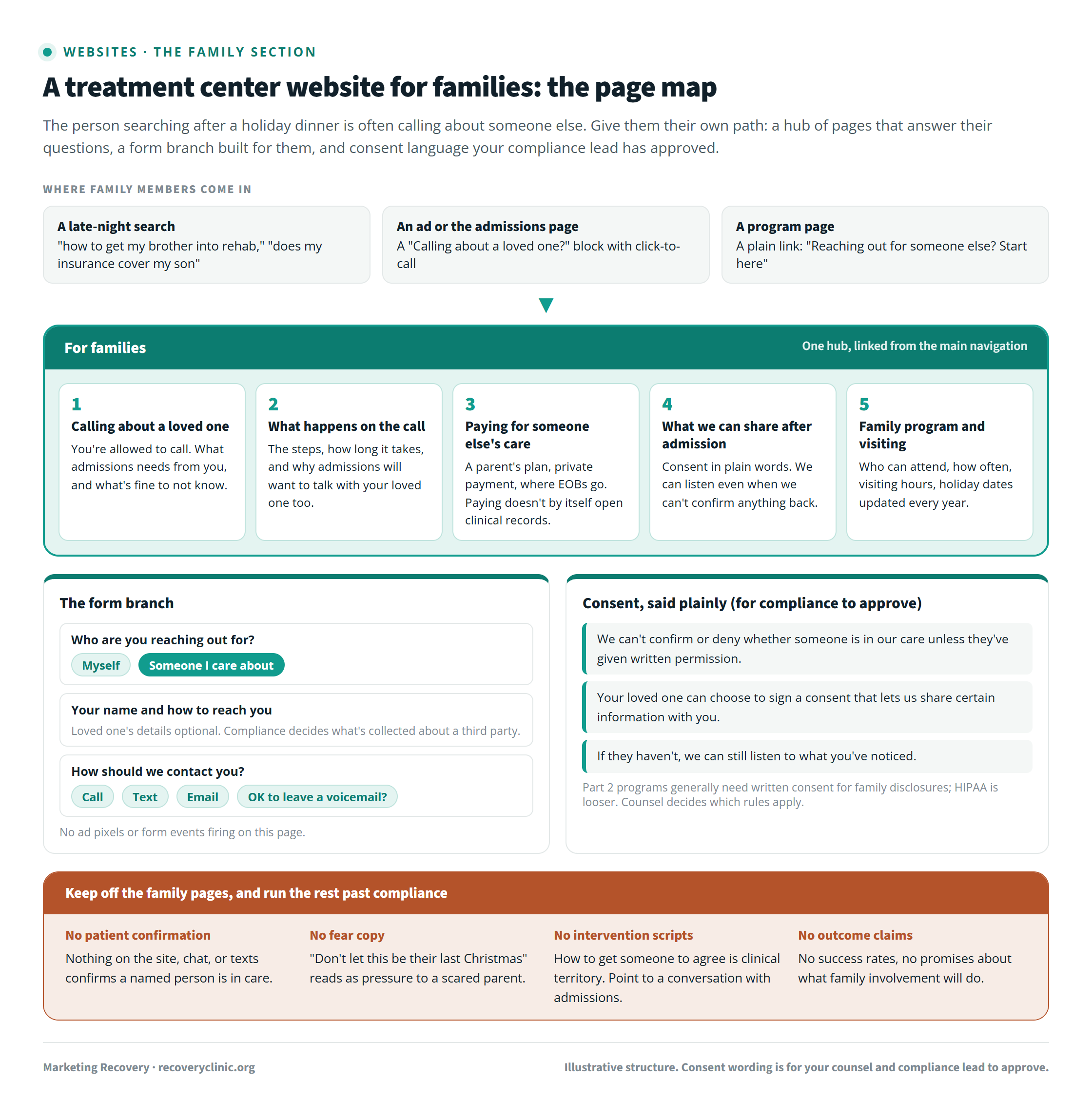
How the family section of a treatment center website fits together: separate pages for the questions family members ask, one form path for the person calling about someone else, and the consent language reviewed before it goes live.
Family program and visiting pages
If your program includes family sessions, a family weekend, or education groups, give them a real page. Say who can attend, how often, whether it's in person or online, and that participation depends on the patient's consent where that applies. A family program page also answers a question the parent was afraid to ask: will we be part of this, or shut out?
Visiting needs less. Post the general policy: days and hours, check-in, what visitors can bring, phone and device rules, and how visits are arranged. Keep it general. The page describes the policy for everyone, and staff handle the individual cases.
Holiday visiting gets its own note each year. Families plan December around it, and a page that still shows last year's dates sends them to the phone with a complaint before they've even visited.
Copy that stays off the family pages
The holiday hook makes it tempting to write urgency copy aimed at families. Resist it. "Don't let this be their last Christmas" is fear copy, and it reads that way to a frightened parent. It can also draw scrutiny under the healthcare rules your ads run under, as we covered in the seasonal demand post.
Skip clinical claims too: no success rates, no promises that family involvement improves outcomes, nothing about what will happen to their loved one. The family section explains how your center works. Clinical and compliance leads approve the family-facing wording before launch and again whenever policies change.
If you're deciding which family questions deserve a page in the first place, our content marketing post starts with your admissions phone log, and that log is full of calls from family members.
Write for the person who isn't the patient
The brother up late after Thanksgiving has already decided to do something. What stops him is a site that only talks to his sister. A form that asks who he's reaching out for, and one approved sentence explaining that the center will listen even when it can't tell him anything back, is often enough to get him to call instead of closing the tab.
Our website work for treatment centers includes building this path: the form branch, the family hub, and the admissions-page block, with your compliance lead signing off on the wording. If you want a read on how your current site treats the person calling for someone else, request a free audit. We work only with licensed, accredited programs, and we never buy or broker leads.
About the author
Zac Spencer is an online marketing specialist and the owner of Crave Media, based in Salt Lake City, Utah. Since 2013 he has managed hundreds of Google Ads accounts across dozens of industries, and founded Marketing Recovery, a specialized arm of Crave Media focused on marketing for licensed addiction treatment centers.