SEO · August 25, 2026
The questions families search that centers never write about

By Zac Spencer
The 1 AM search your website can't answer
Somewhere tonight, a mother is sitting in her kitchen typing "can I talk to my son while he's in detox" into her phone. Nothing about "evidence-based addiction treatment," no interest in anyone's philosophy of care. She has a specific, practical question, she needs the answer before she can breathe, and the center she ends up calling is very often the one that answered it.
Now look at your own blog. If it's like most treatment center blogs we audit, it has posts on the signs of addiction, the benefits of therapy, and the disease model. Respectable topics. Also the most saturated topics in all of healthcare content, where you're competing against WebMD, the Mayo Clinic, and ten thousand other centers for searches that mostly aren't made by people choosing a facility this week. In our experience, treatment center content marketing usually fails on topic selection. The writing is fine. It's aimed at questions nobody in a crisis is asking.
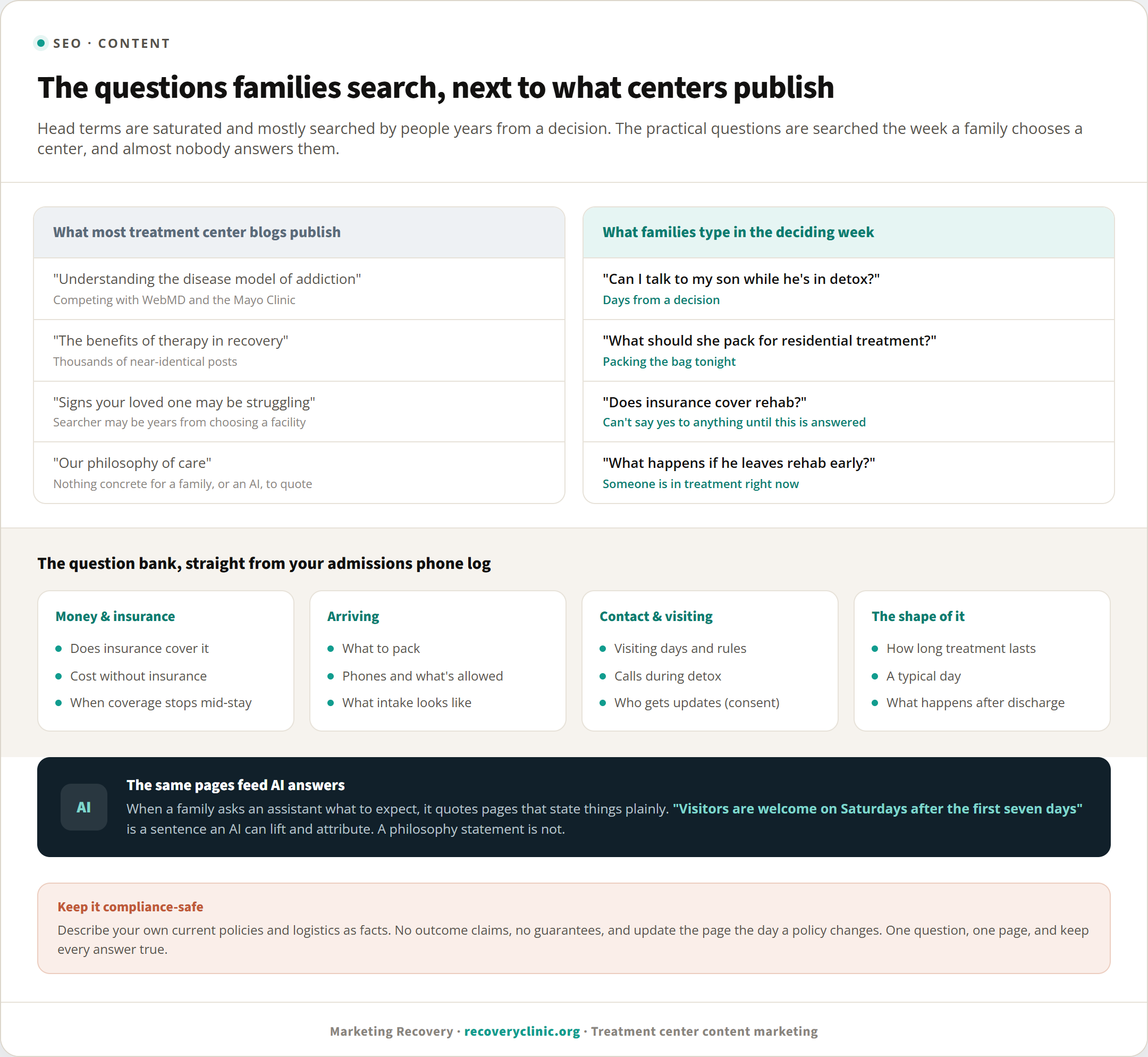
The content gap in one picture: the topics most centers publish, next to the questions families type in the week they choose a center.
Why these questions never get written
The logistics questions get skipped for predictable reasons. To your admissions team, the answers feel too obvious to publish. They answer "what should he pack" fifteen times a week on the phone, so it doesn't register as content. Your clinical leadership, when asked for blog ideas, suggests clinical topics, because that's their world. And keyword tools point everyone at the big head terms, because "drug rehab" has impressive volume and "can my daughter have her phone in residential treatment" looks like a rounding error.
But volume isn't the number that matters. Intent is. The person searching "signs of alcoholism" might be years from a decision. The person searching "what happens if you leave rehab early" has someone in treatment or about to enter it. Nearly every one of these small, awkward, specific questions is asked by a family that is days from choosing a center, and almost no center bothers to compete for them.
The questions worth a page
Pull the last month of questions your admissions line answered and you'll have the list. It usually clusters into four groups.
Money and insurance leads by a mile. "Does insurance cover rehab," "how much does treatment cost without insurance," "what happens when insurance stops paying mid-treatment." We covered the verification side of this in our post on insurance verification in the admissions funnel, and the same logic applies to content: the family that can't answer the money question can't say yes to anything else.
Then the logistics of arriving. What to pack, what gets confiscated at intake, whether they can bring cigarettes, their phone, their own pillow. These read as trivial until you remember who's asking: a parent packing a bag for an adult child, tonight, with no idea what's allowed.
Then contact. Can I visit, when, how often. Can I call during detox. Will someone tell me how he's doing. (That last one deserves an honest page about consent and privacy, written in plain language, because the real answer is "only if he signs a release," and a family that learns that from your website trusts you more, not less.)
And finally the shape of the thing. How long is rehab, what does a day look like, what's the difference between detox and residential, what happens after discharge. Families are trying to picture the next 90 days of their lives. Help them.
Why these pages outrank your pillar posts
The competitive math is lopsided. For "addiction treatment," you're one of thousands of sites with authoritative medical publishers at the top, and Google treats the whole query with heavy YMYL scrutiny. For "can I visit my husband in rehab in his first week," the competition is a couple of forum threads and a directory page. A clear, specific answer from an actual treatment center tends to win, and one center we worked with rode exactly this kind of long-tail coverage to rankings on more than 13,000 keywords, most of which no other center was seriously contesting.
There's a second audience now too. When a family asks ChatGPT or Gemini what to expect from rehab, the assistant assembles its answer from pages that state things plainly. Vague philosophy-of-care prose gives an AI nothing to quote. "Visitors are welcome on Saturdays after the first seven days" is exactly the kind of sentence assistants lift and attribute. The centers showing up in AI answers are largely the ones answering concrete questions, which is the same dynamic we mapped in the family AI-search journey.
And the trust transfer is real. A center that publishes its visiting policy, its packing list, and an honest page about phone access reads as a place that has its act together operationally. Families can't evaluate your clinical program from a website. They can evaluate whether you answer questions like people who run a tight ship.
Writing them without compliance headaches
These pages are compliance-friendly, which is part of their charm. You're describing your own policies and general logistics, not making clinical claims or promising outcomes. A few rules keep it that way.
Answer for your program specifically and say so. "At our facility, phones are stored at intake and available during scheduled windows in week two" beats a generic industry answer and is what a family choosing you needs to know. Keep every stated policy true and current, because a family that packs by your list and gets surprised at intake will remember it. And never let a logistics page drift into outcome territory. What to pack is a fact. "Our structured environment ensures lasting recovery" is a claim you don't want to defend.
One page per question works better than one mega-FAQ. A dedicated page can rank on its own, carry FAQ schema, and give an AI assistant a clean source to cite. Short is fine. A 500-word page that fully answers "can I visit during detox" beats a 3,000-word post that mentions it in passing.
Where this fits in the campaign
If you're early in an SEO engagement, this content usually enters the picture in months two and three, after the technical foundation is set. We laid out that sequencing in the first 90 days of a treatment center SEO campaign. The question pages are the fastest-moving content in the plan, precisely because the competition is thin. It's common to see them pulling impressions within weeks while the head terms are still grinding.
They also compound. Every question page strengthens the site's topical depth, feeds internal links to your program and admissions pages, and gives our SEO work something concrete to build on that a competitor can't copy overnight, because the answers are yours.
Start with the phone log
You don't need a keyword tool to begin. Ask your admissions team for the ten questions they answer most, write a plain, true page for each one, and you'll have covered more real family intent in a month than most centers manage in a year of blogging about the disease model.
If you want to see how you're covered today, run the free AI visibility check to see what AI assistants say when families ask about centers like yours, or request a free audit and we'll map the question gap against your actual search data.
About the author
Zac Spencer is an online marketing specialist and the owner of Crave Media, based in Salt Lake City, Utah. Since 2013 he has managed hundreds of Google Ads accounts across dozens of industries, and founded Marketing Recovery, a specialized arm of Crave Media focused on marketing for licensed addiction treatment centers.