AI Search Visibility · August 7, 2026
The family AI-search journey, from first question to phone call

By Zac Spencer
Nobody asks one question
When we wrote about AI sending families to your competitor, the focus was the destination: which centers the assistant names when someone asks for a recommendation. This post is about the road that leads there, because how families find rehab with AI is rarely one search. It's a conversation that unfolds over days, sometimes weeks, and a center can be out of the running two stages before its name would ever come up.
The sequence matters for a practical reason. Each stage runs on different signals, so each stage has its own way of quietly dropping you. A center with a beautiful website and no directory presence dies at one stage. A center with great listings and a two-year-old review profile dies at another. Walk the journey the way a family walks it and the gaps become specific and fixable.
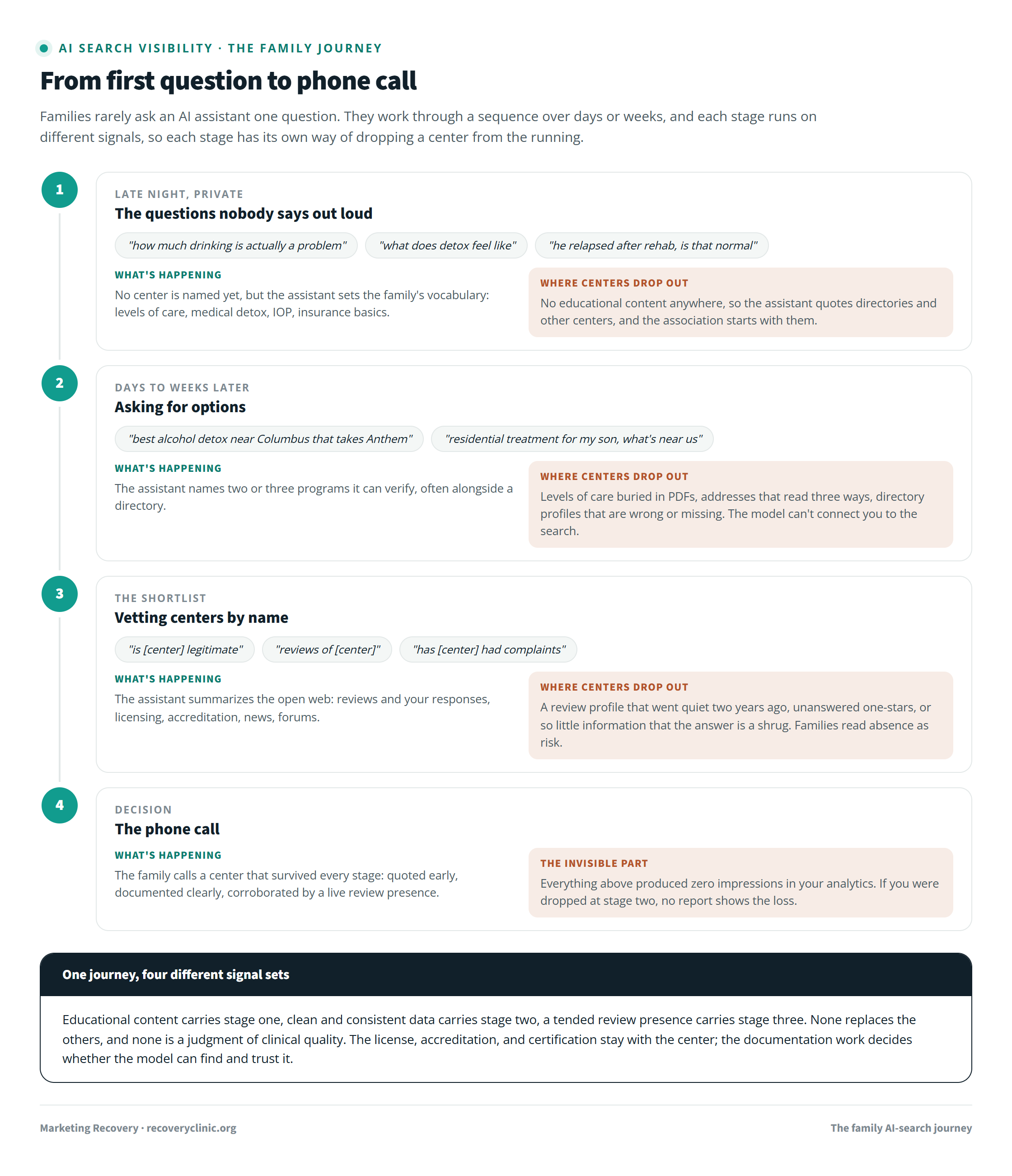
The four stages between a family's first late-night question and a phone call, and what removes a center from the running at each one.
The questions nobody says out loud
The journey starts long before anyone types the word "rehab." It starts at 1 AM with questions a person would be embarrassed to ask a friend: "how much drinking is actually a problem," "my son is using again after rehab, is that normal," "what does detox feel like." An AI assistant is the perfect audience for these. It doesn't judge, and it answers in complete sentences instead of a page of links.
No center gets recommended at this stage, but the frame gets set here. The assistant's answers introduce the vocabulary the family will use for every later question: levels of care, medical detox versus quitting cold, what IOP means, whether insurance typically covers residential treatment. Families that started here arrive at the "which center" stage already educated, with a vocabulary an assistant taught them.
Centers are not powerless at this stage either. The educational questions are answerable, and the assistants pull their answers from somewhere. Content that genuinely explains what withdrawal timelines look like or how a benefits check works is the kind of material AI systems quote, and being the quoted source builds the association between your name and the topic before the family ever asks for options. Most centers write none of it, the same gap we found when we looked at how families search for treatment on Google.
Asking for options
Days or weeks later, the question changes shape: "best alcohol detox near Columbus that takes Anthem." This is the moment the earlier post covered in depth, and the mechanics haven't changed. The assistant names two or three programs and often a directory, and it builds that shortlist from what it can verify. Clinical judgment plays no part in it.
What drops a center here is missing or contradictory data. If your levels of care live in a PDF, if your address reads three different ways across the web, if the directories AI leans on describe you incorrectly or not at all, the model can't confidently connect "medical detox," "near Columbus," and "takes Anthem" to your program. Some other center, documented more clearly, gets the slot. Nothing about that reflects quality of care. It reflects paperwork, which is both the frustrating part and the fixable part.
Vetting the shortlist
Families don't call the first name the assistant gives them. The next round of questions is about you specifically: "is [center] legitimate," "reviews of [center]," "has [center] had complaints." The assistant answers by summarizing whatever the open web says: your Google reviews and how you respond to them, news coverage, forum threads, licensing and accreditation records it can find.
This is the stage where reputation debt comes due. A review profile that stopped growing two years ago reads as a center that stopped being chosen. A one-star review with no response sits in the summary next to your marketing copy. The compliant way to keep that profile current, without ever confirming anyone was a patient, is its own discipline, and we walked through it in getting Google reviews without breaking HIPAA. The work you do there gets read back to families, nearly word for word, by the assistant they trust.
There's a second quiet failure at this stage: the assistant finds so little about you that its answer is a shrug. "I don't have much information about this facility" is a worse result than a mixed review summary, because a family in crisis reads absence as risk.
The phone call
The journey ends the old-fashioned way, with a phone number. But notice what happened before the phone rang: the family got educated, built a shortlist, and vetted it, all inside a tool that produced zero impressions in your analytics. If you lost them at stage two, no report anywhere shows the loss. Page two of Google at least shows you the query and your ranking. An AI answer that doesn't include you is invisible, which is why most centers underestimate how much of this is already happening.
The centers that make it to the call are the ones that treated the whole journey as one system: educational content that gets quoted early, clean and consistent data everywhere the model checks, directory profiles that agree with each other, and a live, well-tended review presence. Each piece supports a different stage. None of them replaces the others, and the local SEO fundamentals underneath them still carry the traditional search journey, which hasn't gone anywhere either.
Find out where you drop out
Every center is losing families at one of these stages, and almost none of them know which one. That's a knowable fact, and checking it doesn't require a contract. Our free AI Visibility Check asks the assistants the questions families ask, at every stage, and shows you exactly what comes back about your program: where you're named, where you're absent, and what the model says when someone asks about you directly.
If the answer turns out to be "you drop out at stage two and your reviews are carrying you at stage three," that's a marketing plan in one sentence. Reach out if you want help acting on it.
About the author
Zac Spencer is an online marketing specialist and the owner of Crave Media, based in Salt Lake City, Utah. Since 2013 he has managed hundreds of Google Ads accounts across dozens of industries, and founded Marketing Recovery, a specialized arm of Crave Media focused on marketing for licensed addiction treatment centers.