Reviews · June 5, 2026
How treatment centers get Google reviews without breaking HIPAA

By Zac Spencer
Reviews are one of the first things a family looks at when they're choosing a treatment center, often before they ever reach your website. They scroll the Google results, read what people say, and form an opinion in about thirty seconds. A center with a handful of old reviews looks like a question mark next to one with dozens of recent, specific ones.
So treatment center Google reviews matter, and most operators know it. The problem is that the usual playbook every other local business uses, blast a review request to your whole customer list, doesn't work in treatment without running straight into HIPAA and 42 CFR Part 2. Get it wrong and you've turned a marketing tactic into a privacy violation. Done carefully, you can build a strong review profile and stay on the right side of the rules. The line is narrower than in any other industry, so it's worth understanding exactly where it sits.
Why this is different for treatment centers
For a plumber or a dentist, asking for reviews is simple. They text every customer a link and call it a day. A treatment center can't, because the fact that someone received care from you is protected health information.
The rule that trips people up is this: you, the provider, cannot confirm that any specific person was your patient. Not in a review response, not in a public reply, not by sending a request that names them as someone who completed your program. The patient is free to say whatever they want about their own experience, because HIPAA binds you, not them. But the moment you acknowledge the treatment relationship in public, you've made a disclosure.
On top of HIPAA, substance use records carry an extra layer of protection under 42 CFR Part 2, which is stricter than HIPAA on its own. That's why a tactic that's perfectly fine for a general medical office can still be a problem for an addiction treatment program. When in doubt, the safe assumption is that you cannot reveal, confirm, or even hint that a named person is or was in your care.
What you can safely do
The good news is that none of this means you have to sit back and hope reviews show up. It means you change who you ask and how.
The cleanest approach is to make leaving a review easy for the people who already want to, without you tracking it back to a treatment record. A QR code in the alumni lounge, a link in a general newsletter, a card someone can take if they choose, all of these let a person decide on their own to share their story. You're opening a door, not pulling a specific patient through it.
Alumni and family members are your best source, and families are often overlooked. A parent or spouse who watched a loved one get help is not your patient, so they can speak freely about their own experience of working with your team, the admissions process, the communication, the way they were treated as a family. Those reviews are honest, compliant, and exactly what the next worried family is searching for.
Timing helps too. People are most willing to share right after a milestone, a completed program, an alumni event, a family weekend. Asking the room in general, rather than pulling individuals aside, keeps the request away from anything that ties a name to treatment.
What crosses the line
A few common moves are the ones that get centers in trouble, and they're easy to avoid once you know them.
Don't respond to a review in a way that confirms care. A reply like "Thank you for trusting us with your recovery" feels warm, but it just confirmed in public that this person was your patient. The same goes for "We're so glad your time in our program went well." Both disclose the relationship.
Don't build review requests off your patient list in a way that documents who's a patient and who reviewed. Don't reach out to a specific former client and ask them, by name, to post about their stay. And don't offer anything in exchange for a review. Incentives violate Google's policies, and in healthcare they can raise anti-kickback concerns on top of that. A review has to be freely given, with nothing attached.
It's also worth training anyone who touches your public profiles, because a well-meaning staff member replying to a comment is where most accidental disclosures happen.
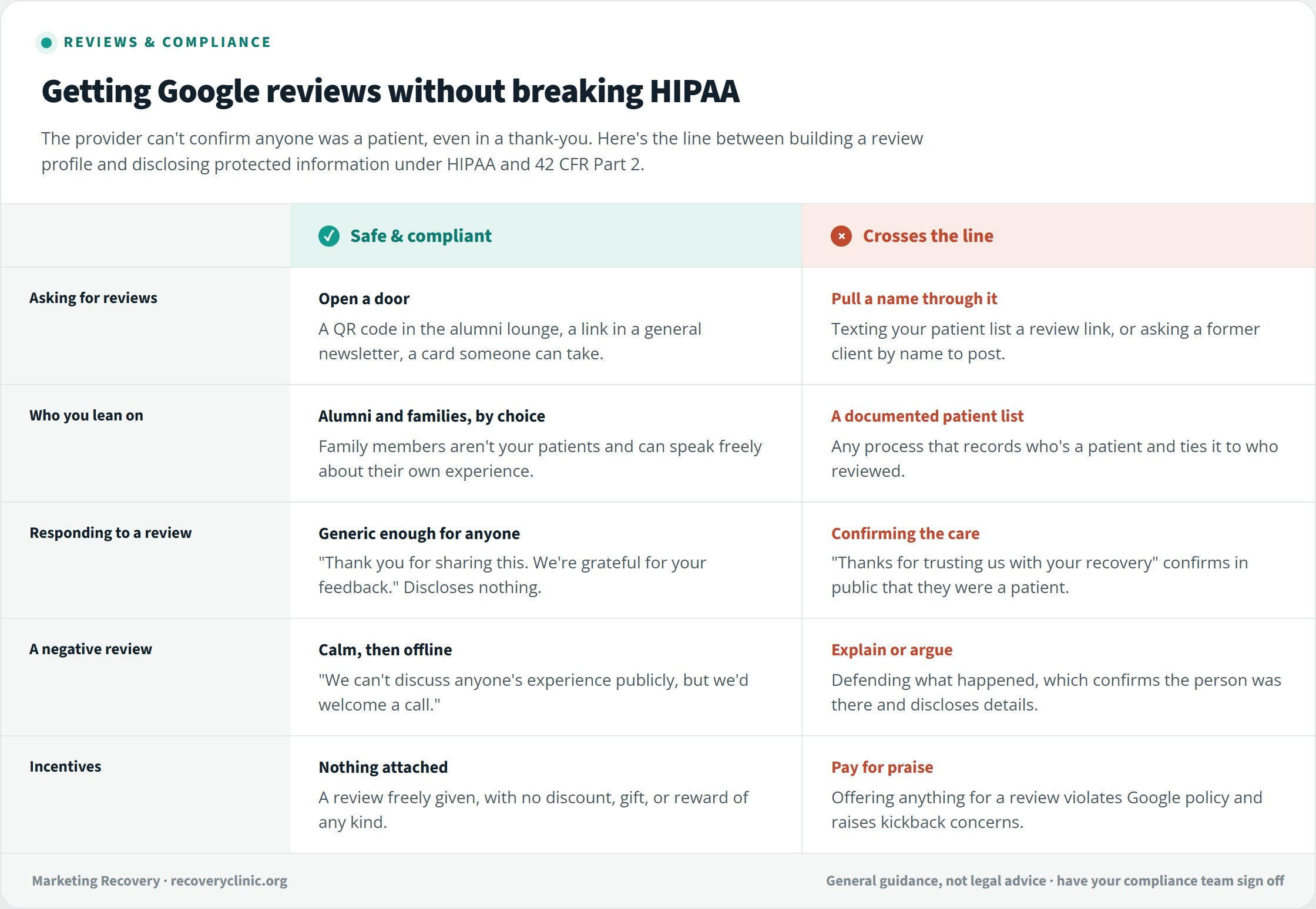
The line between building reviews and disclosing protected information, side by side. When a response is in doubt, the safe version never confirms the relationship.
How to respond without disclosing
You should still respond to reviews, because an active, engaged profile reads as a real, caring organization. You just respond in a way that never confirms whether the person was in your care.
The trick is to keep every reply generic enough that it would make sense whether the reviewer was a patient, a family member, or a passerby. Something like: "Thank you for taking the time to share this. We care deeply about everyone who reaches out to us, and we're grateful for your feedback." That's warm, human, and discloses nothing.
For a negative review, the same rule holds, and it matters even more. Don't argue, don't explain what happened, and don't confirm the person was ever there. A calm, non-confirming reply works: "We take feedback like this seriously. For privacy reasons we can't discuss anyone's experience publicly, but we'd welcome the chance to talk directly, and you can reach our team at [number]." You've shown future readers that you respond with care, without saying a word you shouldn't.
If a review is fake, or clearly violates Google's content policies, you can flag it for removal through your profile rather than engaging publicly. That's slow and imperfect, but it's the compliant path.
Where reviews fit the bigger picture
Reviews don't live on their own. They feed directly into how you rank in the Google map pack and how your Google Business Profile performs, which is often where a family's search begins. A steady stream of recent, genuine reviews signals to both Google and to people that your program is active and trusted.
That ties into the wider way families find care. Most don't start with your brand name, they start with a search like "residential treatment near me" and work through what they find, which is the journey we walked through in our piece on how families find a treatment center on Google. Reviews are one of the strongest trust signals in that journey, and they're free to earn if you do it the right way.
One treatment center we worked with grew its tracked calls from under 100 to more than 300 a month as its overall search presence improved, and a healthy review profile was part of what made the listings worth calling. The reviews didn't do it alone, but they're a piece you can't skip.
A simple, compliant starting point
If you want to build reviews without the risk, start small and structural. Put a review link or QR code where alumni and families naturally see it. Make a habit of inviting reviews in general terms at events and milestones, never by pulling individuals aside. Write two or three generic response templates your team can use so nobody improvises a reply that discloses too much. And keep incentives out of it entirely.
None of this requires you to confirm a single treatment relationship, and that's the whole point. We work only with licensed, accredited programs, and we help set up review and reputation systems that respect both Google's rules and patient privacy, but your program holds the clinical relationship and the compliance obligation that comes with it. This isn't legal advice, and your compliance or legal team should sign off on how you ask.
If you'd like a read on where your current reviews and Google Business Profile stand, and a compliant plan to strengthen them, request a free audit and we'll walk through it with you.
About the author
Zac Spencer is an online marketing specialist and the owner of Crave Media, based in Salt Lake City, Utah. Since 2013 he has managed hundreds of Google Ads accounts across dozens of industries, and founded Marketing Recovery, a specialized arm of Crave Media focused on marketing for licensed addiction treatment centers.