SEO · May 29, 2026
How families actually find a treatment center on Google

By Zac Spencer
Paid search gets the attention in treatment marketing because it is fast and expensive. But most families do not call the first center they see. They research for days, sometimes weeks, before anyone picks up the phone. SEO is how your program shows up during all of that research, without paying for every click. Done well, it becomes a steady source of admissions calls that gets cheaper over time, not more expensive.
This is how SEO actually works for a treatment center, and why it is worth the patience it requires.
Families search in stages, not all at once
The mistake centers make is treating search like a single moment. In reality, the same family moves through several stages, and they search differently at each one. Someone who just realized a loved one has a problem is asking very different questions than someone ready to choose a program this week.
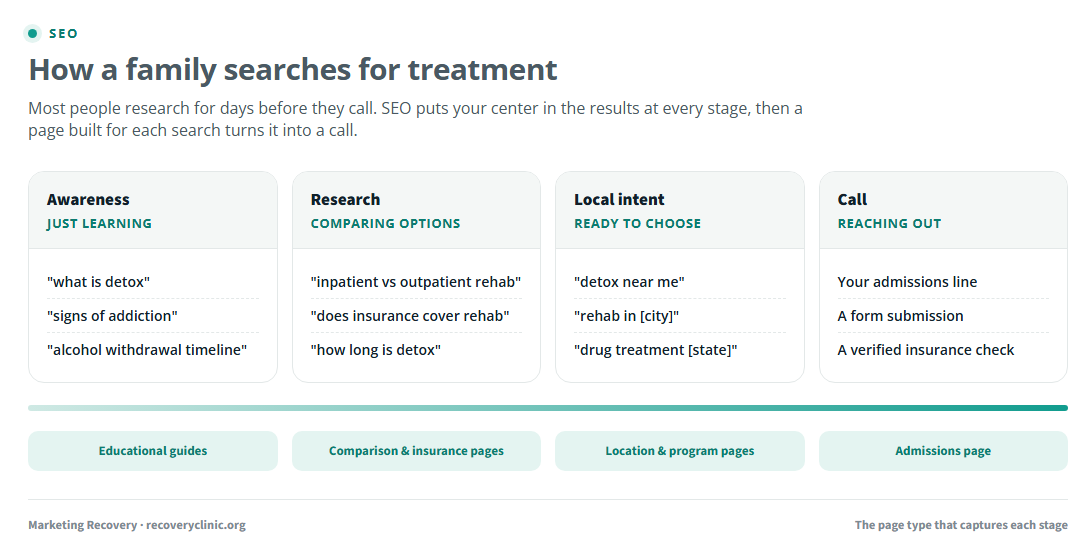
The same family searches differently at each stage. SEO meets them at every one.
Early on, the searches are educational. "What is detox." "Signs of alcohol withdrawal." "How long does rehab take." The person is learning, not buying. Then the searches shift to comparison. "Inpatient versus outpatient." "Does insurance cover rehab." "What to expect in detox." Finally, intent goes local and urgent. "Detox near me." "Rehab in" their city. That last stage is where the call happens.
A treatment center that only has a homepage shows up for almost none of this. A center with the right pages can show up at every stage, build trust early, and be the obvious choice when the family is finally ready to call.
The pages that do the work
SEO for a treatment center is really about having the right pages and making Google trust them. Four kinds of pages map onto the search journey.
Educational guides answer the early questions. They are not sales pages; they are genuinely useful explanations that earn trust and rankings while a family is still learning.
Comparison and insurance pages catch the research stage. People comparing levels of care or trying to understand coverage are getting close to a decision, and a clear page can move them toward you.
Location and program pages capture the high-intent local searches. A real page for each level of care and each area you serve is what lets you rank for "detox in" a specific city instead of hoping your homepage does it all.
An admissions page is where it all converts. Once someone is ready, the path to call has to be obvious and fast.
Building these out the right way is the core of our SEO work. It is slower than flipping on ads, but each page keeps working long after it is published.
Why SEO is worth the wait
The honest tradeoff with SEO is time. You will not see much in the first month or two. Movement usually starts within a few months, and the real gains compound past the six to twelve month mark as Google starts to trust the site and the pages accumulate.
What you get for that patience is durable. Unlike ads, which stop producing the day you stop paying, organic rankings keep bringing calls. And because you are not paying per click, your cost per call tends to drop over time even as the volume grows.
For one treatment center we worked with, organic search grew to more than 13,000 ranking keywords, organic users climbed over 1,400 percent across two years, and tracked calls went from under 100 to more than 300 a month. Those are real, anonymized numbers from that client, not a guarantee for every program. But they show what organic search can become when you commit to it.
SEO and ads are not either-or
People often ask whether they should do SEO or Google Ads. The real answer is that they do different jobs. Ads buy you calls now, while you wait for SEO to mature. SEO lowers your cost per call later, so you are not renting every admission forever. Most centers that grow steadily run both, and we wrote a fuller comparison of the two if you are weighing where to start.
The local piece
For most programs, the searches that matter most are local. Families look for treatment near them or in a specific city, and Google leans heavily on local signals to decide who shows up. That means your Google Business Profile and reviews work hand in hand with your SEO. A strong profile and steady, compliant reviews push you up in the local results that drive the highest-intent calls.
Getting started
SEO rewards centers that start early and stay consistent. The hardest part is usually just knowing where you stand and what to build first. If you want a clear picture of how your site ranks today and where the biggest opportunities are, request a free audit. We will look at your current search presence and show you the pages and fixes that would move the needle. We work only with licensed, accredited programs, and we never buy or broker leads.
About the author
Zac Spencer is an online marketing specialist and the owner of Crave Media, based in Salt Lake City, Utah. Since 2013 he has managed hundreds of Google Ads accounts across dozens of industries, and founded Marketing Recovery, a specialized arm of Crave Media focused on marketing for licensed addiction treatment centers.