AI Search Visibility · July 3, 2026
Why AI names a directory instead of your treatment center

By Zac Spencer
Type "best rehab in your city" into ChatGPT and watch what comes back. A lot of the time it isn't a treatment center at all. It's SAMHSA's FindTreatment.gov, or Psychology Today, or one of the big commercial directories. The assistant hands the family a list of places to look rather than a program to call, and your center, the one with the clinicians and the beds and the outcomes, is nowhere in the answer.
If that stings, it should, but not for the reason you might think. The AI isn't comparing your clinical program to a directory and deciding the directory treats people better. It's reaching for the answer it can most confidently stand behind, and a directory is almost always the safer thing for it to name. We covered the big picture of how AI decides which centers to recommend in an earlier piece. This one digs into the specific problem underneath it: why the directory keeps winning, and what it actually takes to get named next to it.
Start with what this is not
Because this is healthcare, the caveat comes first. An AI naming a directory instead of your center is not a verdict on your care. The assistant has no way to judge clinical quality, and families shouldn't read it that way. It's reflecting what's published and verifiable about treatment options in an area, nothing more. The license, the accreditation, and the LegitScript certification all sit with your program, and being left out of an AI answer says nothing about any of them.
What it does reflect is documentation. The model recommends what it can verify, and right now a directory is easier to verify than most treatment center websites. That's a fixable problem, but only once you see it clearly.
What a directory has that your website doesn't
An AI assistant builds its answer from patterns it can trust across the web. A directory is engineered, almost by accident, to produce exactly those patterns. A few things make it the low-risk pick.
Scale of citations is the first. A directory is referenced across thousands of pages, linked from articles, cited by other sites, and mentioned again and again. That repetition reads as authority. Most single-center sites are referenced in a handful of places, so there's far less for the model to lean on. Structured, consistent data is the second. Directories store each program in a tidy, uniform format, the same fields in the same shape for every listing, which is easy for a machine to parse and reconcile. A center's site, by contrast, often buries its levels of care in prose or a PDF, or states its name and address three slightly different ways across three pages.
Then there's aggregated reputation. A directory carries reviews and ratings in a form the model can weigh at a glance, while a strong center's reputation may be scattered and thin online even when its real-world reputation is excellent. Add freshness, since directories update constantly and look alive, and cross-web corroboration, since multiple independent sources confirm a directory's listings agree with one another, and you have an answer the AI feels safe giving. Your center can have all of these signals too. Most just haven't built them yet.
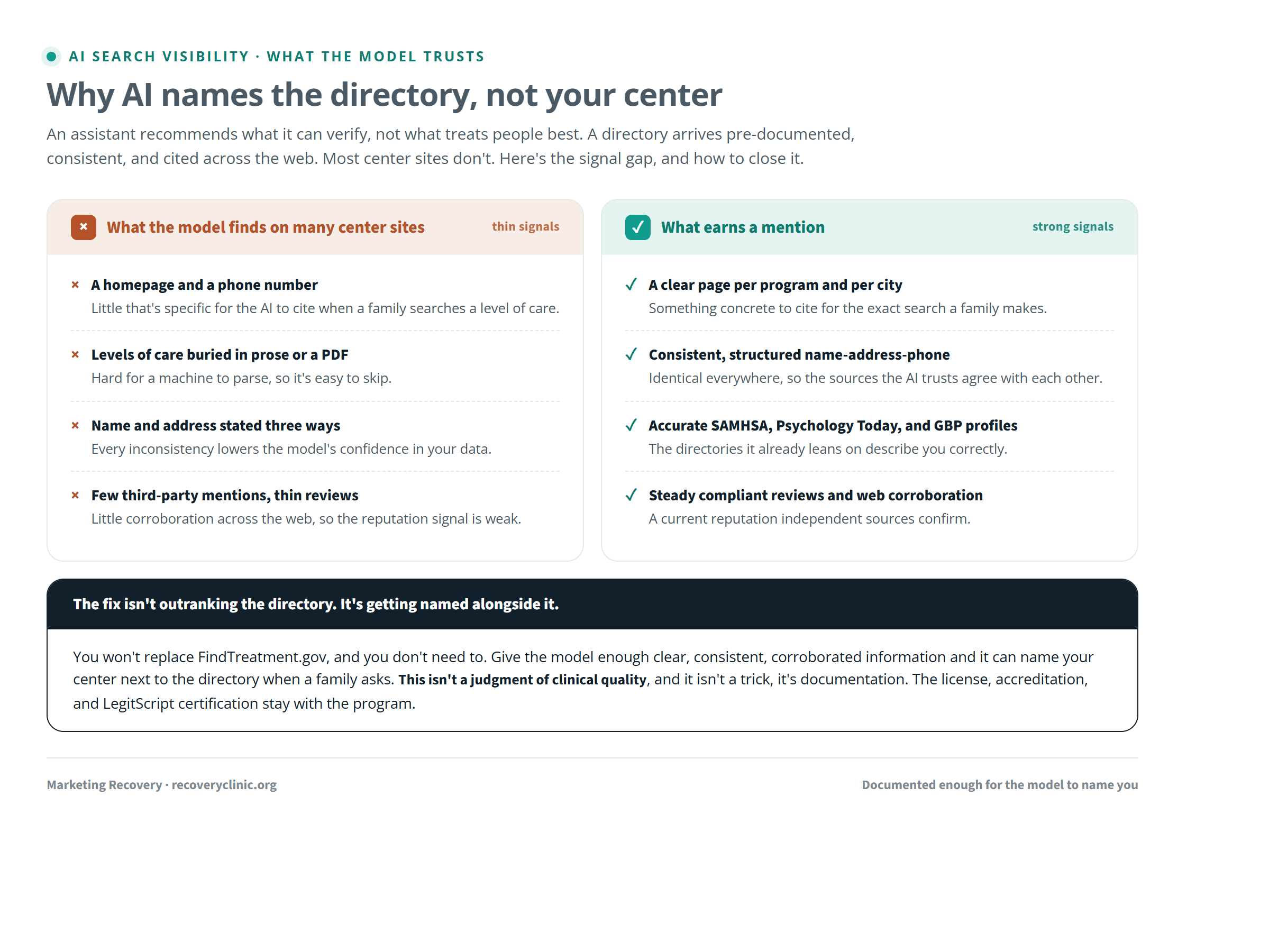
The model names whichever option carries the stronger, more consistent signals. Directories have them by default. A center earns them by documenting its programs clearly, keeping its data consistent, and building a reputation the web can confirm.
The directories the AI leans on for treatment
Not every directory carries the same weight. For treatment specifically, a few sources do most of the work in AI answers, and it helps to know why each one is such a comfortable pick for the model.
SAMHSA's FindTreatment.gov is a government source, which gives it a level of trust almost nothing else can match. When an assistant wants to be careful, and it always wants to be careful about health, pointing to a federal locator is the safest move it can make. Psychology Today runs structured provider profiles with consistent fields and a deep, well-linked presence, so it's easy to parse and heavily corroborated. The large commercial directories earn their place a different way, through sheer volume of content that answers the exact questions families ask, city by city and program by program. None of these got named because they deliver better care. They got named because they're thoroughly documented, consistent, and cited, which is the whole basis on which a model decides who to trust.
Why your better program still loses
This is the hard part to sit with. Documented beats good, at least as far as an AI is concerned. A center doing genuinely excellent clinical work can be invisible in AI answers while a directory, or a slicker competitor, gets named on repeat.
The model isn't rewarding quality of treatment because it can't see quality of treatment. It's rewarding clarity and consistency, because those are the only things it can actually verify. A thin, inconsistent, lightly-referenced web presence reads to an assistant as a risk it would rather not take when a family's wellbeing is on the line. So it defaults to the directory. The way out isn't to be better at treatment, which you may already be. It's to be better represented, so the model has a reason to put you on the list.
How to get named alongside the directory
The encouraging part is that the work here is the same work that earns you regular search visibility, so it pays off in both places at once. It comes down to giving the model the signals it's looking for.
Start by owning the specific searches. Build a clear page for each level of care in each city you serve, so that when a family searches for detox or residential treatment in a particular place, there's a concrete page for the AI to cite instead of a vague homepage. Then get your data consistent everywhere it appears. Your name, address, and phone should read identically on your site, your Google Business Profile, and every directory that lists you, because each mismatch chips away at the model's confidence. Claim and complete the profiles the AI already trusts, including your listing in the SAMHSA locator through the proper channels, Psychology Today, and your Google Business Profile, so the sources it leans on describe you accurately.
From there, build the reputation and corroboration that make the picture agree. Earn steady, compliantly gathered reviews so your reputation signal is current and real, and make sure credible third-party sources reflect your program correctly. This is the core of the SEO and content work we do, and it feeds Google and the AI layer sitting on top of it at the same time. We walked through the underlying search journey in how families find a treatment center on Google, and AI recommendations ride on that same foundation. For one treatment center we worked with, building this out grew organic visibility to more than 13,000 ranking keywords and took tracked calls from under 100 to over 300 a month. Those are real, anonymized results from that client and not a promise for any program, but they show what a well-documented presence can do once search and AI both start trusting it.
A realistic goal
You are not going to outrank FindTreatment.gov, and you don't need to. The goal isn't to replace the directory in the answer. It's to be one of the actual centers the assistant names alongside it, so that when a family asks and the AI lists a government locator plus two or three programs, yours is one of the programs. That's an achievable target, and it's won with documentation, not with any trick.
See whether AI names you or a directory
You don't have to wonder where you stand. We built a free tool that runs the questions families actually type, like "best rehab in" your city, against a live AI assistant and shows you whether it names your center or points to a directory and a competitor instead. It takes a minute, and the full report comes to your inbox. Run the free AI visibility check and see what the assistant is really saying.
And if you'd rather have us map the whole picture, your content, your listings, and the gaps a model is tripping over, request a free audit and we'll show you what it would take to move from invisible to named.
The directory was never your enemy. It's just better documented than you are right now, and that's the one thing you can change.
About the author
Zac Spencer is an online marketing specialist and the owner of Crave Media, based in Salt Lake City, Utah. Since 2013 he has managed hundreds of Google Ads accounts across dozens of industries, and founded Marketing Recovery, a specialized arm of Crave Media focused on marketing for licensed addiction treatment centers.