SEO · June 19, 2026
Local SEO for treatment centers: ranking in your city

By Zac Spencer
A mother is sitting in her car outside her son's apartment at 9 p.m. She pulls out her phone and types "detox near me." What loads first isn't a list of ten websites. It's a small map with three centers pinned on it, each with a star rating, a phone number, and a button that says Call. That little block is the Google map pack, and for a family in crisis, it's often the whole decision. Local SEO is the work that decides whether your center is one of those three pins or buried below the fold where nobody scrolls.
Most families looking for addiction treatment search the way that mother did. They search by where they are and what they need, "rehab in Phoenix," "IOP near me," "dual diagnosis treatment [city]." Google answers those searches with local results, not national ones. So if you run a detox, a residential program, an IOP or PHP, or sober living, the question of whether you appear in your own city is its own discipline, separate from the broader work of SEO for treatment centers.
What families see first
Before someone reads a single word on your website, they see the map pack and your Google Business Profile (GBP). The map pack is those top three local listings with the map above them. Your GBP is the panel that appears when someone searches your center by name or clicks one of those pins, the photos, hours, reviews, and call button all live there.
For a family, that panel is the first impression. A profile with current photos, real reviews, and accurate hours reads as a real place that's open and ready to help. A profile that's half-empty, or shows hours that turn out to be wrong when they call, plants a small seed of doubt at exactly the wrong moment.
How the map pack gets ranked
Google has been fairly open about what drives local rankings. It comes down to relevance, distance, and prominence. Relevance is how well your profile and site match what the person searched. Distance is how close you are to the searcher or the city they named. Prominence is how established and trusted you appear, which is where reviews, citations, and your overall web presence come in.
You can't move your building, so distance is mostly fixed. But relevance and prominence are both things you influence, and that's most of the daily work of local SEO for a treatment center. A center with a complete, accurate profile and a steady stream of honest reviews tends to climb over time, even against bigger names nearby.
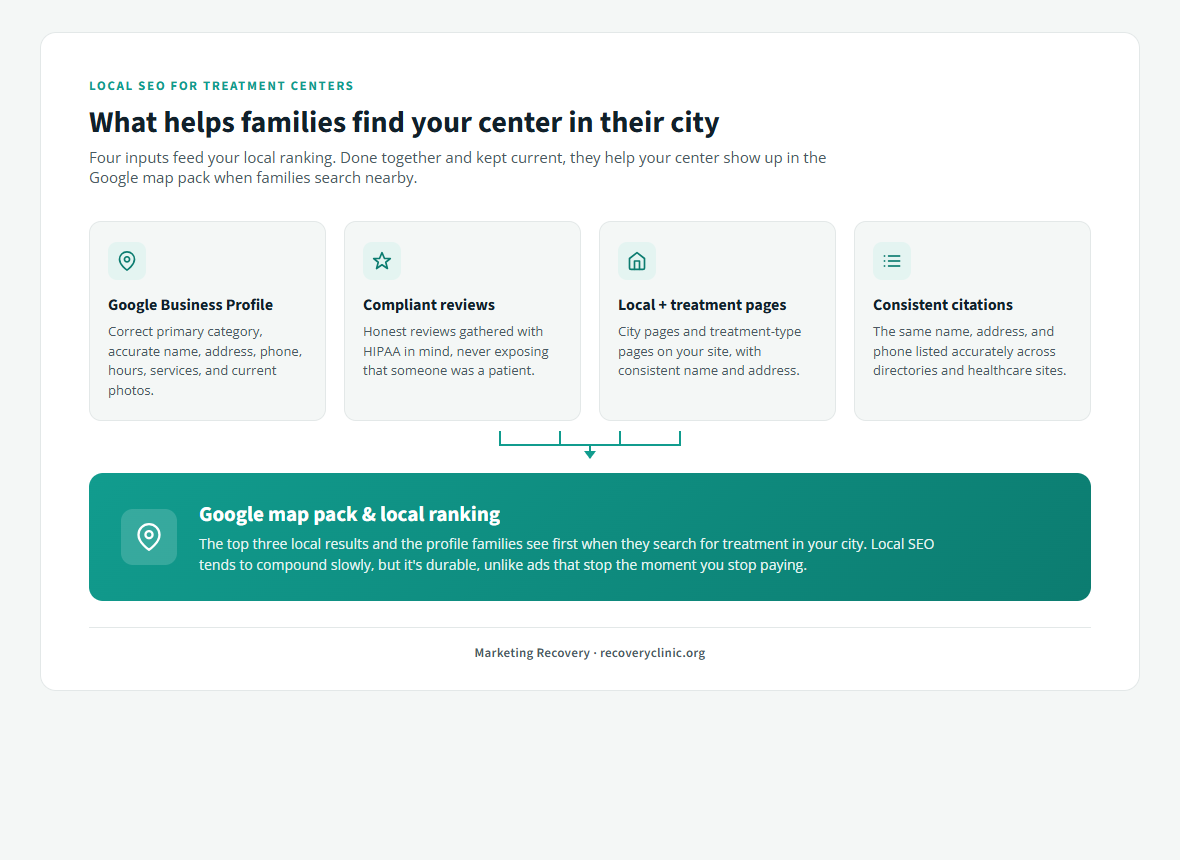
The pieces that feed local SEO for a treatment center, from your Google Business Profile to compliant reviews and local pages, all pointing toward the map pack.
Getting your Google Business Profile right
Your profile is the single highest-leverage thing in local search, so it's worth getting the basics correct. Set your primary category accurately, usually Addiction treatment center, with secondary categories for the services you actually run. Make sure your name, address, and phone number match your website and your licensing records exactly. Fill in your real hours, your service list, and a set of current photos of the actual building and team.
Then keep it current. A profile that was perfect two years ago and untouched since tends to drift, hours change, photos age, and Google notices activity. This is the ongoing part of managing a Google Business Profile that's easy to set up and easy to forget.
One honest caution: GBP can be sensitive for healthcare. Verification sometimes takes extra steps for treatment centers, and profiles do occasionally get suspended, sometimes for reasons that aren't obvious. If that happens, it's usually fixable, but it's worth handling carefully rather than guessing. We've written separately about reviews and the suspension process so you have a path to follow if you hit one.
Reviews that build trust and ranking
Reviews do double duty. They're one of the prominence signals Google weighs, and they're often the deciding factor for a family choosing between two centers that both look fine on paper.
The catch for treatment is HIPAA. You can't confirm that someone was a patient, and you shouldn't ask for a review in any way that exposes that they were in your care. That rules out a lot of standard review-collection tactics that work fine for a restaurant or a plumber. There's a compliant way to do it, and we walk through it in detail in our guide to gathering Google reviews without violating HIPAA. The short version: protect privacy first, and let willing alumni and families speak on their own terms.
We only work with licensed, accredited programs, and we don't buy or broker leads, so the reviews we help centers gather are real ones from real people, never anything manufactured.
Local pages and consistent listings
The map pack gets a lot of attention, but the rest of local SEO happens on your own site and across the web. On your site, that means real pages for the cities you serve and the treatment types you offer, a page for residential treatment in your city, one for your IOP, and so on, rather than a single page trying to rank for everything.
Off your site, it means citations: your center listed on directories and healthcare sites with the same name, address, and phone everywhere. That consistency, often called NAP consistency, helps Google trust that you're a real, stable organization at a fixed location. When your phone number reads one way on your site and another way on an old directory listing, it muddies the signal. Cleaning that up is unglamorous, but it's a real part of local SEO done for treatment centers.
What local SEO can look like over time
A center we worked with shows what compounding looks like. Over two years, the program grew to rank for 13,206 organic keywords, organic users climbed more than 1,400%, and tracked phone calls went from under 100 to over 300 a month. That's one center's path, not a promise, your market, your starting point, and your licensing situation all shape what's realistic.
The honest tradeoff with local SEO is speed. It's slower than ads. You won't flip a switch and see calls tomorrow. But it compounds, and it's durable, the rankings you earn keep working whether or not you're spending that day. Paid ads stop the moment the budget does. If you run more than one location, the work multiplies, since each location needs its own profile, its own local pages, and its own reviews, but the payoff multiplies too.
Worth noting: families don't only use Google anymore. A growing number ask an AI assistant something like "what are good treatment centers near me," and the answer they get is shaped by much of the same groundwork.
Showing up where families look
Local SEO is steady, patient work, but it puts your center in front of people at the exact moment they're ready to pick up the phone. If you want a quick read on how you're doing right now, our free AI Visibility Check will see whether AI recommends your center when families ask. And if you'd rather have a person look over your local presence, you can request a free audit and we'll walk through what we find.
The center holds the license, the accreditation, and the LegitScript certification. Our job is to make sure the families searching in your city can find you.
About the author
Zac Spencer is an online marketing specialist and the owner of Crave Media, based in Salt Lake City, Utah. Since 2013 he has managed hundreds of Google Ads accounts across dozens of industries, and founded Marketing Recovery, a specialized arm of Crave Media focused on marketing for licensed addiction treatment centers.