AI Search Visibility · June 9, 2026
Is AI sending families to your competitor?

By Zac Spencer
A parent worried about their son used to open Google, read for a while, and slowly build a list of places to call. A lot of them don't start there anymore. They open ChatGPT, or they get Google's AI answer at the top of the page, and they ask it straight out: "what's the best rehab near me for someone who needs detox?" The assistant doesn't hand back ten blue links. It names two or three centers, in a calm and confident voice, and the family starts there. AI search for treatment centers has quietly become the new front door, and most programs have no idea what it's saying about them.
That's the uncomfortable question worth sitting with. When a family asks an AI assistant where to send their loved one, is it naming your center, or is it naming the program down the road and a directory you've never heard of? If you don't know, you're not alone, and the answer matters more every month as this behavior grows.
Why families ask AI before they call
The shift is happening fast because it fits how people in crisis actually behave. A family deciding on treatment is scared, overwhelmed, and short on time. An AI assistant feels like asking a knowledgeable friend instead of wading through ads and directories. They can ask follow-up questions in plain language, get a recommendation that sounds personal, and skip the work of comparing a dozen sites.
Google's AI Overviews now sit above the normal results for many treatment searches, and tools like ChatGPT and Gemini pull live information from the web to answer. So whether a family is on Google or in a chat window, an AI is increasingly the thing standing between your center and that first call. The old work of ranking on a search page still matters, but there's a new layer on top of it, and it's deciding who even gets considered.
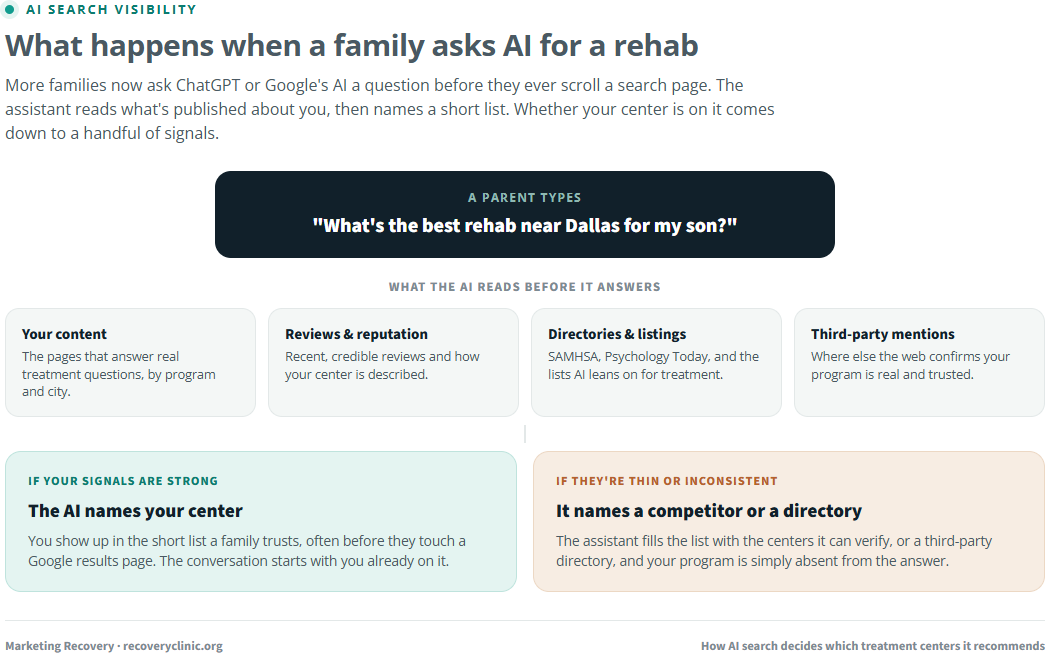
When a family asks AI for a rehab, the assistant reads what's published about you and then names a short list. Whether you're on it comes down to a handful of signals.
What the AI reads before it names a center
An AI assistant isn't guessing. It builds its answer from what it can find and verify about treatment programs in that area. A few sources do most of the work.
Your own content is the foundation. Pages that clearly explain your programs, your levels of care, and the cities you serve give the AI something concrete to point to. If your site is mostly a homepage and a phone number, there's little for it to read. Your reviews and reputation matter too, because the AI weighs how real and well-regarded a place looks. Then there are the directories it leans on heavily for treatment, like SAMHSA's locator and Psychology Today, and the third-party mentions across the web that confirm your program is legitimate. The more of these line up and agree, the more confident the AI is in naming you.
Why AI often names a directory or a competitor
When an AI can't find strong, consistent information about your center, it does the safe thing: it recommends what it can verify. For treatment, that usually means a national directory or the competitor with a deeper web presence. It isn't picking the best clinical program. It's picking the one it has the most trustworthy information about.
This is why a genuinely excellent center can be invisible in AI answers while a slicker competitor gets named again and again. The competitor isn't necessarily better at treatment. They're better documented. Their content answers the questions families ask, their listings are consistent, and the web confirms who they are. The AI rewards that clarity because its whole job is to avoid recommending something it can't stand behind. A thin or inconsistent online presence reads as a risk it would rather skip.
How to become the center AI recommends
The good news is that the work that makes you visible to AI is mostly the same work that makes you visible in regular search, which means it pays off twice. This newer discipline gets called answer engine optimization, but underneath it's familiar.
Build content that actually answers what families ask, organized by program and by city, so there's a clear page for the AI to cite when someone searches for your level of care in your area. Keep your name, address, and phone identical everywhere they appear, because every inconsistency chips away at the confidence an assistant has in your data. Earn steady, compliant reviews so your reputation signal is strong and current. And make sure the credible directories and third-party sources reflect your program accurately. This is the core of the SEO and content work we do, and it's what feeds both Google and the AI layer sitting on top of it. We walked through the underlying search journey in our piece on how families find a treatment center on Google, and AI search rides on that same foundation.
For one treatment center we worked with, building this out grew organic visibility to more than 13,000 ranking keywords and took tracked calls from under 100 to over 300 a month. Those are real, anonymized results from that client, not a promise for every program, but they show what a well-documented presence can do once search and AI both start trusting it.
Keep it in perspective
This is healthcare, so a caveat matters. An AI naming your center isn't a judgment that you offer the best care, and a family should never treat it that way. The assistant is reflecting what's published and verifiable about treatment programs, not ranking clinical quality. In practice, showing up in AI answers is about being clearly and accurately represented online, so families can find the program that fits and decide with full information. We work only with licensed, accredited programs, and we never buy or broker leads.
See what AI is saying about your center
You don't have to guess where you stand. We built a free tool that runs the questions families actually type, like "best rehab in" your city, against a live AI assistant and shows you whether it recommends your center or names someone else. It takes a minute and you get the full report by email. If you want to know whether AI is quietly sending families to your competitor, run the free AI visibility check and find out.
And if you'd rather have us look at the whole picture, your search presence, your content, and where the gaps are, request a free audit and we'll show you exactly what it would take to become the center AI puts in front of families first.
About the author
Zac Spencer is an online marketing specialist and the owner of Crave Media, based in Salt Lake City, Utah. Since 2013 he has managed hundreds of Google Ads accounts across dozens of industries, and founded Marketing Recovery, a specialized arm of Crave Media focused on marketing for licensed addiction treatment centers.