Strategy · October 13, 2026
Addiction treatment seasonal demand and the January surge

By Zac Spencer
Ask an admissions director about the holidays and you'll usually hear some version of the same story. The phones go soft from Thanksgiving through Christmas, then January arrives and the team can't keep up. That's addiction treatment seasonal demand the way most centers describe it, and plenty of them plan their whole fourth quarter around it.
How much of that is a national pattern, and how much is your market, your levels of care, and your payer mix? Hard to say. We haven't found a published month-by-month curve of U.S. rehab searches that we'd stake a budget on. So this post sorts what the research supports from what centers report, then spends most of its time on the part you control: how you pace spend and staffing from October into the first quarter.
What the evidence says about seasonal demand
The best published evidence is indirect. A 2025 study in Scientific Reports looked at Google searches for alcoholic beverages alongside alcohol-related primary care visits at Kaiser Permanente Northern California from 2017 through 2021. Both showed consistent spikes in the weeks around late December and early January of each year. That's search interest in drinking and clinic visits tied to drinking, not searches for rehab, but it lines up with what admissions teams describe.
People also change behavior when the calendar turns. Dry January, the month-off-alcohol campaign run by the UK charity Alcohol Change UK, grew from 4,000 participants in 2013 to 175,000 registered in 2023. For some of those people, a month without a drink is easy. For others, it's the month they find out they can't stop.
There's also research tying help-seeking searches to treatment itself. A 2022 study in the Journal of Medical Internet Research found that help-seeking searches for treatment tracked with treatment admissions for opioids and methamphetamine at the state level. That study used yearly data, though, so it says nothing about months. Everything past this point is either what centers commonly report or what you can check in your own numbers.
The holiday dip and what's hiding in it
From late November through December, many centers see fewer calls from people planning ahead. That makes sense. Families don't want to send someone away the week of Christmas. The person using says they'll go "after the holidays," and everyone agrees, because nobody wants a fight at the dinner table.
Crisis calls keep coming anyway. A detox call at 9 PM on December 24 is often the most urgent call your team gets all month, and it goes to whoever answers first. If your admissions line rolls to voicemail on holidays, or your ads pause because someone decided December was "slow," that's the call you lose.
Insurance pulls in both directions. Marketplace plans and many employer plans reset deductibles on January 1 (some employer plans renew on other dates). A family that has already met this year's deductible may push to admit before December 31. One that hasn't may wait. Add a "timing reason" field to the intake form for November through January, and next year you'll know which of those two families your center hears from more.
Family gatherings open a window
Thanksgiving and Christmas put people in the same room who haven't seen each other in months. A sister notices the shaking hands, or someone drinks through the whole afternoon and the family stops pretending.
The phone call usually doesn't come that night. Research comes first, and in the days after a holiday a lot of it is done by family members. They want to know what residential treatment looks like, whether insurance covers it, and how to talk to someone who doesn't want help. Those are the searches a residential program should already have pages for, written for a worried parent at 11 PM on December 26.
Be careful with how you speak to that moment. "Use the holidays to stage an intervention" ads are the kind of fear-driven copy that reads badly to families and can draw scrutiny under the healthcare and misrepresentation rules your ads already run under. A page that explains what the first phone call to admissions sounds like will get read by more of those parents anyway.
Why January calls stack up
A lot lands in the same three weeks. The "after the holidays" promises come due, deductibles reset for the families who were waiting, and some of the people who tried a dry month find out it didn't go the way they expected. December's consequences show up too: a DUI court date, a warning from a boss.
Your competitors come back at the same time. In the accounts we see, January is when other centers restore the budgets they trimmed for the holidays, and cost per click on the most contested terms often climbs with them. So expect more calls at a higher price each. A rising cost per click in the second week of January usually means the market got busier, and pulling back because of it hands those families to someone else.
Pacing your budget into Q1
This is the part with real money in it. A lot of the accounts we audit get the pacing backwards. They cut spend hard in December to "save it for January," then pour it all into the first two weeks of the year, right when clicks are most expensive and the admissions team is stretched thin.
We'd rather see December run lean but never dark. Pause or trim the broad research terms and the campaigns that only exist to drive volume. Keep your branded campaign fully funded, because people still search your name over the holidays. Keep detox and near-me terms running with enough budget to reach the evening, since those are crisis searches and the holidays don't stop them. Then raise budgets in steps through January instead of all at once on the 2nd.
A few practical notes on how Google handles this:
- Google's seasonality adjustments are built for short events of one to seven days, and Google says they may not work as well when used for more than 14 days at a time. A month-long January surge is outside what the tool was built for, so handle it with budgets.
- Smart Bidding needs a stable baseline. Cutting a campaign to almost nothing for six weeks and then tripling it can leave you paying a learning period in the most expensive weeks of the year.
- Read results by week in December and January, not by month. A monthly average hides the Christmas week drop and the second-week surge in one number.
Staffing belongs in the pacing plan too. The most expensive January mistake we see has nothing to do with bids: an admissions team that can't answer during the rush, so paid calls ring out or go to voicemail. Before you raise a budget, make sure the people answering can absorb the calls it buys. If you're still deciding how big the number should be for next year, our guide to how much a treatment center should spend on marketing walks through sizing it against cost per admission.
Levels of care don't move together
Detox runs on crisis, so it tends to be the steadiest, and it's the campaign you can least afford to switch off on a holiday. Residential is the planned decision. It's the one most likely to wait for "after the holidays" and the one that tends to come back hardest in January. IOP follows work and school calendars more than holidays. Plan each one on its own calendar. We explain why each needs its own campaign and scoreboard in why detox, residential, and IOP need different marketing.
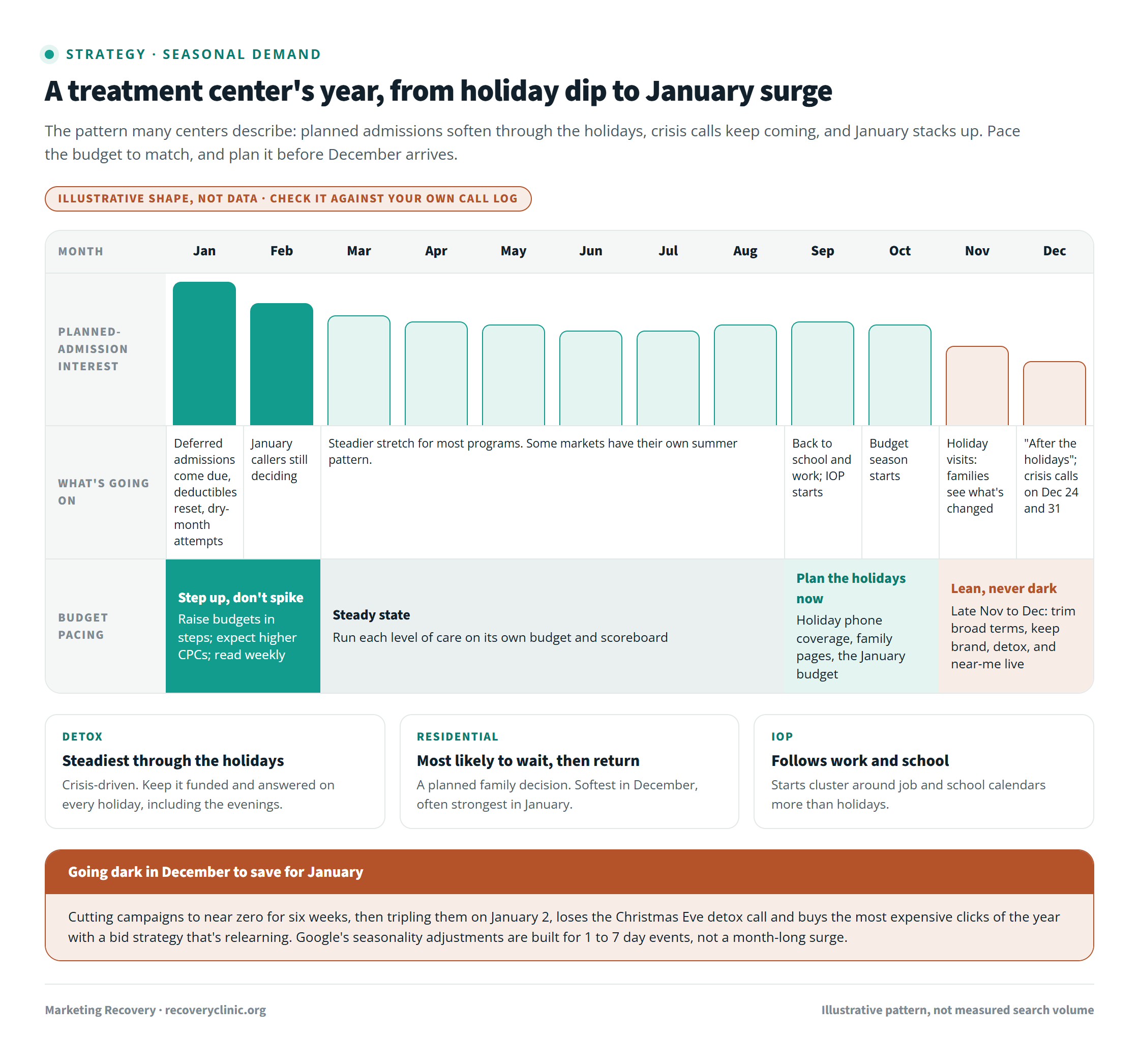
An illustrative calendar of addiction treatment seasonal demand and budget pacing. The shape is a common pattern, not data. Check it against your own call log.
Check your own market in Google Trends
You don't have to take anyone's word for this, ours included. Google Trends is free and shows search interest over time. Set the region to your state, the time range to five years, and compare terms like "alcohol rehab," "detox near me," and "drug rehab." If the same shape repeats year after year around the holidays, that's your seasonal curve.
Read Trends correctly. It shows relative interest on a scale of 0 to 100, not search volume, so a jump from 60 to 90 tells you interest went up, not how many people searched. Small states and narrow terms get noisy fast, so stick to broad terms and longer time ranges.
Then put that chart next to two numbers you already own: qualified calls by week from your call tracking, and admissions by month for the last two years. Where they disagree with Trends, or with this post, go with the admissions log. A program in a beach town with a big summer population may have a July that looks nothing like the pattern above.
Plan January before December goes quiet
January gets the attention, but by the time it arrives the useful decisions are already made. Whether your detox campaign is live at 9 PM on Christmas Eve, whether somebody answers that call, whether a parent searching on December 26 finds a page written for her: all of that gets settled in October and November, usually in a budget meeting that never mentions the holidays. Put them on the agenda now.
Pacing a treatment center's budget around the calendar is part of our Google Ads management for treatment centers. Licensing, accreditation, and LegitScript certification stay with your program, and we never buy or broker leads. If you want a second set of eyes on your December plan before the holidays arrive, request a free audit and we'll walk through last year's weekly numbers with you.
About the author
Zac Spencer is an online marketing specialist and the owner of Crave Media, based in Salt Lake City, Utah. Since 2013 he has managed hundreds of Google Ads accounts across dozens of industries, and founded Marketing Recovery, a specialized arm of Crave Media focused on marketing for licensed addiction treatment centers.