Strategy · June 23, 2026
How much a treatment center should spend on marketing

By Zac Spencer
There is no single right answer to what a treatment center marketing budget should be, and anyone who gives you a flat number without asking about your market is guessing. What you spend depends on how competitive your city is, how many beds you need to fill, and which channels you are willing to fund. But the math behind the number is knowable, and once you see it, the budget stops feeling like a gamble and starts looking like a decision you can make on purpose.
This is how to think about it: what drives the number, where the money goes, and how to size your spend against the one figure that matters.
What drives a treatment center marketing budget
Three things set the floor on what you need to spend. The first is your market. A click on a treatment search runs anywhere from about $25 to $150, and in the most competitive cities the top terms climb higher than that. If you are in a major metro with twenty programs bidding against you, your budget has to be larger just to be visible.
The second is how many beds you need to fill, and how fast. Filling a few open beds this quarter is a different budget than launching a new location from zero. The more urgent the need, the more you lean on paid search, which is the fastest channel and also the most expensive.
The third is which channels you fund. A budget that is all ads behaves very differently from one split across ads, SEO, your website, and your local presence. The all-ads approach buys calls now but stops the day you stop paying. A balanced budget costs more to maintain across more line items, but it builds something that lowers your cost per admission over time.
Follow the admission, not the click
Most centers anchor their budget to the wrong number. They look at cost per click, or worse, the monthly total, and either panic at how big it is or feel good about traffic that never becomes a call.
The number that should drive everything is your cost per admission. You pay $25 to $150 for a click. Some fraction of clicks become a real call to your admissions team, and some fraction of those calls become an admission. An admission, depending on level of care and length of stay, is commonly worth $6,000 to $10,000 or more. When you do the math forward, a $300 click that becomes a $9,000 admission was cheap. A $30 click that goes nowhere was expensive.
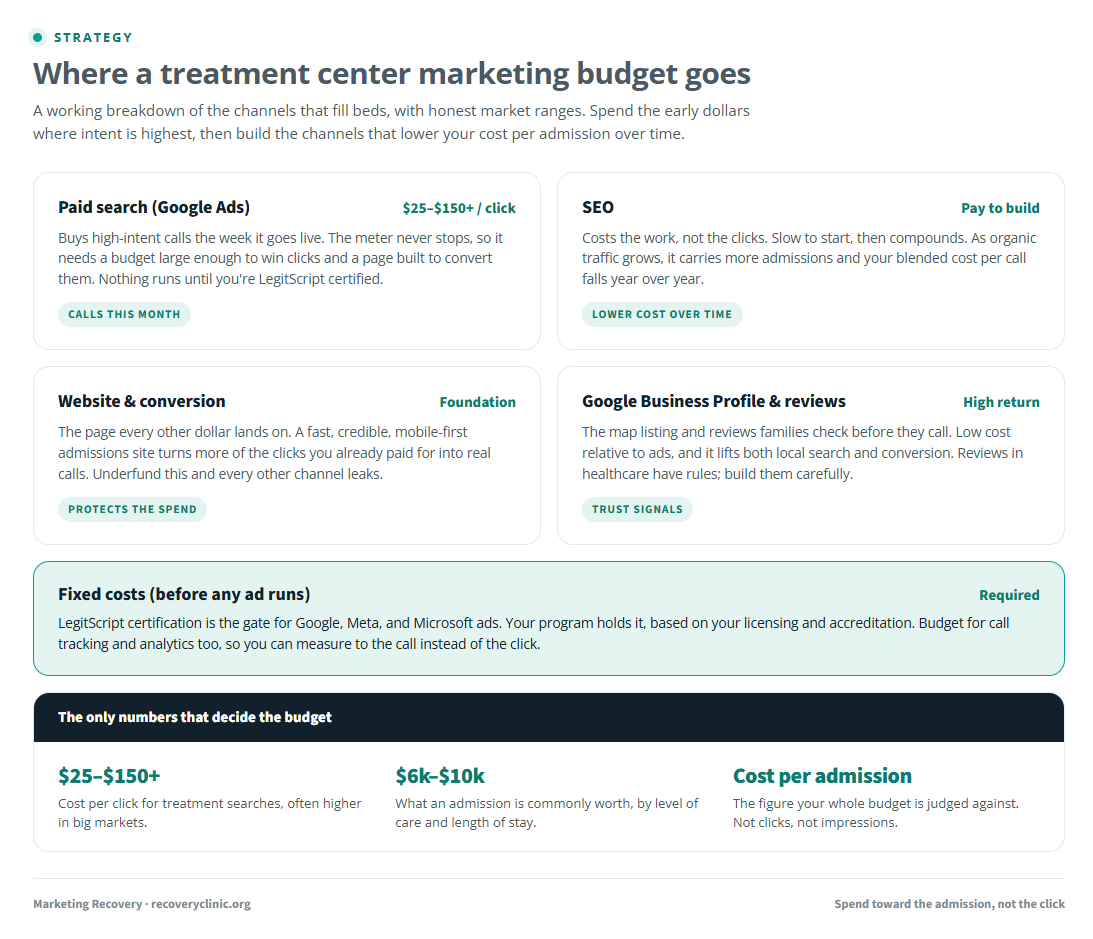
Where a treatment center marketing budget goes, and the cost ranges behind each line.
You cannot see any of this without call tracking, which is the cheapest line item on the list and the one that makes every other dollar accountable. If you cannot tell which keywords and which channels produce admissions, you are sizing your budget in the dark. We broke the paid side of this math down in detail in our piece on what Google Ads costs a treatment center.
Where the dollars go
A treatment center marketing budget is not one expense, it is several, and they do different jobs.
Paid search is usually the largest line for a center that needs calls now. It buys high-intent admissions the week it goes live, but only if you are certified and only if the clicks land on a page built to convert. Most programs that want paid search to work end up budgeting in the thousands to tens of thousands a month, scaled to how competitive their market is.
SEO is the channel that compounds. It costs the work of building and earning rankings rather than paying per click, so it feels expensive early when there is little traffic to show, then gets cheaper per call as the traffic grows. For one treatment center we worked with, the organic side grew to more than 13,000 ranking keywords and became a steady source of calls that did not turn off when the ad budget did. That kind of result is not a promise, but it shows what the channel can build when it is given time. Our honest comparison of Google Ads versus SEO covers when to lead with which.
Your website is the foundation every other dollar lands on. A fast, credible, mobile-first admissions site turns more of the clicks you already paid for into calls. Underfund it and you are paying premium ad prices to send people to a page that loses them. Then there is your Google Business Profile and reviews, a comparatively cheap line that lifts both local visibility and the trust families check before they ever pick up the phone.
The costs you pay before any ad runs
Some of your budget is not optional, and it comes before the first ad. You cannot advertise addiction treatment on Google, Meta, or Microsoft until your program is LegitScript certified. That certification is something your program holds, based on your licensing and accreditation. We can help prepare your site and campaigns to meet what the platforms check for, but the certification itself sits with you. If you are not certified yet, start with our explainer on LegitScript certification before you plan a dollar of ad spend, because none of it can run until you are.
Call tracking and analytics belong in this fixed-cost bucket too. They are inexpensive, and they are what turn your budget from a guess into something you can read and adjust every month.
How to size your number
Start with the goal, not the budget. Decide how many admissions you need over the next quarter, then work backward through your cost per admission to a spend that can plausibly produce them. If you do not know your cost per admission yet, that is the first thing to find out, because every other number depends on it.
If you have beds to fill now and you are already certified, weight the early budget toward paid search and a landing page that converts. Run Google Ads for the near-term calls while you decide whether to build the slower channels underneath them. If your beds are reasonably full and you are tired of renting every admission, shift more of the budget toward SEO and your website so that a year from now a larger share of your calls arrives without a click charge attached.
A reasonable starting split for a growing center puts the largest share in paid search, a meaningful share in SEO and content, a real line for the website and conversion work, and smaller ongoing amounts for your local profile, reviews, and tracking. The exact ratios shift with your market and your stage, and they should.
Setting your number
The honest answer to "how much should we spend" is that it depends on your market, and it can be measured. Rather than hand you a figure that ignores your city and your beds, we would rather look at what your specific market costs, what your competitors are doing, and what your cost per admission actually is, then give you a grounded range.
If you want that read for your program, request a free audit and we will tell you what the numbers look like instead of what is easy to sell. You can also check whether AI recommends your center when families search, which is a free, no-pressure way to see one piece of where you stand today. We work only with licensed, accredited programs, and we never buy or broker leads.
About the author
Zac Spencer is an online marketing specialist and the owner of Crave Media, based in Salt Lake City, Utah. Since 2013 he has managed hundreds of Google Ads accounts across dozens of industries, and founded Marketing Recovery, a specialized arm of Crave Media focused on marketing for licensed addiction treatment centers.