Strategy · August 18, 2026
Why detox, residential, and IOP need different marketing

By Zac Spencer
Most treatment center websites market "rehab" as if it were one product. One admissions page, one Google Ads campaign, one budget line. But a center that runs detox, residential, and IOP is selling three different things to three different people on three different timelines, and marketing levels of care with a single playbook means at least one of them is being marketed badly.
The person searching for detox at 2 AM is in a different world from the mother researching residential programs for her son over two weeks, and both are different from the professional looking for an evening IOP that won't cost them their job. Same center. Three buyers.
Splitting the playbook rarely means spending more. Most of the fix is noticing where the current budget quietly works against itself.
Detox marketing is a speed contest
Detox inquiries are the closest thing this field has to an emergency call. The searcher is often in acute crisis, or sitting next to someone who is. The decision window is measured in hours, sometimes minutes, and the center that answers the phone first frequently gets the admission.
That shapes everything. Paid search dominates here because the moment of need can't wait for SEO, and it's why detox-intent keywords carry some of the highest costs in the niche; clicks in this market run $25 to $150 or more. We broke down which keyword types earn that money in the keywords that fill beds, and detox-intent terms sit at the expensive, high-converting end.
The page those clicks land on needs a phone number at the top and almost nothing else in the way. And the operational requirement is blunt: someone qualified answers that phone live, around the clock. A detox campaign feeding calls to a voicemail after 9 PM is a campaign donating admissions to the next center on the list. If you measure one thing here, measure speed to answer.
Residential marketing is a trust campaign
Residential is a considered decision. The admission may be urgent in the clinical sense, but the choosing takes days or weeks, and it's rarely one person choosing. A spouse finds the center, an adult daughter reads the reviews, someone calls about insurance, and the family compares three or four options before anyone picks up the phone.
So the residential playbook is built on being findable and credible at every stop on that research loop. The content that answers family questions (what to pack, visiting policies, how long programs run, which insurance is accepted) does real work here, and it's the same content that tends to earn rankings, which we walked through in how families find a treatment center on Google. Reviews and your Google Business Profile carry weight all out of proportion to the effort most centers put into them. Increasingly, the family's first question goes to an AI assistant instead of a search results page; you can see whether AI recommends your center in about a minute.
Paid search still matters for residential, but it converts differently: fewer crisis calls, more insurance-verification form fills and "can I ask some questions" conversations. Your intake team's follow-up rhythm matters as much as the click. With admissions in this niche costing $6,000 to $10,000 to acquire through paid channels, losing a researched family to a slow callback is the expensive version of a mistake.
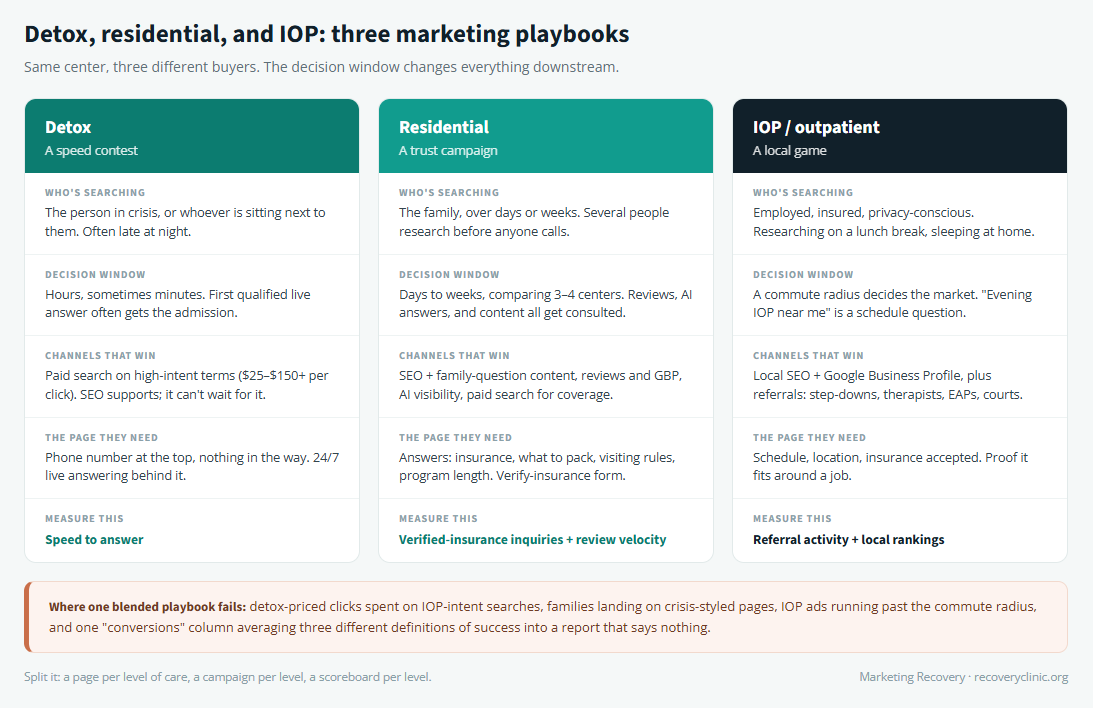
Three levels of care, three different buyers. The decision window is what changes the channel mix, the landing page, and the metric that matters.
IOP marketing is a local game
IOP flips the geography. A residential program can admit from three states away. An IOP client sleeps at home and drives to you three or four evenings a week, which means your real market is a commute radius, not a region. Ads targeted past that radius are decoration.
The searcher is different too. IOP prospects are often employed, insured, and privacy-conscious, researching on a lunch break: "evening IOP near me," "outpatient program that takes Blue Cross." Local SEO and a tuned Google Business Profile earn more admissions here than big paid budgets do, and schedule details answer the question these searchers are really asking, which is whether treatment can fit inside a life they're trying to keep intact.
And a meaningful share of IOP admissions never touch Google at all. Step-downs from residential programs (yours and other people's), therapist referrals, EAPs, and courts feed outpatient programs. That relationship work isn't glamorous marketing, but a monthly touchpoint with a dozen referring therapists is worth more to an IOP census than most ad campaigns.
Where the single playbook quietly fails
Blend the three and the failures are predictable. Detox-priced clicks get spent on searches with IOP intent. The residential family lands on a crisis-styled page that reads like an ER when they wanted reassurance and information. The IOP program inherits a regional ad radius it can't serve. And the monthly report averages it all together, so a strong residential month can hide a detox campaign that's been bleeding for a quarter.
The conversion definitions blur too. A live-answered call in 30 seconds is the win condition for detox and merely nice for IOP; a completed insurance-verification form means everything for residential and nothing for a court-referred outpatient client. One "conversions" column can't hold all three, which is a big part of why blended reports feel true and useful while saying almost nothing.
What a split playbook looks like in practice
You don't need three agencies or triple the budget. You need separation. A page per level of care, written for its actual searcher, so ads and rankings have somewhere specific to land. Separate campaigns with separate conversion definitions and their own budgets, so detox economics stop subsidizing or starving everything else. And a scoreboard per level: speed to answer for detox, verified-insurance inquiries and review velocity for residential, referral activity and local rankings for IOP.
That's a restructuring project more than a spending project, and most of it is one-time work. It's also the kind of thing we look at first in a free marketing audit, because level-of-care blending is one of the most common problems we find in accounts run by generalist agencies, and one of the cheapest to fix relative to what it returns.
One center, three products
A center that runs detox, residential, and IOP is running three businesses that happen to share a license and a building. The clinical team already treats them as distinct levels of care with distinct protocols. Marketing them with one playbook is the odd choice, not the split.
Start with whichever level fills your census, give it its own page, its own campaign, and its own definition of success, and build out from there.
About the author
Zac Spencer is an online marketing specialist and the owner of Crave Media, based in Salt Lake City, Utah. Since 2013 he has managed hundreds of Google Ads accounts across dozens of industries, and founded Marketing Recovery, a specialized arm of Crave Media focused on marketing for licensed addiction treatment centers.