Google Ads · June 26, 2026
The keywords that fill beds (and the ones that waste budget)

By Zac Spencer
In treatment marketing, a click can cost anywhere from $25 to well over $150, and in competitive markets the top terms run higher than that. At those prices, your keyword list isn't a setting you fill in once. It's the single biggest decision about whether your Google Ads budget fills beds or evaporates. Two centers can spend the exact same amount and get completely different results, and most of that gap comes down to which searches they chose to pay for.
The hard part is that the keywords that feel obvious are often the ones that bleed money, and some of the most valuable searches are narrower than operators expect. Sorting your rehab Google Ads keywords into the ones that produce admissions and the ones that just produce traffic is where a campaign is won.
This is how to tell them apart, and how to keep the wasteful ones from eating your spend.
Why keywords decide a treatment center's budget
Paid search is an auction, and every keyword you turn on is a standing bid against everyone else chasing the same search. When a click costs as much as it does in this field, a keyword that brings the wrong person to your page isn't neutral. It's a charge with nothing to show for it.
The goal is not traffic. It's admissions. A keyword earns its place only if the person typing it is close to picking up the phone and a fit for what you treat. That's a much smaller set of searches than the broad terms most accounts start with, and the difference between funding the right ones and the wrong ones is the difference between a campaign that pays for itself and one you quietly resent every month.
The keywords that fill beds
The searches worth paying for share two traits: high intent and a clear fit. The person is looking to start treatment soon, and they're looking for the kind of treatment you actually provide.
Geographic intent is the strongest signal there is. Someone searching "alcohol rehab in [your city]" or "detox center near me" is far down the path. They've stopped researching and started shopping. These local, level-of-care-specific terms cost more per click precisely because they convert, and they should anchor your budget.
Modality and condition terms matter just as much. "Inpatient drug rehab," "medical detox," "dual diagnosis treatment," each tied to a location, brings people who want exactly what that phrase describes. The tighter the match between the search and your program, the more of those clicks become real calls. Insurance-related searches are another strong vein when handled well: someone asking whether a specific plan covers treatment is often ready to verify benefits and admit, as long as your page meets them honestly. The common thread is that the searcher has moved past wondering and into deciding.
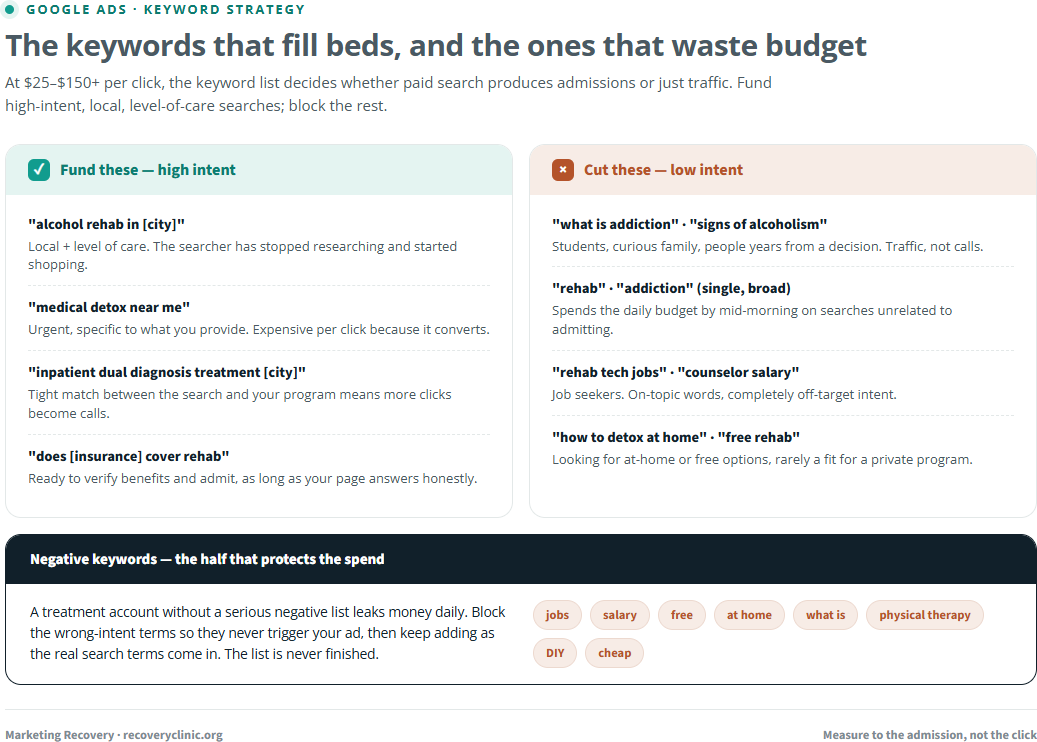
High-intent searches fill beds; broad and off-target ones drain the budget. Negative keywords are what keep the second group from spending your money.
The keywords that quietly waste budget
The expensive mistakes rarely look like mistakes. They look like reasonable, on-topic keywords that happen to attract people who will never admit.
Broad, informational searches are the biggest drain. Terms like "what is addiction," "signs of alcoholism," or "types of drug treatment" pull in students, curious family members, and people years from a decision. The traffic looks healthy in a report and produces almost no calls. Single-word terms are worse, "rehab" or "addiction" on a broad match will spend a daily budget by mid-morning on searches that have nothing to do with admitting a patient.
Then there's the off-target traffic that's easy to forget about. Job seekers searching "rehab technician jobs" or "addiction counselor salary." People looking for at-home or free options with "how to detox at home" or "free rehab," who usually aren't a fit for a private program. Searches for medical rehabilitation, like physical therapy after surgery, that share the word but none of the intent. Every one of these is a click you can be charged for if your list and your negatives aren't tight. We dug into how fast this adds up in our breakdown of what Google Ads really costs a treatment center.
Negative keywords are half the job
Most operators think of campaign building as choosing what to bid on. The other half, the half that protects the budget, is telling Google what not to spend on. That's the negative keyword list, and a treatment account without a serious one is leaking money every single day.
Negatives are how you keep the wasteful searches above from ever triggering your ad. You block "jobs," "salary," "free," "at home," "physical therapy," "what is," and the long list of terms that signal the wrong person, then you keep adding to it as you watch the real search terms come in. A campaign's negative list is never finished. The first month of a new account is mostly this work: reading what people actually searched to reach you, and cutting off the ones that wasted the click. It's unglamorous, and it's where a disciplined account pulls away from a sloppy one.
Match types control how far your keywords reach
How you set a keyword matters as much as the keyword itself. Broad match casts the widest net and, without tight negatives, catches the most junk. Phrase and exact match keep you closer to the intent you chose. For treatment, where every click is expensive, leaning toward tighter match types and expanding deliberately tends to protect the budget far better than turning everything broad and hoping the algorithm sorts it out. It won't, at least not at a price you'll like.
None of this runs until you're certified
Before any of these keywords can spend a dollar, your program has to clear the platform's gate. Google, Meta, and Microsoft don't allow addiction treatment advertising until your center is LegitScript certified, and that certification is something your program holds, based on your licensing and accreditation. We help prepare your campaigns and site to meet what the platforms check for, but the certification itself sits with you.
It's worth getting this right early, because keyword choices interact with the compliance rules, and certain claims or targeting can put an account at risk even after approval. If you've ever had a campaign stall, our piece on why Google suspends treatment center ad accounts covers the triggers worth avoiding.
Measure to the admission, not the click
You can't tell which keywords fill beds by looking at clicks or even at form fills. The only way to know is to track which specific searches lead to calls, and which calls lead to admissions. That's what call tracking is for, and it's the cheapest line item that makes every other dollar accountable.
Once you can see it, the picture usually surprises people. A handful of expensive, high-intent local keywords often carry most of the admissions, while a long tail of cheaper, broader terms produces traffic and little else. For one treatment center we worked with, tightening the list around what actually converted, and building out the organic side to more than 13,000 ranking keywords alongside it, helped turn paid search into a steady source of 300-plus calls a month rather than a budget they dreaded. That's not a promise of the same result, but it's what becomes possible when you stop paying for the wrong searches. Sizing the budget around that math is the subject of our guide to what a treatment center should spend on marketing, and the day-to-day management lives in Google Ads for treatment centers.
Build the list before you build the budget
The number you spend matters far less than the searches you spend it on. A modest budget pointed at high-intent local keywords, with a disciplined negative list underneath it, will outperform a larger budget poured into broad terms every time. Get the list right first, then scale what's working.
If you want to see which keywords are actually carrying your admissions and which are quietly wasting spend, request a free audit and we'll show you what your account is really paying for. You can also check whether AI assistants recommend your center when families search, which is a free way to see one more piece of where you stand. We work only with licensed, accredited programs, and we never buy or broker leads.
About the author
Zac Spencer is an online marketing specialist and the owner of Crave Media, based in Salt Lake City, Utah. Since 2013 he has managed hundreds of Google Ads accounts across dozens of industries, and founded Marketing Recovery, a specialized arm of Crave Media focused on marketing for licensed addiction treatment centers.