Compliance · June 16, 2026
Why Google suspends treatment center ad accounts

By Zac Spencer
There is a particular kind of bad morning in treatment marketing. You log in to check your campaigns and the whole account is frozen. Not one ad disapproved, the entire account suspended. The admissions calls that were coming in yesterday stop today, and the message from Google is vague enough that you are not sure what you did.
Addiction treatment is one of the most heavily policed categories in all of paid search, so a Google Ads suspension hits rehab advertisers more often than most. The good news is that the reasons are knowable and mostly preventable. This is a plain look at why these suspensions happen, how to avoid them, and what to do if your account is already down.
A disapproved ad and a suspended account are not the same thing
It helps to know which problem you have, because the severity is very different.
A disapproved ad is routine. One ad or keyword gets blocked, usually for a policy the rest of your account follows fine. You fix the wording or the landing page, resubmit, and it runs. Annoying, not serious.
A suspended account is the serious one. Google stops all of your ads and locks the account, often citing something broad like a policy violation or misrepresentation. Nothing runs until you resolve the underlying issue and win an appeal. And there is a third level worse than that, a permanent ban, which is usually reserved for advertisers who try to get around a suspension instead of fixing it.
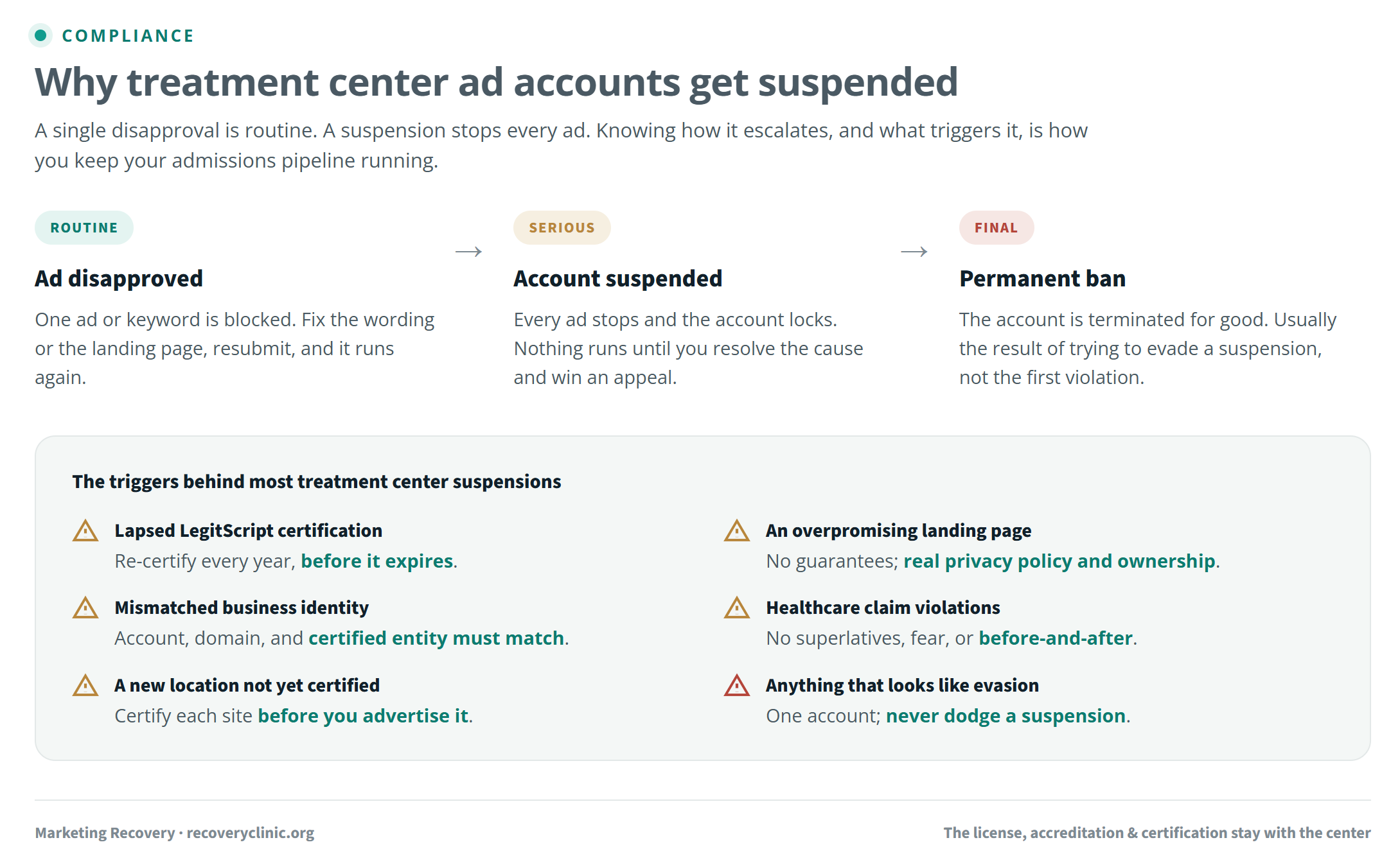
How a single disapproval escalates to a suspension, and the triggers behind most treatment center account suspensions.
The reasons treatment accounts get suspended
Most rehab suspensions trace back to a short list of causes. Knowing them is most of the battle.
Lapsed or missing LegitScript certification
In this category, this is the big one. Google requires LegitScript certification before it will run addiction treatment ads at all, and that certification has to be renewed every year. Centers that let it lapse, or that expand to a new location or level of care that was never certified, can find the account suspended for running ads they are no longer cleared to run. Certification is not a one-time gate. It is a status you have to keep current.
A landing page that does not hold up
Google reviews where your ads send people, not just the ads themselves. Pages that overpromise tend to draw a misrepresentation flag: language guaranteeing recovery, claiming a specific success rate you cannot substantiate, or implying outcomes no program can promise. Missing pieces matter too, like a weak or absent privacy policy, unclear ownership, or contact details that do not match your verified business. A surprising share of suspensions start on the website rather than in the ad copy.
Business identity that does not match
Google's advertiser verification expects the name, domain, and ownership on the account to line up with the business actually being advertised. Mismatches between the account holder, the certified entity, and the website raise a misrepresentation flag fast. This is also why running a treatment center's ads through an unrelated account, or sharing one account across separate legal entities, invites trouble.
Healthcare policy violations in the ad itself
The restricted healthcare and medicines policies carry specific rules about claim language. Superlatives, fear-based messaging, before-and-after framing, and guarantees are the usual offenders. A single careless headline can flag an account that is otherwise clean.
Anything that looks like gaming the system
This is the one that turns a recoverable suspension into a permanent ban. Cloaking, showing Google one page and users another, running multiple accounts to dodge a limit, or spinning up a fresh account after a suspension all read as evasion. The platforms treat evasion far more harshly than the original violation.
How to avoid a suspension in the first place
The pattern behind almost every suspension is the same: something fell out of alignment between your licensing, your certification, your business identity, and what your ads and website actually say. Keeping those in sync is the whole job.
Keep LegitScript certification current and re-certify before it expires, and add certification for any new location or service before you advertise it. Keep the website honest, with a real privacy policy, clear ownership, accurate addresses, and claims you can back up. Run ads through one properly verified account whose identity matches the certified business. And keep the ad copy inside the healthcare rules, with no guarantees and no scare tactics. None of this is exotic. It is maintenance, and the centers that do it quietly rarely see a suspension.
What to do if you are already suspended
First, read the notice carefully and identify the exact policy cited. The wording is generic, but it usually points at a category: certification, misrepresentation, healthcare policy, or business operations. Fixing the right thing matters, because an appeal that addresses the wrong issue gets rejected.
Then fix the root cause before you appeal, not after. If certification lapsed, renew it. If the landing page made a claim it should not, change the page. If the business details do not match, correct them. Submit the appeal once, with documentation, through the official process, and be specific about what you changed.
What you should not do is open a new account and start over. That is the move that escalates a temporary suspension into a permanent ban, and it is one of the most common mistakes treatment advertisers make under pressure. The account you have is worth more fixed than replaced.
Where this fits
A suspension is not bad luck. It is almost always a sign that the marketing and the compliance drifted apart somewhere, and the platform noticed. The license, the accreditation, and the LegitScript certification all sit with your program. What a marketing partner can do is keep the advertising side aligned with all of it, so the account that runs your admissions pipeline keeps running.
If you want to know whether your current setup is carrying suspension risk you cannot see, request a free audit. We will look at your account, your site, and your Google Ads against what the platforms expect, and tell you plainly what would need to change. We work only with licensed, accredited programs, and we never buy or broker leads.
About the author
Zac Spencer is an online marketing specialist and the owner of Crave Media, based in Salt Lake City, Utah. Since 2013 he has managed hundreds of Google Ads accounts across dozens of industries, and founded Marketing Recovery, a specialized arm of Crave Media focused on marketing for licensed addiction treatment centers.