Google Ads · June 12, 2026
Call tracking for treatment centers, and why every campaign needs it

By Zac Spencer
Most treatment centers running paid search can tell you their cost per click down to the cent. Ask them which keyword produced last month's admissions and the room goes quiet. That gap is the whole problem, and call tracking is what closes it. For a treatment center, call tracking is the difference between knowing your ads work and being able to prove which part of them does.
This is what call tracking actually does for a campaign, how the pieces fit together, and the compliance you have to get right before you turn any of it on.
Why the click is the wrong thing to measure
Treatment is one of the most expensive categories on Google. A single click can run anywhere from $25 to well past $150, and the most competitive terms in big markets go higher. You are paying those prices because an admission is worth thousands. Depending on level of care and length of stay, one admission commonly lands somewhere between $6,000 and $10,000 or more.
So picture the funnel. The click is the top, the admission is the bottom, and the call sits in the middle doing all the work. Without call tracking you can see the top of that funnel and nothing else. You know what you spent and how many people clicked. Whether any of them ever called, and which search sent the ones who did, stays invisible.
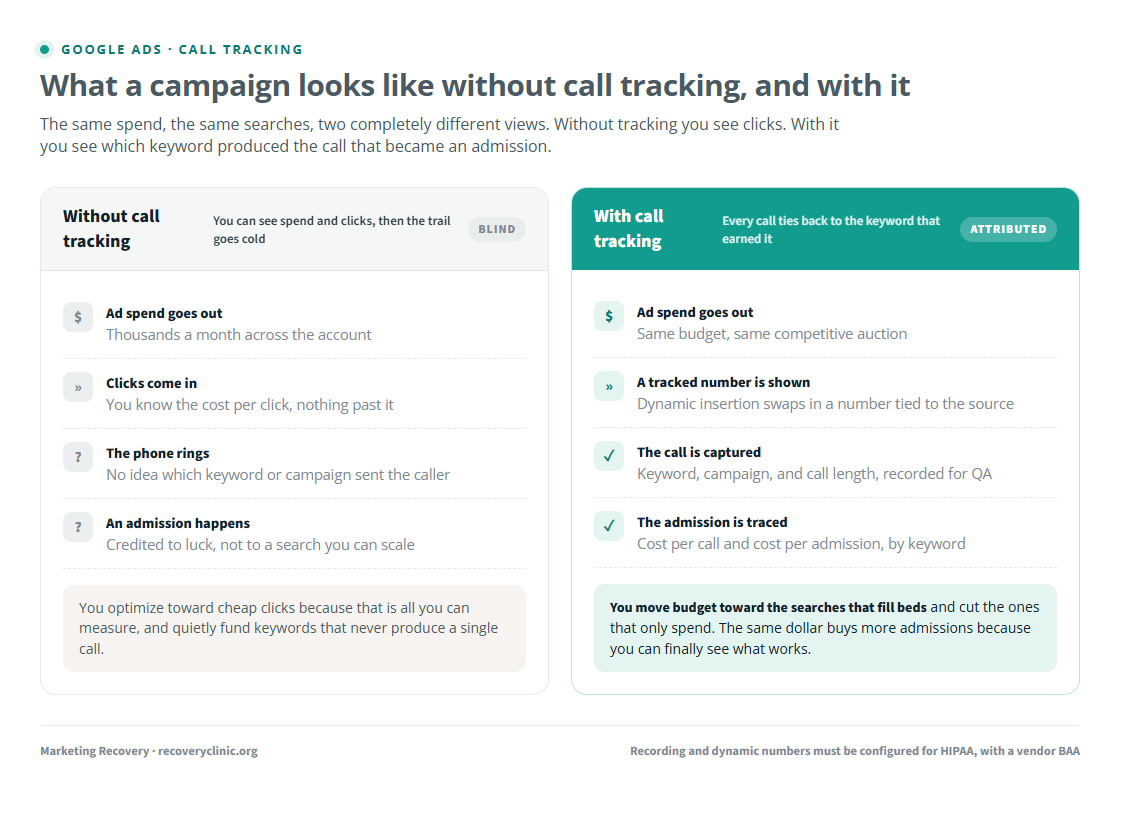
Without call tracking you optimize toward cheap clicks. With it, you optimize toward calls that fill beds.
That blind spot costs real money. When the only number you can see is cost per click, you naturally chase cheaper clicks, and cheaper clicks in this field usually mean broader, lower-intent searches. You end up funding keywords that look efficient on paper and never put a single family on the phone.
What call tracking actually shows you
Call tracking ties each phone call back to the thing that caused it: the campaign, the ad group, often the exact keyword someone searched before they picked up the phone. Instead of a pile of clicks, you get a list of calls with a source attached to each one.
The mechanism is something called dynamic number insertion. The page swaps in a tracking number based on how the visitor arrived, so a caller from a paid search ad sees a different number than someone who found you through your map listing or typed in your name. To the family, nothing looks unusual. They see a phone number and they call it. On your side, that call now carries the keyword and campaign that earned it.
Once the calls are attributed, the math you actually care about appears. Cost per call. Cost per qualified call. Eventually cost per admission, broken out by keyword. You stop guessing which searches work and start moving budget toward the ones that fill beds, which is the entire point of running ads in this category. We wire call tracking into every Google Ads campaign we build for exactly this reason.
Recording is for training, not just numbers
Attribution tells you which keywords produce calls. Recording tells you what happens on those calls, and in treatment that second question matters as much as the first.
A high-intent click that reaches a flustered or under-trained intake line is wasted money, and you would never know it from a report that only counts calls. Listening to real conversations shows you where families hesitate, which questions come up before insurance, and where good admissions calls quietly fall apart. Some of the most expensive leaks in a treatment account are not in the ad account at all. They are on the phone.
Recording also gives intake a way to get better. New staff can hear what a strong call sounds like instead of being handed a script and left to figure it out. None of this works, though, unless the recording is set up to healthcare standards, which is where most of the caution in this article lives.
Routing and what happens after hours
Families do not search for treatment on a schedule. A lot of the highest-intent calls come at night, on weekends, in the middle of a crisis. If those calls ring an empty desk, you paid premium prices to send someone straight to voicemail, and in this field a voicemail usually means they call the next center on the list.
Call tracking surfaces this fast, because the timestamps and missed-call records sit right next to the attribution. You can see how many tracked calls came in after hours and how many went unanswered. From there it becomes an operations decision: extend intake hours, route overflow to an answering service that can take a warm message, or set up a clear escalation path. The data just makes the leak impossible to ignore.
The compliance you cannot skip
Here is the part too many marketers wave past. Call tracking and call recording in healthcare touch protected information, and they have to be handled carefully. A recorded admissions call can contain names, locations, substances, and clinical details. That is PHI, and the moment you record and store it, you have obligations.
A few things have to be true before any of this goes live. Recording consent has to follow the laws in the states you operate and call into, which in many states means both parties consent. Your call tracking vendor has to be willing to sign a business associate agreement, because they are handling PHI on your behalf, and a vendor that will not sign a BAA has no business touching treatment calls. Recordings and call data need to live somewhere access-controlled, not in a random inbox or a shared drive.
To be clear about our role: the license, the accreditation, and the LegitScript certification all sit with your program, and so does the final word on how patient information is handled. What we do is help prepare campaigns and tracking that respect those obligations, and steer you toward vendors and configurations built for healthcare rather than for selling cars. The responsibility is yours; the setup is something we can get right with you. And we work only with licensed, accredited programs, because the alternative is buying or brokering leads, which we do not do.
What this looks like when it works
When call tracking is doing its job, the whole account changes character. You can point to a keyword and say how many calls it produced, how long they ran, and what they cost. Budget stops drifting toward whatever looks cheap and starts concentrating on what converts.
For one treatment center we worked with, tracked calls grew from under 100 to more than 300 a month as the campaigns matured and the wasted spend got cut. The paid side reached 1,740 conversions at a 13.46 percent conversion rate. Those are real, anonymized numbers from that engagement, not a promise for every program, and the only reason any of them could be measured at all is that the calls were tracked from the start. An account that knows where its calls come from gets better every month. One that does not just keeps guessing at a higher and higher price.
It is the same lesson underneath what Google Ads really costs a treatment center and the comparison of ads and SEO: the channel is only half the story, and measurement is the other half. Spend without tracking is just an expensive guess.
Stop paying for clicks you can't trace
If you are running treatment ads without call tracking, you are paying some of the highest click prices on the internet and choosing not to see what they buy. The fix is not a bigger budget. It is knowing which part of the budget already works, so you can feed it and cut the rest.
If you want to know what your account is actually producing, request a free audit. We will look at your campaigns, your tracking, and where the calls are coming from, and tell you straight where the money is going. We work only with licensed, accredited programs, and we never buy or broker leads.
About the author
Zac Spencer is an online marketing specialist and the owner of Crave Media, based in Salt Lake City, Utah. Since 2013 he has managed hundreds of Google Ads accounts across dozens of industries, and founded Marketing Recovery, a specialized arm of Crave Media focused on marketing for licensed addiction treatment centers.