Reviews · September 18, 2026
Getting alumni testimonials the compliant way

By Zac Spencer
A testimonial names someone as a former patient
An alumni story is the most persuasive asset a treatment center can publish. It is also protected health information the moment it identifies the person telling it, because a testimonial on your website announces, in public and in your voice, that this person was in your care. That one fact is what makes rehab testimonials compliance its own discipline, with rules that ordinary marketing never has to think about.
We drew the short version of this line in the claims treatment marketing can't make: a testimonial has to reflect honest experience, any compensation behind it has to be disclosed, and nothing gets published without written authorization on file. That post called the full process a longer topic than it could hold. This is the longer topic. When to ask an alumnus, what a valid authorization contains, where the finished story belongs, and the shortcuts that turn a marketing asset into a federal problem.
One caveat first, and it's the same one we attach to every compliance piece. We're marketers, not lawyers. Testimonial programs sit close enough to HIPAA and 42 CFR Part 2 that your compliance officer or counsel should approve the process before the first story goes up, and nothing here replaces that review.
Written authorization makes it legal
HIPAA allows a patient's story in marketing with a valid written authorization, and "valid" carries real weight in that sentence. A signature on a generic media release usually doesn't clear it. The authorization needs to name what's being disclosed, meaning the person's identity and story as a former client, and it needs to say where the story will appear. It should state that the use is marketing. It should carry an expiration. And the person has to be able to revoke it at any time, which is the piece that shapes everything downstream.
The conditions around the signature matter as much as the paperwork. Signing can never be a condition of treatment, of alumni services, or of anything else the person gets from you. An authorization someone felt they couldn't decline isn't voluntary, and voluntary is the entire point.
Because when an alumnus calls two years into their new life and asks to come down off your homepage, "we'll try to find all the copies" is not a plan. Keep a log of every place each story appears and when its authorization expires. Then, if the call comes, pull the story fast and without argument. It's their recovery. You were borrowing it.
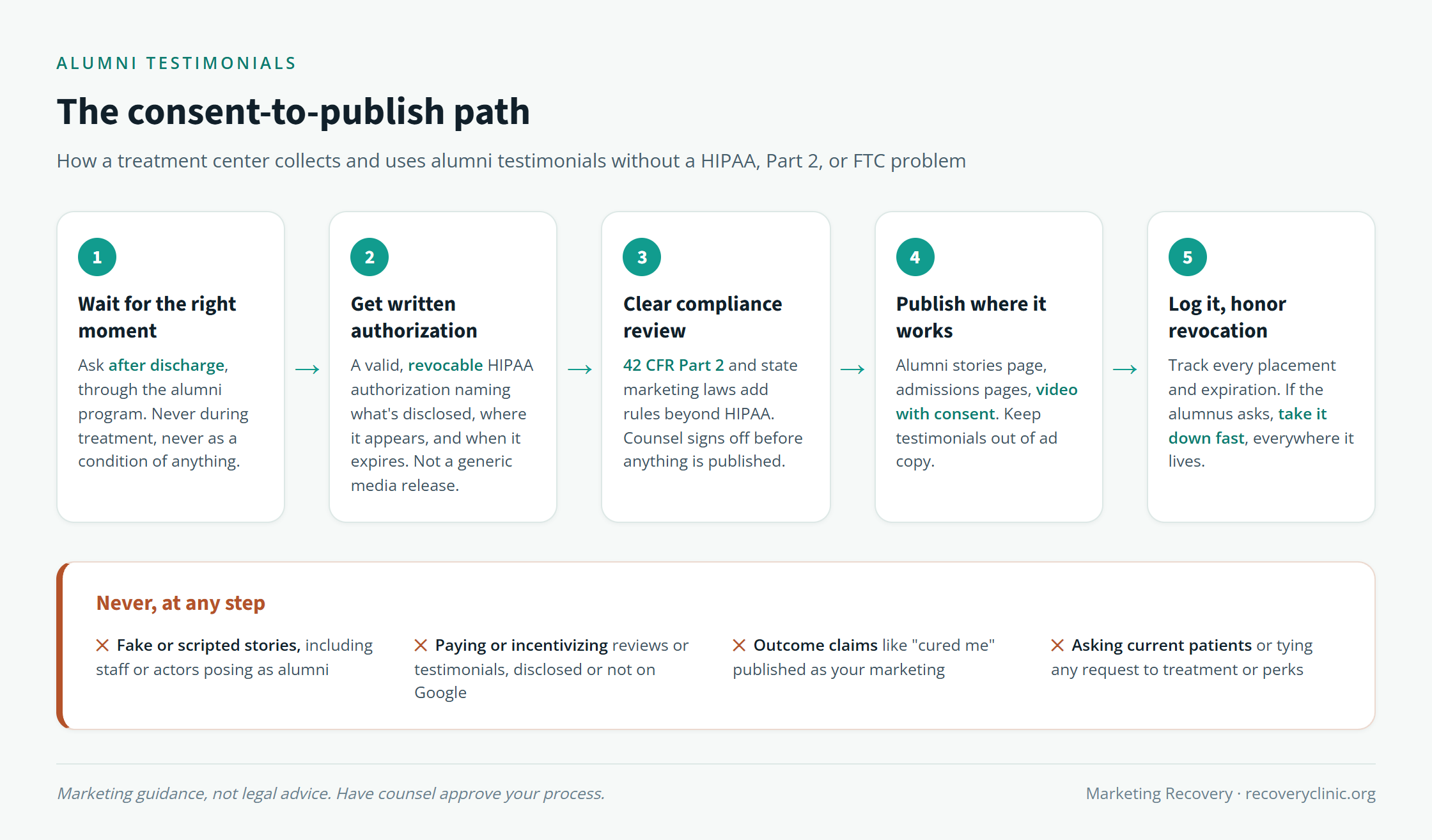
The consent-to-publish path for alumni testimonials, from timing through authorization to placement, and the shortcuts that are never worth it.
42 CFR Part 2 raises the bar again
Substance use disorder records carry protection under 42 CFR Part 2 beyond what HIPAA alone requires, which is why testimonial advice written for dermatologists and dentists doesn't transfer to detox and residential programs. Part 2 consent has its own required elements, and the identity of someone as a patient of a Part 2 program is itself protected. Your authorization form and your process need to be built for this industry specifically, not adapted from a general healthcare template.
State law adds another layer. Several states now regulate addiction treatment marketing directly, and some speak to testimonials and paid endorsements by name. We're not going to walk fifty state statutes here, and you shouldn't navigate them from a blog post anyway, ours included. The takeaway is narrower: have counsel confirm what your state requires before the program launches, not after a regulator asks.
It helps to keep testimonials and reviews separate in your head. A Google review is the alumnus's own speech, posted on their own initiative, and privacy law binds you, not them. A testimonial you publish is your disclosure, which is exactly why the paperwork exists. The review side has its own rulebook, and we've covered both halves of it: how treatment centers get Google reviews without breaking HIPAA for building the positive side, and responding to negative reviews without violating HIPAA for the day a bad one lands.
The FTC and the platforms police honesty
Privacy law decides whether you can publish a story. Advertising law decides whether the story itself is legitimate, and the FTC's endorsement rules are blunt about it. A testimonial has to reflect the person's real, honest experience, in their own words. If anything of value changed hands, even free alumni services or a meaningful gift, that connection has to be disclosed wherever the testimonial appears. And in healthcare, offering value for endorsements can raise anti-kickback questions, which is a conversation to have with counsel before it ever becomes a question.
The platforms enforce their own version. Google prohibits incentivized reviews outright, and it prohibits review gating, the practice of steering happy alumni toward Google while routing unhappy ones to a private form. Both can get reviews wiped or a profile penalized, and a treatment center's Google Business Profile is too valuable an asset to gamble on a solicitation shortcut.
Scripting fails the same test from a different angle. Talking points handed to an alumnus produce a story that isn't theirs, and readers can tell. Ask open questions, record honest answers, and let the rough edges stay in. The unpolished version persuades better anyway.
Ask after discharge, never during treatment
Timing is where good intentions most often go wrong. Someone still in your program cannot be asked for a testimonial, full stop. The power imbalance is too great for the consent to mean anything, and the request itself puts pressure on a person you're supposed to be treating.
The right moment comes later, once the clinical relationship has ended and an alumni relationship stands in its place. Alumni events and milestone celebrations create natural openings where a story can be offered rather than extracted. Let the ask come from the alumni coordinator who knows the person, and make declining easy. The alumni who want to give back tend to say so. Those are the stories worth having, and they hold up because nobody had to be talked into telling them.
Where compliant testimonials earn their keep
Placement decides how much a story returns on all this care. A dedicated alumni stories page gives families a place to sit with real experiences. Admissions pages may be stronger still, because a short story sitting next to your checkable facts answers the question every family is silently asking: what was this like for someone like us?
And video testimonials with real consent beat anonymous quote walls. It isn't close. A page of unattributed quotes signed "J., 2024" is legally lighter, but families discount what they can't see, and a wall of anonymous praise reads like it could have been written by anyone. A real person on camera, telling their own story because they chose to, is the single most credible piece of marketing a center can own. It demands the most from your consent process, and it repays every bit of it.
Ad copy is where testimonials get risky. First-person recovery stories in paid placements draw extra platform scrutiny, and Meta's rules make most of them unrunnable, so keep testimonials on your own site and let ads do a different job.
The never-do list
Some practices fail every layer at once, and no volume of good stories justifies them. Fabricated or composite testimonials top the list, however plausible they read. Close behind: a staff member or paid actor posing as an alumnus, which some state statutes prohibit by name and the FTC treats as deception everywhere. Buying reviews belongs in the same bin.
The subtler danger is the outcome claim hiding inside an honest story. An alumnus who says "this place cured me" means every word, but once you publish it, it functions as your outcome claim, the kind regulators and ad platforms read as a promise. Choose the clips about the experience of care, how someone was treated, what the first days felt like. The story stays honest and your marketing stays defensible.
Worth the paperwork
Every requirement in this post exists because alumni stories are powerful, and powerful marketing in this industry gets watched. The centers that handle testimonials well don't experience the process as a hurdle. The consent conversation, the waiting, the log of where each story lives, all of it is just what respecting an alumnus looks like when their story becomes your marketing. Families can feel that respect in the finished product, too, which is a quiet part of why these stories convert.
If you'd like a second set of eyes on how your testimonials and reviews read right now, request a free audit and we'll flag anything that's exposed before someone else does.
About the author
Zac Spencer is an online marketing specialist and the owner of Crave Media, based in Salt Lake City, Utah. Since 2013 he has managed hundreds of Google Ads accounts across dozens of industries, and founded Marketing Recovery, a specialized arm of Crave Media focused on marketing for licensed addiction treatment centers.