Compliance · November 13, 2026
HIPAA tracking pixels on a treatment center website

By Zac Spencer
Start with your own thank-you page
Fill out your center's insurance verification form tonight, using a test name, and watch what loads after you hit submit. On a lot of treatment center websites we look at, that thank-you page wakes up four or five scripts at once: the Meta pixel, a Google tag, a session replay tool, the chat widget, sometimes a call-tracking script nobody remembers adding. Each one sends something about that visit to a company that isn't you.
That page load is the HIPAA tracking pixels problem for a treatment center in miniature. A person just told you they're looking for addiction treatment, and your site may have repeated it to an ad platform before your admissions team even saw the form.
We should be plain about our role. We're marketers, not lawyers. We can map what fires where and explain how the tags work, but whether a given setup is a HIPAA or Part 2 violation is a call for your compliance officer and healthcare counsel. Nobody, us included, can make a website "HIPAA compliant" by installing something.
Where OCR's tracking guidance stands now
In December 2022, HHS's Office for Civil Rights published a bulletin on online tracking technologies and revised it in March 2024. It said pixels, cookies, session replay, and similar scripts can disclose protected health information to vendors, that vendors receiving PHI generally need a business associate agreement, and that a cookie banner is not a HIPAA authorization.
Hospitals sued. On June 20, 2024, a federal judge in the Northern District of Texas ruled in the American Hospital Association's favor and vacated one specific piece of the bulletin: the idea that an IP address plus a visit to an unauthenticated public page about a health condition is, by itself, PHI. HHS filed an appeal and then dropped it in August 2024, so that ruling is final.
For a rehab, the narrowness is the point. The rest of the bulletin is still posted, with a notice about the vacated portion, and logged-in pages like patient portals were never part of the case. A form where someone types their name, phone number, and insurance carrier to ask about detox is a long way from an anonymous visitor reading a blog post. Most legal readings we've seen treat that kind of page as squarely in scope, though your counsel gets the final word on how it applies to your site.
Part 2 makes the inquiry itself sensitive
For a lot of treatment centers, the stricter rule is 42 CFR Part 2. It protects records of substance use disorder programs, and its definition of a patient is anyone who "has applied for or been given diagnosis, treatment, or referral for treatment." Applied for. The person filling out your verification form at 11 PM may already count.
Part 2 covers federally assisted programs, and the regulation's list of what counts is long. Medicare participation is on it. So is DEA registration to dispense controlled substances for SUD treatment, any federal financial assistance, and tax-exempt status, which by itself pulls in almost every nonprofit. Counsel decides whether you're a Part 2 program. If you are, any tag that tells a third party "this person started an admission inquiry" is a problem worth solving this quarter. The same definition came up in our post on HIPAA-compliant texting for admissions, since follow-up messages raise the identical issue.
The FTC has already done this to a recovery company
The clearest warning for this niche didn't come from OCR. In April 2024, the FTC settled with Monument, an online alcohol addiction treatment company, over pixels and APIs that sent Meta and Google custom events with names like "Paid: Weekly Therapy," alongside email and IP addresses, for as many as 84,000 users. Monument had told people their information was "100% confidential." The order banned it from sharing health data for advertising and carried a $2.5 million civil penalty under the Opioid Addiction Recovery Fraud Prevention Act, suspended because the company couldn't pay.
Look at the event name. Somebody on a marketing team labeled a conversion so the reports would be readable, and the label itself was the disclosure. That happens on treatment center sites all the time, in event names like "detox_form_submit" and thank-you URLs like /thank-you?program=fentanyl-detox.
If your program isn't a HIPAA covered entity (some cash-pay sober living homes, for instance), the FTC's Health Breach Notification Rule may be the one that reaches you, and its 2024 amendments count an unauthorized disclosure to an advertiser as a breach. The FTC withdrew an older 2021 policy statement on health apps in September 2026, but the rule itself still stands. Hospitals, meanwhile, keep settling Meta pixel class actions. HIPAA gives patients no right to sue, so those cases run on state privacy and wiretap laws instead.
Remarketing was mostly off the table anyway
Marketers usually want the full pixel on every page for remarketing, so ads can follow a visitor around the internet. For addiction treatment, that payoff is mostly gone already.
Google's personalized advertising policy treats health as a sensitive interest category, with addiction counseling named in its examples, and advertisers in sensitive categories can't use advertiser-curated audiences. That covers your data segments (what Google used to call remarketing lists), Customer Match, and lookalike segments. Meta restricts health-condition targeting in its own way, which we covered in why Meta ads are harder for treatment centers than Google.
Which leaves a lopsided deal. A full ad pixel on your sensitive pages carries all of the risk above and buys you very little, because the audience it builds is one you mostly can't use. Our view, as marketers: ad pixels don't belong on any page where a person has identified themselves. Conversion counting is the one real job left, and it can be done without handing an ad platform the page someone was on.
Audit every tag on the site
The Meta pixel gets the headlines. It's rarely alone. A real audit lists every script on the site and asks the same questions of each one.
- Ad pixels and conversion tags: Meta, Google Ads, TikTok, LinkedIn, Microsoft
- The Google tag and GA4, which Google says shouldn't be used in a way that creates HIPAA obligations and for which it doesn't offer a BAA
- Session replay and heatmap tools, which can record what someone types into a form before they ever submit it
- Chat widgets, embedded scheduling, and third-party form builders that host the form on their own servers
- Call-tracking scripts that swap phone numbers on the page
- Whatever is inside the tag manager container, which is often where forgotten scripts from three agencies ago live
For each one, write down which pages it loads on, what it sends (URL, page title, event names, form fields, IP address, cookies), who receives it, and whether that vendor has signed a business associate agreement. Most of it is visible in your browser's developer tools on the Network tab; a tag-scanning tool gets you there faster on a big site. Expect at least one surprise. Old agency accounts and abandoned A/B testing tools turn up constantly.
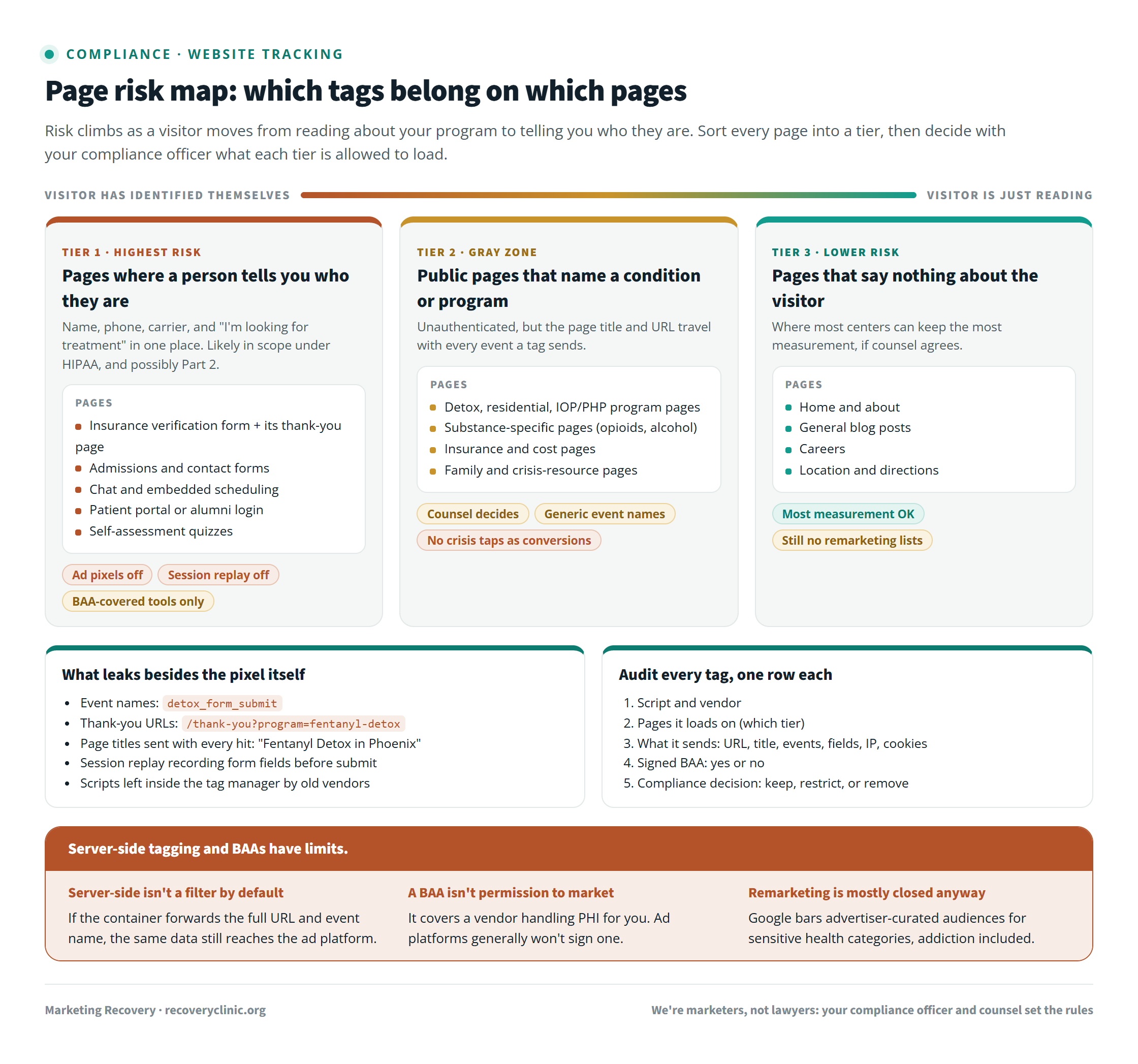
A page risk map for a treatment center website. Risk climbs as a visitor moves from reading about you to telling you who they are. Your compliance officer sets the actual rules for each tier.
The pages that carry the most risk
Risk follows what a visitor has revealed. Someone reading your careers page has told you nothing about their health. Someone on the thank-you page after an insurance verification has told you their name, their carrier, and that they or someone they love wants treatment.
The top tier is anywhere a person identifies themselves. That means verification and admissions forms, the pages that load after them, chat, any portal or alumni login, and self-screening quizzes. Ad pixels and session replay should come off these first. Your insurance verification form is the front door of the admissions funnel, which is exactly why it's the riskiest page on the site.
Program pages are the gray zone. A detox page is public and unauthenticated, which is the kind of page the 2024 ruling addressed, yet a page title like "Fentanyl Detox in Phoenix" rides along with every event a tag sends. Crisis content needs its own rule, and our 988 placement post explains why taps on crisis numbers shouldn't feed conversion tags at all.
The bottom tier (home, about, general blog posts, careers) is where most centers can keep the most measurement, if counsel agrees.
Server-side tagging and BAA tools have limits
Vendors pitch two fixes hard in this space, and both help less than the pitch suggests.
Server-side tagging routes events through a server you control before anything reaches Google or Meta, so you can strip IP addresses, page paths, and form data first. A server-side container that forwards the full URL and event name has disclosed the same thing from a different address, and now it's your server doing the disclosing.
Tools whose vendors will sign a BAA are a better foundation, and for anything touching inquiry data we'd treat a signed BAA as the entry fee. It doesn't make a marketing disclosure permissible, though, and the ad platforms generally won't sign one.
What tends to work in practice is boring. Count conversions inside tools that are under a BAA, like call tracking set up for a treatment center, keep ad tags limited to low-risk pages with generic event names, and decide with counsel whether any conversion data goes back to an ad platform at all, and in what form.
What to bring your compliance officer
- The tag inventory: every script, every page it loads on, what it sends, and who receives it
- A copy of each vendor contract, marked BAA or no BAA
- Your thank-you URLs, event names, and page titles, since those often carry the program name
- The list of pages your team considers high risk, so counsel can confirm or change the tiers
- A plan for measuring admissions if the ad pixels come off the sensitive pages
Don't skip number five. If the answer to "pull the pixel" is "then we can't measure anything," the pixel usually stays.
Measure the click, not the person
Picture the real version of your test submission: a mother at the kitchen table at 11 PM, typing in her son's insurance. The ad platform needs to know a click turned into something worth paying for. It doesn't need her name, the program she asked about, or the carrier on the card, and on a treatment center site it shouldn't get the chance to learn them.
Our website work for treatment centers includes mapping what every tag sends and rebuilding measurement around whatever your compliance team approves. We don't certify anything as compliant; the license, the accreditation, and the compliance calls stay with your program. For a second set of eyes on what your site sends today, start with a free audit. We work only with licensed, accredited programs, and we never buy or broker leads.
About the author
Zac Spencer is an online marketing specialist and the owner of Crave Media, based in Salt Lake City, Utah. Since 2013 he has managed hundreds of Google Ads accounts across dozens of industries, and founded Marketing Recovery, a specialized arm of Crave Media focused on marketing for licensed addiction treatment centers.