Websites · October 16, 2026
988 on a treatment center website: where it belongs

By Zac Spencer
Most treatment center websites we audit handle crisis information in one of two ways. Either it isn't there at all, or the admissions number has been relabeled to cover it: "In crisis? Call us 24/7." A missing crisis line leaves a frightened visitor with nowhere to go. The relabeled admissions line is worse, because it sends that visitor to someone whose job is intake and insurance verification.
Getting 988 onto your treatment center website takes about an afternoon. Deciding where it goes and what the words around it say takes more thought, and that's what this post covers: which number does which job, where each one sits on the page, and the sentence most admissions sites are missing. None of this is clinical guidance. Your medical director and compliance lead should sign off on the final wording, because they're the ones accountable for what your program promises.
Four numbers that do different jobs
The 988 Suicide & Crisis Lifeline is the national crisis line. It launched on July 16, 2022, replacing the old 10-digit National Suicide Prevention Lifeline, and SAMHSA administers it. People can call or text 988, or chat at 988lifeline.org. It covers more than suicide. The Lifeline lists alcohol and drug use concerns among the reasons to reach out, and it takes calls from people worried about someone else, which describes a lot of the parents on your site.
The SAMHSA National Helpline, 1-800-662-4357, is a different service. It's free, confidential, open 24/7 in English and Spanish, and it's a treatment referral and information line. It points callers to local programs, support groups, and state-funded treatment. It isn't crisis counseling, though we regularly find it listed under a "crisis resources" heading on treatment center sites. And for an overdose, a medical emergency, or anyone who can't be kept safe right now, the answer is 911, not any of these lines.
Your admissions line is the fourth number. It exists to answer questions about your program, verify insurance, and start an admission. Good admissions coordinators are calm and kind under pressure, and many are in recovery themselves. They are still not a crisis team, and the website shouldn't suggest they are.
Say plainly that admissions isn't a crisis line
This is the sentence most treatment center sites are missing, and it's the one we'd put on every site we touch:
Our admissions team can answer questions about treatment and insurance. We are not a crisis line. If you or someone you love is in danger right now, call 911. For a mental health or substance use crisis, call or text 988.
Marketing teams push back on this, because it reads like turning a caller away. Picture who it turns away, though. A person in active crisis who reaches your admissions coordinator at 2 AM gets someone working from an intake script, while the Lifeline has counselors trained for exactly that call.
We'd also drop the words "hotline" and "helpline" from your own number. Those labels belong to the lookalike rehab-referral sites that pushed Google to start requiring LegitScript certification for addiction treatment ads, and families have learned to distrust them. "Call admissions" says what the number is.
Where 988 goes on a treatment center website
We'd keep 988 out of the header. The sticky header and the mobile call bar belong to admissions. Putting two phone numbers side by side in the header asks a scared person to make a choice before they've read anything, and a choice is one more place to stall. Crisis information gets its own, quieter, permanent home, plus a prominent spot on the pages where people in crisis tend to land.
The site-wide footer
One line in the footer of every page, above the legal links: "If you're in crisis, call or text 988. In an emergency, call 911." Make both numbers tappable on mobile with tel: links, plus sms:988 for text. That's the floor, on every page.
High-risk pages
Some pages draw readers who may be in trouble right now: detox, co-occurring and dual diagnosis, anything about suicide, overdose, or withdrawal symptoms, and the family pages where a parent is describing what they saw last night. On those, place a short callout near the top of the content, visually distinct but calm. A soft-tinted box works. Flashing red banners read as alarm, and alarm is the wrong tone for someone already scared.
The contact page and form confirmations
Open the contact page with the triage block from the section above, before the form. Then follow the form through to its end, because the thank-you page is the spot almost everyone forgets.
Think about what was just typed into that form. "My husband hasn't been sober in four days and he's talking about not wanting to be here anymore." It's 11:40 on a Saturday night. The confirmation page says "Thanks! We'll be in touch within one business day," and the auto-reply email says the same thing. Nothing on either one tells her what to do in the next hour.
Fix both. Say when your team will really respond, and right under it: "If you can't wait, or someone is in danger, call 911. For a mental health or substance use crisis, call or text 988." Have your clinical lead read the form fields too. If the form invites people to describe what's happening, someone will describe a crisis in it, and that submission may sit unread until Monday.
The chat widget
The chat's opening message or pre-chat screen carries the same 911 and 988 line as the footer. Escalation rules for what the chat does mid-conversation are in our live chat post.
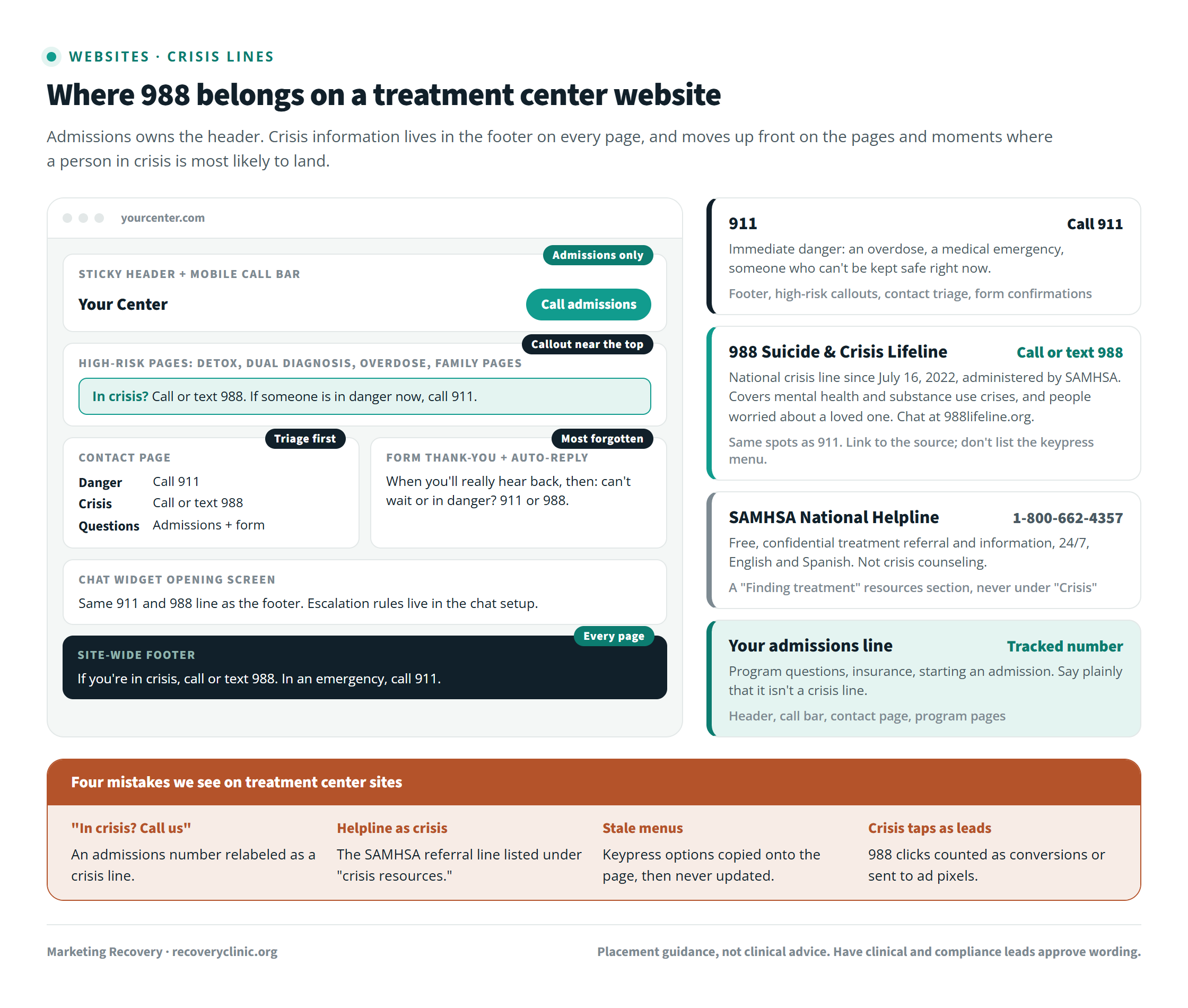
Where each number lives on a treatment center website. Admissions owns the header; crisis information is in the footer on every page and up front where people in crisis land.
Wording that stays accurate
Link to the source and keep the details light. The 988 menu changes. The LGBTQ+ youth option, "Press 3," ended on July 17, 2025, and came back on September 30, 2026. Any resource page that spelled out the menu was wrong for about 14 months, while "Call or text 988, or chat at 988lifeline.org" stayed true the whole time. If your resources page lists keypress options, check it today.
A few more wording rules we hold to:
- Use the official name, "988 Suicide & Crisis Lifeline," at least once on the page, then "988" after that.
- If you have Spanish-language pages, carry the crisis line onto them. The Lifeline offers Spanish by call, text, and chat.
- If you use the 988 logo, download it from SAMHSA's 988 partner toolkit and follow its brand guidelines. Don't redraw it or recolor it to match your site.
- Never imply a relationship with 988 or SAMHSA. Listing a public resource is fine. "In partnership with" is not, unless it's true and documented.
- Keep the SAMHSA helpline under a heading like "Finding treatment," not "Crisis resources." Some families will use it to find a program other than yours. Let them; it's the honest resource.
Keep crisis taps out of your marketing data
This part gets missed on the analytics side. Many sites run a tag that counts every tel: link click as a lead. Add a 988 link and that tag starts counting crisis taps as conversions, which inflates your numbers and, if those conversions feed Google Ads, teaches Smart Bidding to chase the wrong visitors.
Exclude 988, 911, and the SAMHSA number from every conversion goal and every ad platform pixel. A tap on a crisis number is sensitive information about a person, and it has no business in Meta's or Google's ad systems. Your call tracking should cover only the numbers you own. If you aren't sure what your tags count today, the setup we describe in call tracking for treatment centers starts with an inventory of exactly that.
Warm lines, alumni lines, and admissions
A warm line is a different thing again. It's a free, confidential support line, usually staffed by peers with lived experience, for someone who needs to talk before things become an emergency. The American Psychiatric Association describes warm lines as explicitly not for emergencies and notes that their hours vary, so if you list one, list its hours too.
Some centers run their own alumni or family support line, and that's a real service worth showing. Label it for what it is, with honest hours, and keep it separate from admissions. The mistake we see is a center calling its admissions number a "warm line" because the phrase sounds gentler. A family calling for peer support and getting an insurance verification is a bad surprise, and so is the reverse. Local numbers also die. A county warm line or crisis team listed in 2023 may have moved by now, so put a quarterly check of every third-party number on someone's calendar.
Let 988 take the call it was built for
The pull on an admissions website is to keep every caller with you. For most callers, that's right, and the treatment center website should make calling admissions feel easy and safe. The person in crisis is the exception, and a site that's honest about it earns trust with the families reading over that person's shoulder.
Our website work for treatment centers includes crisis placement and wording your clinical and compliance leads can approve, along with tags that keep crisis taps out of your ad data. Your program holds the license and the clinical responsibility, and we never buy or broker leads. If you'd like a second look at how your site handles a visitor in crisis, request a free audit.
About the author
Zac Spencer is an online marketing specialist and the owner of Crave Media, based in Salt Lake City, Utah. Since 2013 he has managed hundreds of Google Ads accounts across dozens of industries, and founded Marketing Recovery, a specialized arm of Crave Media focused on marketing for licensed addiction treatment centers.