Websites · September 1, 2026
Treatment center live chat and who answers at 2 AM

By Zac Spencer
The reaching-out happens after hours
We've written before about the 2 AM visitor, the mother or spouse on a phone in a dark house, finally ready to contact someone. This post is about the other half of that moment: what happens when they do.
In our experience the reaching-out clusters at night and on weekends, which is exactly when most centers' admissions coverage is thinnest. A website can be perfect, the ads can be dialed in, the rankings can be earned, and all of it funnels into whatever answers at 1:40 AM on a Tuesday. If that's a voicemail greeting, the family usually doesn't leave a message. They go back to the search results and try the next center on the list, and that center admits the patient your marketing paid to find.
So before spending another dollar on traffic, it's worth taking an honest inventory of your after-hours coverage: the phone, live chat, and text. Each channel serves a different family, and each one fails in its own way.
Start by calling your own number tonight
Not during the Tuesday staff meeting. Tonight, at 11, from your personal phone. Count the rings, hear what a frightened parent would hear, and note what happens if you press nothing.
Centers are routinely surprised by this test. The website says "call anytime" because the marketing agency wrote it that way, the line rings to a front desk that closed at 5, and the overflow goes to a general voicemail box someone checks in the morning. By morning, a crisis-window decision has already been made somewhere else. In this field the window between "ready to call" and "talked out of it" can be a few hours. Coverage that resumes at 9 AM misses it.
Whatever your real coverage is, the website has to tell the truth about it. "Admissions answers 24/7" only belongs on the page if a human answers at 3 AM. If your honest answer is "a person answers weekdays 7 to 9, and overnight calls reach an on-call coordinator within 20 minutes," say that. It's still a strong promise, and it's one you can keep.
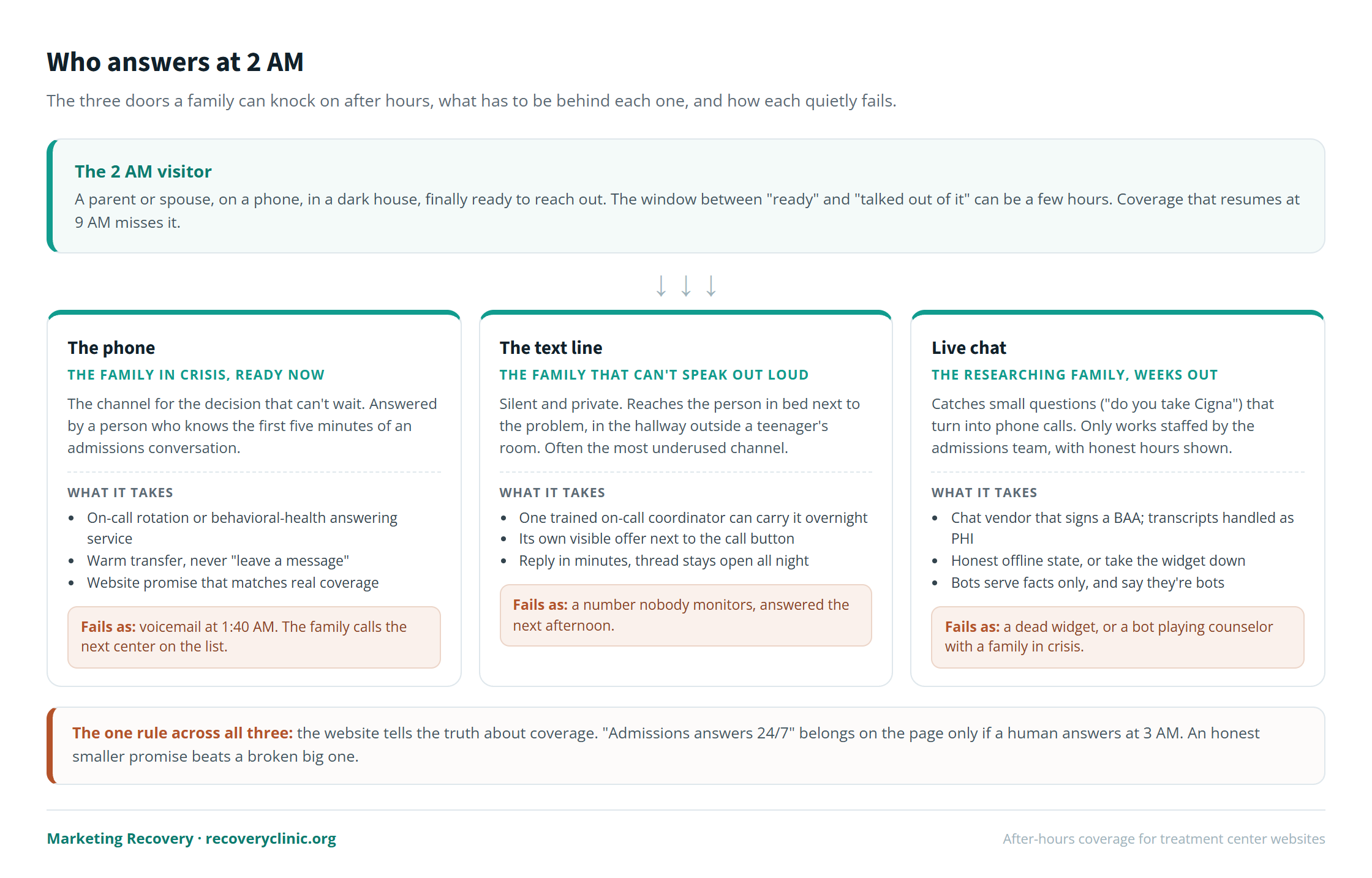
The three doors a family can knock on at 2 AM, what has to be behind each, and how each one quietly fails.
The case for a text line
For this field, a text line does more work than live chat, and most centers have it backwards: chat widget installed, no text line anywhere.
Think about where the 2 AM visitor physically is. In bed next to the person they're worried about, or in the hallway outside a teenager's room. A phone call is audible. Texting is silent, private, and already the channel this person uses for every hard conversation in their life. "Text us confidentially: (XXX) XXX-XXXX" removes the last physical barrier to reaching out, the sound of their own voice saying the problem out loud.
A text line is also forgiving on the operational side. A chat visitor expects a reply in seconds and abandons the widget when it doesn't come. A texter expects a reply in minutes and keeps the thread open all night. One trained on-call coordinator can carry a text line through the overnight hours, which makes honest 24/7 text coverage achievable for centers that can't staff 24/7 phones.
Put the number on the site as its own offer next to the call button, not buried on the contact page. The family that won't call yet is precisely the one you're trying to catch, the same family a low-pressure insurance verification form captures during business hours.
What live chat is good for, and what it costs
Live chat earns its place when it's staffed by the same people who answer your admissions line. The researching family, the one two weeks from a decision, will open a chat to ask "do you take Cigna" or "can parents visit on weekends" long before they'll call. Answered well, those small questions turn into a phone conversation; admissions teams that run their own chat report exactly that hand-off pattern.
Unstaffed, chat does damage. A widget that says "we're here to help!" and then sits silent, or wakes someone's inbox tomorrow, teaches the visitor that your promises are decorative. If you can't commit staff to it, configure the widget to show honestly when a human is on ("Chat with admissions, back at 7 AM") or take it off the site. An absent chat widget costs you nothing. A dead one costs you trust at the worst possible moment.
And chat transcripts are sensitive by nature. People type things into a treatment center's chat box that qualify as health information the moment they hit send. That means a chat vendor willing to sign a business associate agreement, transcripts stored and accessed like the sensitive records they are, and a hard look at what your advertising pixels can see on pages where the widget runs. Your compliance officer should approve the chat stack before marketing turns it on, the same standard we apply to admissions landing pages that carry forms.
Where a bot belongs, and the line it must not cross
An automated assistant can do real, honest work on a treatment center site at 2 AM: surface the insurance list, give directions, state visiting hours, explain what happens on the first call, and offer the text line when a human isn't on. Those are facts, and a bot that serves facts quickly is better than a search through your site's footer.
The line is impersonation. A bot in this field must say it's a bot, and it must never counsel. A family in crisis typing "I think my son is overdosing" needs 911 language and a human escalation path, instantly, not a chatbot's sympathetic paragraph. Configure the escalation phrases deliberately, test them, and put a human behind the hand-off. A center that lets software play counselor with people in crisis has a problem bigger than marketing, and families can tell when the warmth is synthetic. In a decision built entirely on trust, getting caught faking a person can end the conversation for good.
Making the coverage real
None of the channels matter more than the roster behind them. The centers that win after-hours do it with unglamorous scheduling: an on-call admissions rotation with a phone that actually rings, a behavioral-health answering service that warm-transfers rather than takes messages, or night clinical staff trained on the first five minutes of an admissions conversation. Pick the model your staffing supports, then write the website's promises to match it exactly.
Then measure it. Tracked numbers on the call button, the text line, and the chat hand-off will show you what each channel produces and where the after-hours leaks are. One center we worked with went from almost no tracked calls to more than 300 a month, and without tracking, nobody would have known which hours and channels those calls came through. Review a sample of chat and text transcripts monthly the way you'd review calls. The 2 AM conversations are where your admissions process is at its most honest.
If you're not sure what your site promises at 2 AM, or what happens when someone tests it, that's exactly what we look at in a free audit. Our website work for treatment centers covers the whole after-hours front door: honest coverage language, a text line families will use, chat that respects both the visitor and the rules. The families are reaching out at night. The only question is who answers.
About the author
Zac Spencer is an online marketing specialist and the owner of Crave Media, based in Salt Lake City, Utah. Since 2013 he has managed hundreds of Google Ads accounts across dozens of industries, and founded Marketing Recovery, a specialized arm of Crave Media focused on marketing for licensed addiction treatment centers.