Websites · June 30, 2026
Send ad traffic to your admissions page, not your homepage

By Zac Spencer
It's almost midnight and a mother is on her phone, trying to get her son into treatment before he changes his mind. She searches, taps the first ad, and lands on a homepage. There's a hero photo of the building, a mission statement, a menu with eight tabs, a paragraph about the center's history. What she needed was one thing: can you help him, and what do I do right now. She didn't find it in the three seconds she gave the page, so she went back to the search results and tapped the next ad.
That click cost the program real money. Treatment is one of the most expensive categories in all of paid search, where a single click can run from $25 to well past $150. Spending that much to land someone on a page built for browsing, not for the moment they're in, is how a lot of ad budgets quietly disappear. There's a better target for that click: paid traffic should land on an admissions landing page built for that exact moment, not the homepage. This post walks through why the homepage loses the click and what the admissions page has to do instead.
The homepage is built for the wrong visitor
A homepage tries to serve everyone at once. Alumni, referents, job seekers, families in week three of research, and the board all land there, so it talks about the organization broadly. That's the right job for a homepage and the wrong job for a paid click.
The person who clicked a search ad is not browsing. They typed something specific, often in a crisis, often late at night, and they're deciding in seconds whether this is the place that can help. Hand them a general homepage and you've made them do the work of finding the answer themselves, on the worst night of their year. Most won't. They'll bounce to the next option, and you'll have paid for the visit anyway.
An admissions page answers one question
The admissions page exists to answer a single question the searcher is really asking: can you help, and what is the first step. Everything on the page should serve that. The headline names the level of care and who it's for. The first screen has a way to call or reach someone, without scrolling. Nothing competes for attention, because there's nothing else the visitor came to do.
That focus is what makes the page convert. When the click lands on a page about the exact thing the searcher typed, they don't have to think, and far more of them reach out. It's the same reason the keywords you bid on have to match real intent: the ad, the keyword, and the page all need to be having the same conversation, or the money leaks out between them.
What the page has to make obvious, fast
A family in that moment has a short list of questions, and the admissions page should answer all of them above the fold or close to it.
Can I talk to a person now. The phone number belongs at the top, tap-to-call on mobile, repeated where the reader finishes. For most admissions traffic, the call is the conversion, so the whole page should point at it.
Do you treat what we're dealing with. Name the levels of care and who the program serves in plain language, not clinical jargon a frightened parent has to decode.
Will insurance help. Families worry about cost first. A simple way to verify benefits, framed honestly and without promising coverage, removes the biggest hesitation between the click and the call.
What happens when I reach out. A sentence or two on what the first conversation is like lowers the fear of picking up the phone. People hesitate at the unknown; tell them what to expect.
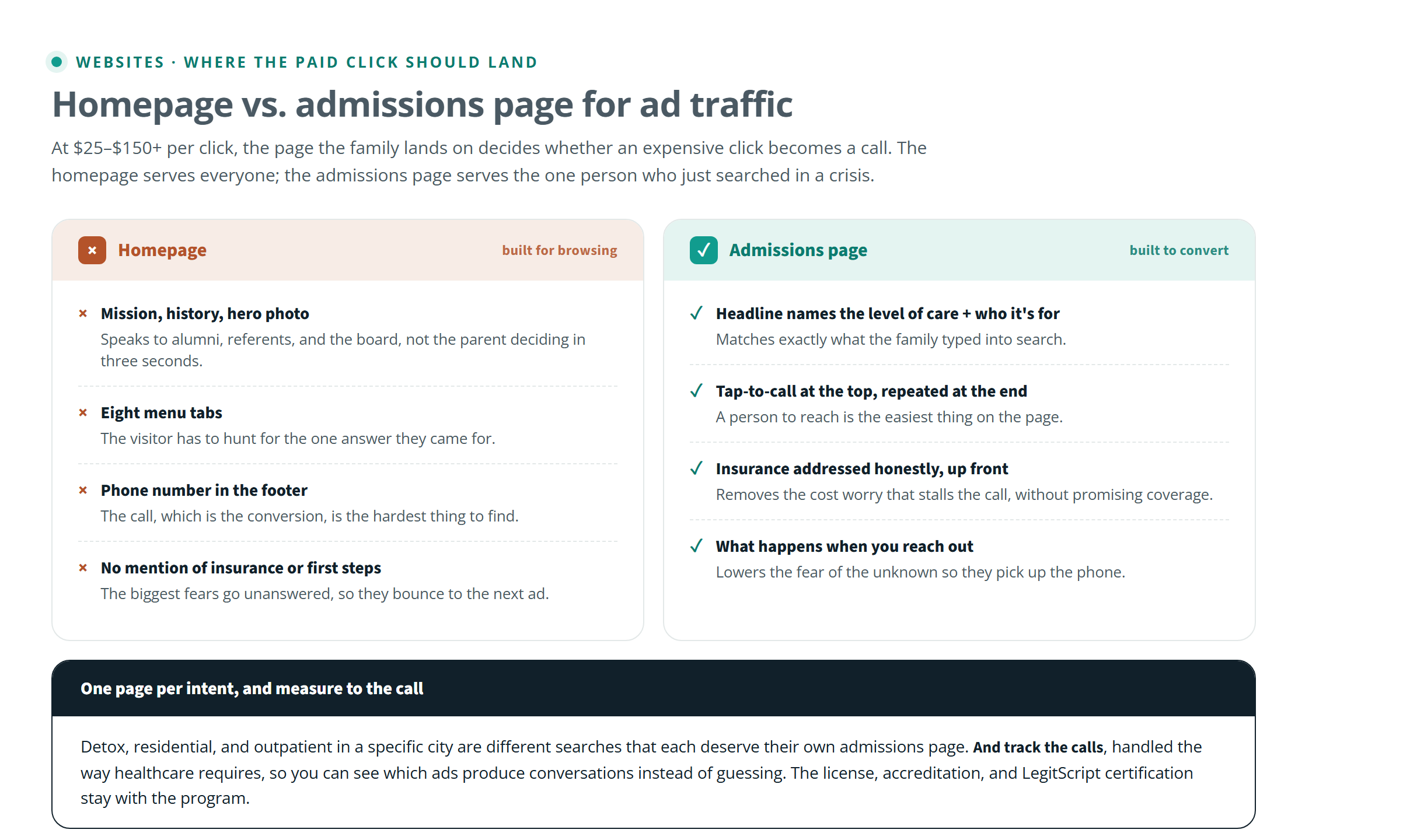
The homepage spreads a paid visitor's attention across everything the organization does. The admissions page narrows it to the one decision the searcher came to make, which is what turns an expensive click into a call.
Why this matters more when the click costs $50
In most industries, sending ad traffic to the homepage is a missed opportunity. In treatment, it's an expensive one, because the clicks are so costly and what's at stake on the other end is so high. When an admission can be worth thousands and a click can cost $50 or more, the difference between a 4% and a 10% conversion rate on the landing page isn't a rounding error. It's the difference between a campaign that pays for itself and one that doesn't.
Run the math on your own numbers. Take what you spend per click, the share of clicks that turn into calls, and the share of calls that become admissions, and you can see exactly what a weak landing page costs you per month. We broke down what Google Ads really costs a treatment center if you want a sense of the per-click reality, but the short version is that at these prices, the page the click lands on is one of the highest-leverage things you can fix.
The call is the conversion, so measure it
An admissions page does its job when the phone rings, which means you have to be able to see the calls and where they came from. Without call tracking, a click that turned into an admissions call looks identical to a click that bounced, and you end up guessing which ads and keywords produce conversations.
This is also where treatment marketing has to be careful. Admissions calls contain protected information, and call tracking and recording in healthcare have to be set up to respect that. We get into the specifics in our piece on call tracking for treatment centers, but the principle is simple: measure to the call, not just the click, and handle what's in those calls the way the law requires. To be clear about our role, the license, the accreditation, and the LegitScript certification all sit with your program, and so does the final say on how patient information is handled. What we do is help build the page and the tracking so they respect those obligations from the start.
One page per intent beats one page for all
A center usually runs ads for several things at once: different levels of care, different substances, sometimes different cities. One admissions page can't speak to all of them with the same focus. A search for detox and a search for outpatient in a specific town are different conversations, and the most effective setup gives each its own page that picks up that exact thread.
This is the same logic behind ranking in local search, where pages built for a specific place and need outperform one generic page trying to cover everything. If you're thinking about how paid and organic fit together here, our SEO guide for treatment centers covers the organic side of the same idea.
What this looks like when it's working
When the page is built for the moment and the calls are tracked, the same ad spend produces a lot more. One treatment center we worked with reached 1,740 conversions from paid search at a 13.46% conversion rate, and its tracked calls grew from under 100 to more than 300 a month. Those numbers came from the back half of the funnel doing its job, not from spending more at the top.
That's one program's result, shared to show the pattern, not a promise of what any center will see. Results depend on the market, the offer, and how fast calls get answered. And to be straight about how we work: we partner only with licensed, accredited programs, and we never buy or broker leads. What we help with is the admissions page, the tracking, and the campaign feeding it, so the expensive clicks you're already paying for actually turn into conversations.
If you want to see where your current setup is losing the click, that's what a free marketing audit is for, and you can also check how families find you in AI search with the AI Visibility Check. Either one will usually surface the gap in a single look.
Put the click where it can convert
The homepage has a job, and it isn't catching paid traffic. When you're paying $25 to $150 for a click and a family is deciding in seconds, send them to a page built for that decision: one question answered, a person to call, insurance addressed honestly, and a clear first step. Do that, and the campaign you thought was underperforming often turns out to have been pointed at the wrong page the whole time.
About the author
Zac Spencer is an online marketing specialist and the owner of Crave Media, based in Salt Lake City, Utah. Since 2013 he has managed hundreds of Google Ads accounts across dozens of industries, and founded Marketing Recovery, a specialized arm of Crave Media focused on marketing for licensed addiction treatment centers.