Compliance · July 10, 2026
Why Meta ads are harder for treatment centers than Google

By Zac Spencer
The channel that looks easy and isn't
Plenty of treatment center operators assume Facebook and Instagram will be the easy, cheap way to fill beds. The audience is enormous and the clicks are cheap. It's where everyone already spends their day. Then they try to run addiction-treatment ads on Meta and hit wall after wall the Google side never had.
It's not bad luck. Advertising a treatment center on Meta is genuinely harder than on Google, and the reasons are mostly about compliance, not creativity. The platforms treat sensitive health advertising very differently, and understanding why saves you months of rejected ads, wasted spend, and, in the worst cases, real regulatory exposure. None of this means Meta is useless for a treatment center. It means you have to know what you're walking into.
Both platforms start with the same gate
Before either channel matters, one thing is true on both: you can't advertise addiction treatment at all without LegitScript certification. Google and Meta both require it for treatment and recovery advertisers, and the certification belongs to your program, not your agency. The center holds the license, the accreditation, and the LegitScript certification; a marketing partner helps you use them correctly, but can't stand in for them.
So the baseline hurdle is shared. Where the two platforms split is everything that happens after you're certified, and Meta piles on restrictions that Google's intent-driven search simply doesn't have.
You can't target the people who need you
This is the first hard wall. On Google, someone types "detox near me" or "inpatient rehab that takes my insurance," and their search tells you they're looking. You're responding to a stated need.
Meta works the opposite way, and its rules make that a problem. Addiction and health conditions are protected sensitive categories, and Meta prohibits targeting people based on them. You cannot build an audience of "people interested in addiction recovery" or anyone Meta associates with a health condition, because letting advertisers target users by medical status is exactly the kind of thing that's gotten platforms sued. So you're left with broad location, age, and general-interest targeting, and hoping your message finds the right person by luck rather than intent. For a service as specific as treatment, that's a steep disadvantage before your budget spends a dollar.
The personal-attributes rule shapes every ad
The wording of your ads is constrained too, in a way most operators don't expect. Meta's personal-attributes policy forbids ad copy that implies or asserts knowledge of someone's personal characteristics, health conditions included, so the ad that feels most natural to write is the one Meta rejects. "Struggling with addiction? We can help" implies you know something about the person seeing it, and that gets flagged. So does "Your drinking is out of control" or "Get help for your opioid use." You have to rewrite everything in the third person and keep it general, describing the program and the help available without pointing at the viewer's situation. It trips up center after center whose first batch of honest, direct ads gets disapproved with a vague policy citation and no clear path to fix it. Google enforces a version of this too, but Meta's is stricter and its review far less predictable, which is a big part of why ad accounts in this space get suspended with little warning on either platform.
The tracking trap almost nobody sees coming
Most Meta advertisers install the Meta pixel to track conversions without a second thought. For a treatment center, that pixel is a liability. When it fires on a sensitive page — an inquiry form, an insurance-verification step, an admission confirmation — it can transmit information that ties an individual to addiction treatment back to Meta. That's health-related data leaving your control, and it's the exact pattern behind the wave of lawsuits and regulatory actions over healthcare providers sending patient data to advertising platforms. A treatment center has to be extremely careful about what its pixel and conversion tracking touch, or avoid sending those events to Meta entirely. This is one of the clearest places where doing the easy, default thing every other advertiser does is the wrong move for a healthcare provider handling protected information.
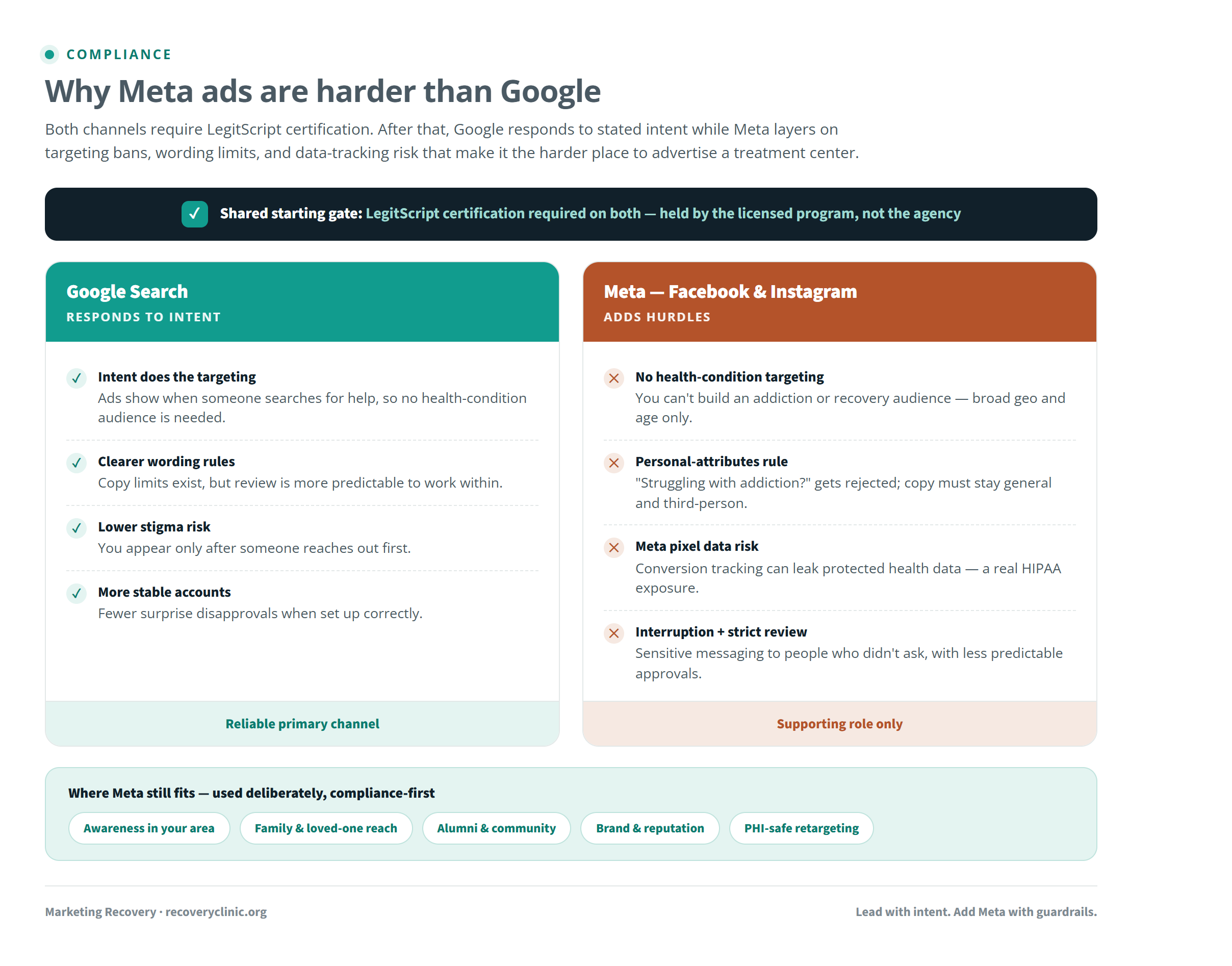
Both channels require LegitScript. After that, Google responds to stated intent while Meta layers on targeting bans, wording limits, and data-tracking risk, which is why it belongs in a supporting role, not the lead.
Interruption is a bigger problem here than elsewhere
For an ordinary local business, interrupting people in a feed is just a colder, cheaper way to find customers. For a treatment center, it carries extra weight.
You're placing sensitive messaging about addiction in front of people who didn't ask for it, which raises the odds of complaints, higher scrutiny from Meta's reviewers, and stigma you don't want attached to your brand. Combine that with the targeting bans and it compounds: you can't aim precisely, and the imprecise aim you're left with puts a delicate subject in front of the wrong people. Google's model sidesteps most of this, because you only show up when someone reaches out first.
Meta still earns a place, with guardrails
None of this means Meta doesn't work for a treatment center. It works, just not as the primary engine, and only with the right guardrails around it.
Where it's strong is awareness and reputation in your area. It's also where you reach families and loved ones, who are so often the ones actually doing the searching, where you keep alumni and the local community engaged, and where you retarget past site visitors through compliant, PHI-safe methods. What it isn't, for most centers, is the reliable engine for capturing people actively looking for treatment right now. That job belongs to search, where intent does the targeting the platform won't let you do yourself. If you're deciding where limited budget goes first, our take on Google Ads versus SEO for treatment centers walks through the intent-driven side that should usually anchor the mix.
Build the mix compliance-first
The two channels demand different handling, and Meta's is heavier. Lead with the one that meets people at the moment of stated need and carries less compliance risk, which for nearly every treatment center is Google search. Add Meta deliberately, for awareness and family reach, with ad copy written to the personal-attributes rule and tracking built so protected data never leaves your control.
If you're running Meta ads for your program and getting disapprovals you can't explain, or you're worried your pixel is touching something it shouldn't, we'll review your setup and tell you where the real risk is. Our Google Ads work for treatment centers is built around admissions and compliance from the start. We work only with licensed, accredited programs, and we never buy or broker leads.
About the author
Zac Spencer is an online marketing specialist and the owner of Crave Media, based in Salt Lake City, Utah. Since 2013 he has managed hundreds of Google Ads accounts across dozens of industries, and founded Marketing Recovery, a specialized arm of Crave Media focused on marketing for licensed addiction treatment centers.