The first question we get from a virtual IOP is almost always about the map. A residential center down the road shows up in the three-pack for "IOP near me," and the virtual program, which treats people in the same state, doesn't show up anywhere. So someone suggests a virtual office, or the clinical director's home address, or a coworking desk nobody sits at. Don't.
A virtual program doesn't have a neighborhood. It has a set of states it's licensed to treat in, and virtual IOP marketing works best when those states are the map you rank on. This post covers why Google Business Profile is mostly off the table, how to build your site around your licenses instead of around cities, and what changes in ads and compliance when nobody walks through your door.
Why a Google Business Profile doesn't fit
Google's Business Profile guidelines are built for businesses that meet customers face to face. A listing has to be contactable in person at the verified location during the hours it posts. A rented mailing address the business doesn't operate out of, which Google calls a virtual office, isn't eligible. Service-area businesses can't list one either unless it's staffed during business hours, and even a legitimate service area isn't supposed to stretch past about two hours of driving. Online-only businesses don't qualify at all.
A virtual-only IOP fails that test on every count. Patients never come to the address, and staff work from home. Picture the coworking-desk version going wrong: the listing gets flagged months in, Google asks for proof the business operates there, and there's no signage, no staff, and nothing to show but a shared conference room. Healthcare listings already draw extra scrutiny, so that day tends to come sooner for a treatment program than for a plumber. We've written about how Google Business Profile suspensions happen in healthcare, and address problems sit near the top of the list. A suspension on a listing that never should have existed isn't something you appeal your way out of.
There's one honest exception. If your program runs a real clinic where patients come in person for assessments, drug screens, or check-ins, with staff and posted hours, that location can have a profile. It ranks for searches near that building and nowhere else, and the hours on it should be the clinic's hours, not your telehealth hours. Don't turn one physical site into a listing that claims to serve the whole state.
How people search for a virtual IOP
The searches look different from the ones that drive a local program. Some still say "near me," because that's how people type. Many more name a state, an insurance plan, or a constraint:
- "virtual IOP Ohio"
- "online intensive outpatient that takes Aetna"
- "telehealth IOP for working professionals"
- "evening IOP I can do from home"
The state shows up so often because the person searching usually knows, or learns fast, that the program has to be licensed where they live and has to take their insurance there. In our levels-of-care post we called in-person IOP a local game, since people choose a program they can drive to after work. Virtual IOP is a statewide game. The commute is gone, and so is the reason to care about the city.
That works in a virtual program's favor. In the markets we've looked at, fewer programs compete for "virtual IOP Ohio" than for "IOP Columbus," and most of these searches play out in the organic results, where nobody has a map pin.
Build the site around your licenses
The structure we recommend is one hub page that explains your virtual IOP, plus one page for each state you're licensed to treat in. Not each state you'd like to treat in, and not each state a patient once asked about. If you're licensed in Ohio and Kentucky, you have two state pages.
Each state page should carry the details that are true only in that state:
- Your license or certification for that state, named the way the state names it, with a number where your state expects it shown
- The insurance plans you're in network with there, which rarely match across state lines
- Session times in that state's time zone
- How the in-person pieces work, such as where drug screens or labs happen and what you do in an emergency
- Who's eligible, including the plain requirement that a patient has to be physically located in that state during sessions
Write that last one plainly, near the top. Something like: "We can treat adults who live in Ohio and are in Ohio during sessions. If you're in another state, we can't treat you, and we're happy to point you toward programs that can." You'll lose a few calls from people you couldn't have admitted anyway. In exchange, your site, your ads, and your LegitScript application all describe the same footprint.
Have your clinical and compliance leads confirm the license language on each page. Rules for treating across state lines differ by state and by license type, and that's their call to make.
Skip the city pages
The instinct after building state pages is to keep going: "Virtual IOP in Cleveland," "Virtual IOP in Dayton," "Virtual IOP in Toledo," forty cities deep. For a virtual program, those pages almost always end up as doorway pages. The program, the staff, the schedule, and the insurance are identical in every city. The only thing changing is the name in the title, and that's the pattern Google's spam policies describe. Our programmatic SEO post covers where that line sits for physical centers. A virtual program sits on the wrong side of it almost every time.
Put that effort into statewide content instead. One page on how your Ohio program works with the plans Ohio employers tend to offer will do more than forty swapped-name pages. If a city has something real and specific to it, like a county drug court that refers to virtual programs or a large employer whose EAP sends people to you, that can earn its own page. Most cities won't have one.
Content that answers the virtual question
People considering a virtual IOP have questions an in-person program never gets. Answer them on the site, in your own words, and have your clinical lead review them:
- What does a week look like, hour by hour?
- What do I need at home, and what if I don't have a private room?
- Is it covered by my insurance the same way an in-person IOP is?
- Can my employer find out?
- What happens if I'm struggling between sessions?
The page we'd push hardest for is the one most programs skip: who virtual IOP isn't a good fit for. Someone who needs medical detox, someone without a safe or private place to log in from, someone who's tried outpatient care a few times and needs more structure. Writing that page means turning some people away. In our experience it's also the page that makes the right people trust the rest of the site, and it gives AI assistants a clear, quotable answer when a family asks whether online treatment is enough.
More families now ask ChatGPT and Google's AI answers things like "is there an online IOP in Kentucky that takes Humana." If you want to see whether AI names your program for questions like that, run the free AI visibility check.
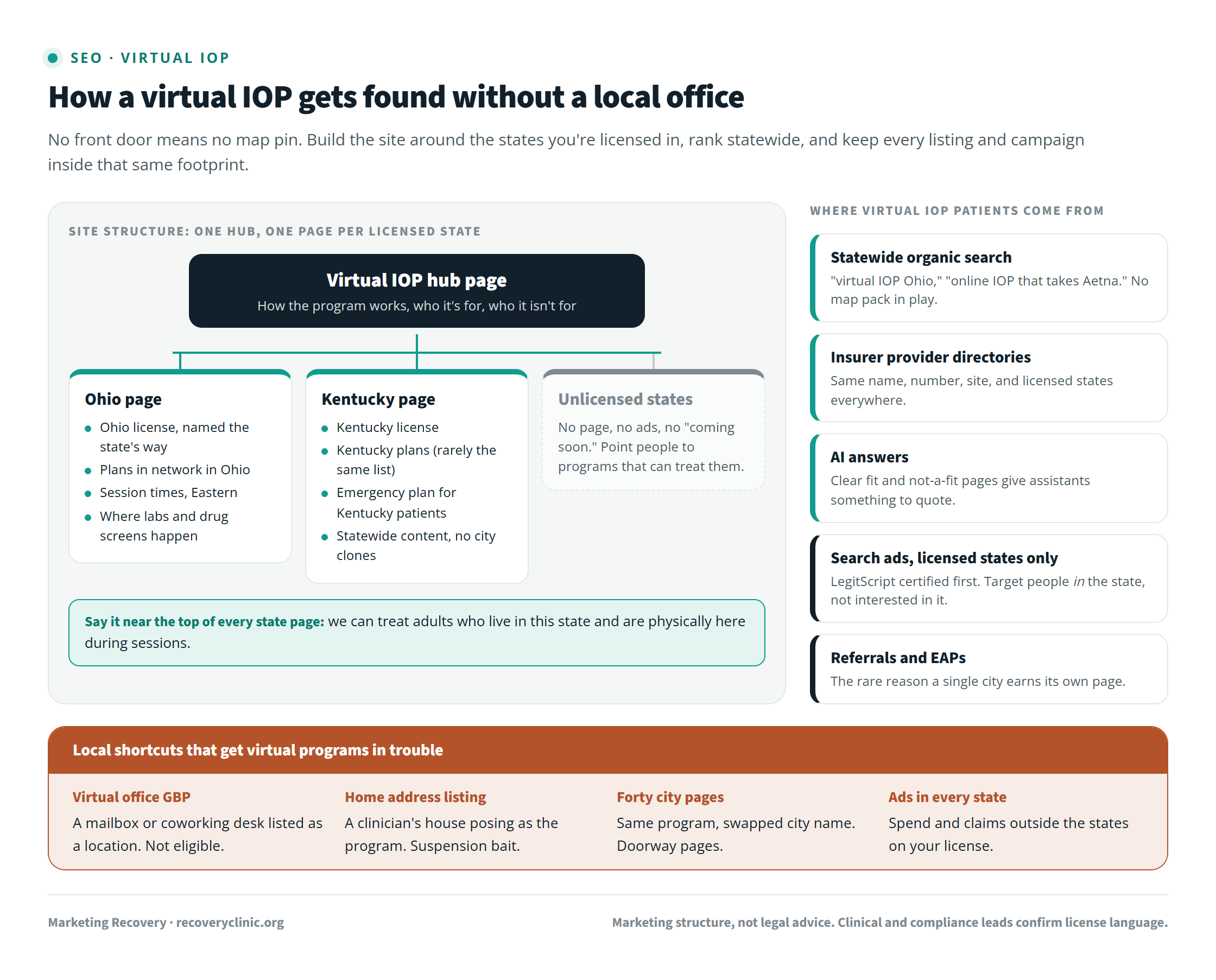
How a virtual IOP gets found without a local office: rank statewide in the states you're licensed in, and skip the shortcuts built for programs with a front door.
Listings that work without an address
Losing the GBP doesn't mean losing listings. Insurer provider directories are the big one, since that's where a lot of members start and most of them list telehealth providers. Your state's behavioral health directory may list outpatient or telehealth programs too, and some treatment directories let you mark a program as virtual and name the states you serve.
Whatever you list, keep the name, phone number, website, and licensed states identical everywhere. The local SEO post explains why consistency counts for physical centers. For a virtual program, the licensed-states line does the job the address does for everyone else.
Ads and compliance without a front door
Paid search works well for virtual IOP, with two guardrails. First, Google requires LegitScript certification before addiction treatment ads run, and that doesn't change because you're virtual. LegitScript's certification standards require a provider to be licensed for its services in the jurisdictions it serves, so the state list on your site and the one in your application should be the same list. The certification belongs to your program; we help get the site and campaigns ready for review. Our LegitScript guide walks through the process.
Second, target only your licensed states, and set location targeting to people who are in those states, not people who are interested in them. Interest targeting puts your ad in front of someone in Florida typing "virtual IOP Ohio," and if that person is searching for themselves, you can't treat them. A parent in Tampa searching for a son in Columbus is the exception, and if that's a real share of your calls, test it in its own campaign. The geo-targeting post covers that setting in detail.
If your program prescribes medication for opioid use disorder by telehealth, be careful with marketing copy right now. The DEA's temporary telemedicine prescribing flexibilities run through December 31, 2026. The DEA's permanent special registration rule was still under White House review in early October, and its final text wasn't public. We wouldn't publish any promise about starting medication without an in-person visit that runs past the end of the year until your counsel has read the final rule.
Rank where you're licensed to treat
Every shortcut in this post starts with pretending to be a local program. If your licenses say Ohio and Kentucky, those two states are your market, so write for them and leave the city map to the programs that have a front door. Start with the state page for your largest licensed state; it's the one you'll learn the most from.
We help licensed programs build state-by-state structure and content as part of our SEO work for treatment centers, and we never buy or broker leads. If you'd like a second look at how your virtual program shows up today, request a free audit.

About the author
Zac Spencer is an online marketing specialist and the owner of Crave Media, based in Salt Lake City, Utah. Since 2013 he has managed hundreds of Google Ads accounts across dozens of industries, and founded Marketing Recovery, a specialized arm of Crave Media focused on marketing for licensed addiction treatment centers.