Reviews · July 21, 2026
How Google Business Profile suspensions happen in healthcare

By Zac Spencer
One morning the calls stop. Someone searches your center's name and the profile that used to sit on the right side of the screen, with your reviews, your photos, and your phone number, is gone. No warning email worth the name, no clear explanation. Just a notice in your dashboard that your profile has been suspended.
A Google Business Profile suspension is one of the most disruptive things that can happen to a treatment center's marketing, because for many centers that profile drives more admissions calls than the website itself. One center we worked with grew from near zero to 300+ tracked calls a month, and a large share of those started as a Google search that ended at the profile. Lose the listing and that pipeline goes quiet the same day.
Suspensions in healthcare are more common than most operators expect, and they usually trace back to something specific someone did to the profile, often with good intentions. Understanding what trips the wire is most of the protection.
Why healthcare gets watched more closely
Google doesn't treat all business categories the same. Addiction treatment sits in a small group of verticals that get extra scrutiny, and the industry earned it. A few years ago, bad actors were hijacking legitimate rehab listings, swapping in call-center phone numbers, and routing desperate families to whoever paid for the call. Google responded across its products: LegitScript certification became the gate for running treatment ads, and Maps listings in the category started getting reviewed with a much more suspicious eye.
That history means a treatment center's profile lives with a lower tolerance for anything that looks off. An edit pattern a landscaper could get away with can put a rehab listing into review. It isn't fair, exactly, but it's the terrain, and it rewards centers that keep their profiles boring, accurate, and stable.
What a suspension looks like
Google issues two kinds. A soft suspension takes away your management access: the listing may still appear in search, but it's marked unverified, and you can no longer update it, respond to reviews, or see insights. A hard suspension removes the profile from search and Maps entirely, reviews and all, which for a treatment center means the phone stops ringing on your strongest channel.
Either way, Google rarely tells you which rule it thinks you broke. The notice cites the guidelines in general, and it's on you to figure out what changed recently and whether anything about the profile could read as a violation.
The edits that trigger suspensions
Most healthcare suspensions follow a change to the profile. These are the ones we see set them off.
The most common is the business name. Google requires the profile name to match your real-world name, the one on your signage and your license. Adding keywords, "Serenity House" becoming "Serenity House Detox & Alcohol Rehab Memphis," reads as stuffing, and it's the classic self-inflicted suspension. It often happens after someone reads that keywords in the title help rankings. They do, which is exactly why Google polices them.
Address problems are close behind. Virtual offices, PO boxes, a location that doesn't have signage, or an address shared with another business all draw flags. Healthcare has an extra wrinkle: organizations often run a facility listing plus practitioner listings for individual clinicians, and when those multiply, drift out of sync, or duplicate each other, the cluster itself can get the main profile suspended.
Then there's change velocity. A burst of edits in a short window, a new name, new categories, new hours, new website, looks like a takeover, because that's what an actual hijacking looks like. The same goes for suddenly adding new managers or handing access to a third-party service that starts bulk-editing. If an agency you hired triggers this, you'll be the one holding the suspension.
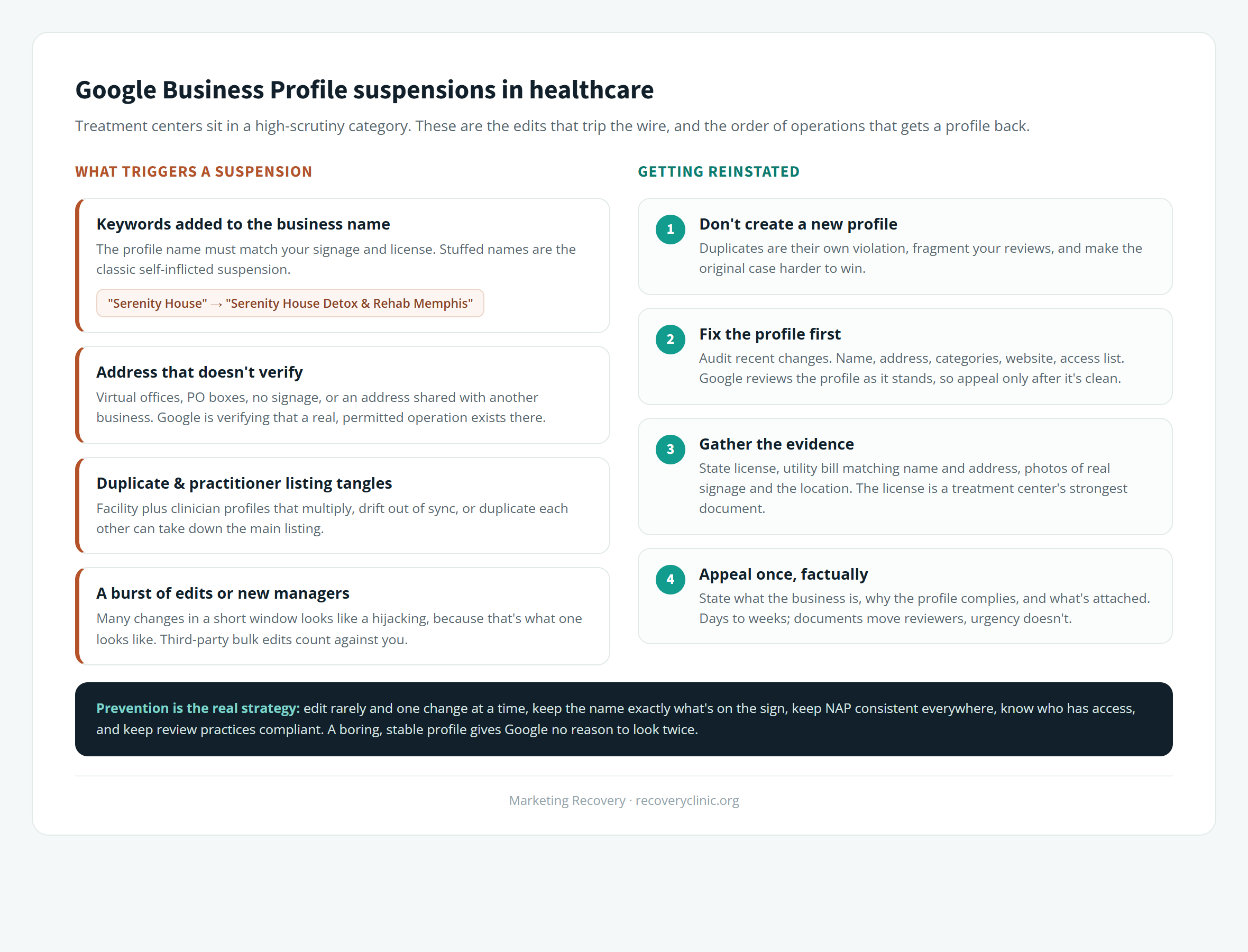
The edits that put a healthcare profile into suspension, and the order of operations for getting it back. The appeal comes last, after the profile is clean and the evidence is gathered.
What to do in the first 48 hours
The first instinct is usually the worst one: do not create a new profile. Duplicate listings are themselves a violation, they fragment your reviews, and a fresh profile created while another sits suspended tends to get caught and makes the original case harder to win.
Start instead with a quiet audit. What changed in the last few weeks? Check the name against your signage and license, the address, the categories, the linked website, and who has access. Fix anything that doesn't match reality before you appeal, because Google evaluates the profile as it stands when they review it, and appealing a profile that still contains the violation burns your best chance.
While you're fixing, gather the evidence Google's reinstatement process asks for: your business license, a utility bill showing the business name and address, and photos of the location, real signage, the entrance, the interior. For a treatment center, your state license is the strongest document you have. It establishes exactly the thing Google is trying to verify, that a real, permitted operation exists at this address under this name.
Then file the appeal, once, and make it count. The reinstatement form gives you limited room, so be factual: what the business is, why the profile complies, what evidence is attached. If a specific edit caused the flag, say plainly that it's been corrected. Ranting about lost revenue doesn't move the reviewer; documents do.
How long reinstatement takes
In our experience, straightforward cases resolve in a few days to a couple of weeks, and messier ones, duplicates, address disputes, practitioner-listing tangles, can run longer. There's no phone number to call and no way to pay for speed. That waiting period is painful for a center that counts on profile calls, which argues for two things: treat prevention as the real strategy, and make sure your local SEO and website can carry weight while the profile is down, so one suspension doesn't zero out your visibility.
It's also the strongest argument for tracking where your calls come from in the first place. Centers that track by source know within a day that profile calls dropped. Centers that don't sometimes discover a suspension weeks in, by accident, after the census already dipped.
Keeping the profile boring
Prevention is mostly discipline. Make edits rarely and one at a time, not in batches. Keep the name exactly what's on the sign. Keep your name, address, and phone consistent everywhere it appears online, because mismatches between your profile, your website, and directories are quiet credibility leaks. Know exactly who has access to the profile, remove old employees and former vendors, and vet any agency before handing them the keys, since their shortcuts become your suspension.
And keep your review practices clean, both for Google and for HIPAA. Review-solicitation shortcuts that violate Google's policies put the profile at risk the same way a stuffed name does, and in treatment they carry privacy problems on top. We covered the compliant playbook in how treatment centers get Google reviews without breaking HIPAA, and it's the version that also keeps your profile safe.
This is unglamorous work, which is why it slips. It's also most of what our Google Business Profile management service does for treatment centers: keep the profile accurate and stable so it never gives Google a reason to look twice.
The profile that never gets flagged
Suspensions feel random from the inside, but they almost never are. A name that matches the license, an address that checks out, a short list of people with access, and a slow, deliberate edit history describe a profile Google has no reason to touch. If yours is suspended now, fix first, document second, appeal once. And if it's healthy, the best time to tighten it up is while it still is. If you'd like a second set of eyes on your profile before Google's, request a free audit and we'll tell you what looks risky.
About the author
Zac Spencer is an online marketing specialist and the owner of Crave Media, based in Salt Lake City, Utah. Since 2013 he has managed hundreds of Google Ads accounts across dozens of industries, and founded Marketing Recovery, a specialized arm of Crave Media focused on marketing for licensed addiction treatment centers.