A family in Franklin doesn't search "addiction treatment." They search "detox near Franklin TN," or "IOP that takes Blue Cross in Nashville," or "residential treatment for my son in Tennessee." The searches are specific: a level of care, a place, and often an insurance plan.
Programmatic SEO is the strategy of meeting those searches at scale. Instead of hand-writing every page, you build a template and generate a page for each combination of treatment type and city you serve. Done carefully, it's how a center earns rankings across dozens of towns it admits from. Done lazily, it's the fastest way we know to get a treatment site buried, and this niche punishes lazy harder than almost any other.
This post covers how the treatment-by-city model works, why it fits the way families search, and the line between a page cluster that ranks and a doorway-page problem that sinks everything.
How programmatic SEO works
The mechanics are simple. You take a page template, a list of your levels of care, and a list of the cities and counties you genuinely serve. Detox, residential, PHP, IOP, crossed with ten towns, is forty potential pages, each one aimed at a search a real family types.
The big directories run this exact play, which is part of why they outrank centers so often. A directory has a page for every treatment type in every city in America, and Google rewards the coverage. An individual center can't match that breadth. It doesn't need to. It only needs to win the combinations it can honestly claim, in the market where it operates and the feeder towns families travel from.
The spread is where the volume hides. One treatment center we worked with ranks for 13,206 keywords, and the overwhelming majority are not "rehab" or the brand name. They're the long tail: specific programs, specific places, specific insurance questions. No single one of those searches is big, and together they're the campaign.
Why Google is stricter with treatment sites
Before building anything, it's worth being clear about the risk, because programmatic SEO has a bad reputation that this industry earned honestly.
Health content sits in the category Google scrutinizes hardest, and addiction treatment gets extra care on top of that after years of listing-hijacking and lead-broker abuse. Google also has explicit policies against scaled content that exists for rankings rather than readers, and against doorway pages, which are near-duplicate pages targeting every city name with the words swapped out. A hundred pages that all say "We offer compassionate addiction treatment in [CITY]" with nothing else changed is the textbook definition. Sites get demoted for it as a whole, not page by page, which means a sloppy page cluster can drag down the pages that were working.
There's a plainer problem underneath the policy one. A thin city page makes a promise to a family in crisis that the center may not keep. If nobody from your center has ever admitted a patient from that town, and you have no bed, staff, or outreach anywhere near it, the page exists to catch a click. Families notice, and so do the quality raters Google trains on exactly this category.
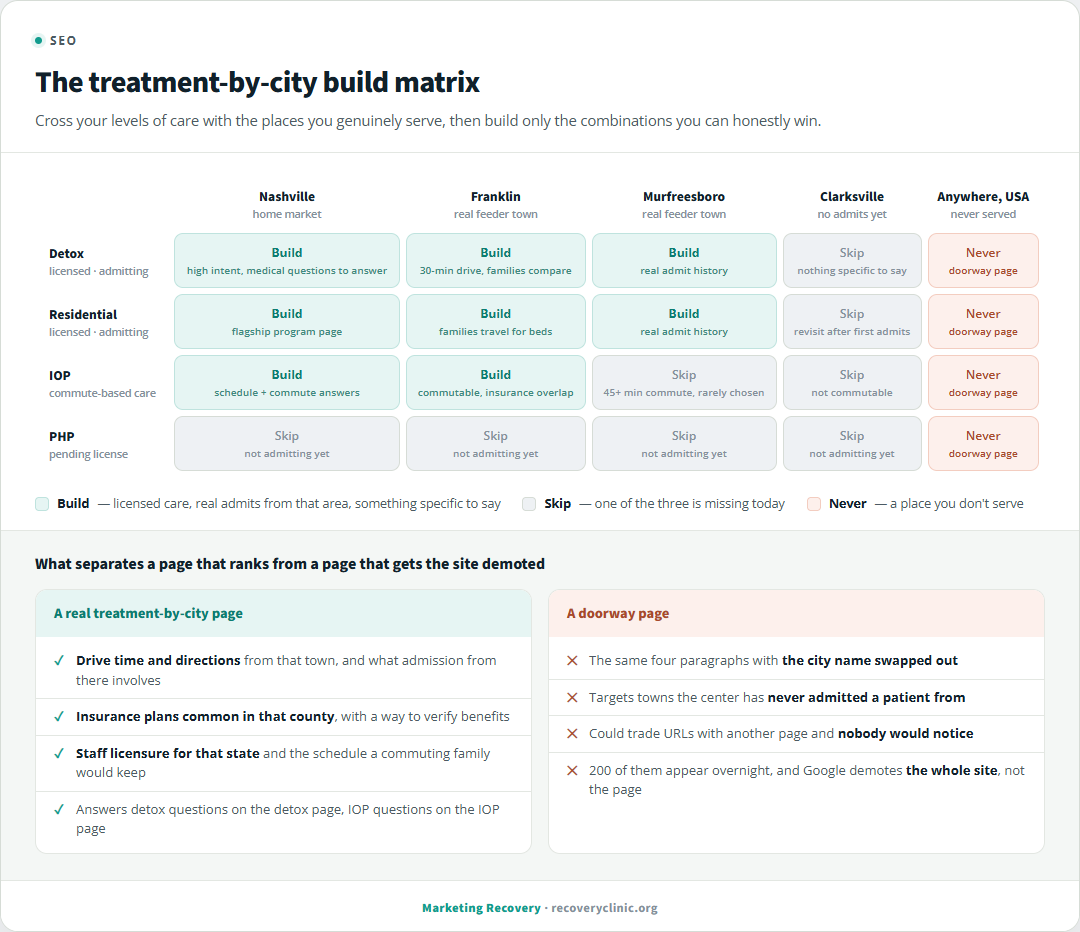
The build-or-skip matrix for treatment-by-city pages, and what separates a page that ranks from a doorway page that gets the site demoted.
Build the matrix, then cut most of it
The discipline that makes this strategy work is deciding which combinations not to build.
Start with the full grid of levels of care against cities. Then keep a page only where three things are true. The level of care is real, licensed, and admitting. The place is one you genuinely serve, meaning you've admitted patients from it, your staff can speak to it, and a family there could reasonably choose you. And you have something specific to say about that combination that no other page on your site already says.
For most single-location centers, that filter cuts a 200-page fantasy down to somewhere between 10 and 40 pages. That's the right size. Twenty strong pages covering your metro and its real feeder towns will outperform 200 templated ones, and they'll do it without betting the domain. Multi-state operators can go wider because the underlying facts, licensure, facilities, and staff genuinely differ from market to market, which gives each page real material.
What makes a treatment-by-city page real
The template can be shared. The substance can't. A page for "IOP in Murfreesboro" earns its ranking when it answers what a Murfreesboro family specifically needs: how far the drive is and from where, what the weekly schedule looks like for someone commuting from there, which insurance plans common in that county you accept and verify, who on staff holds the relevant Tennessee licensure, and what admission from that area involves.
The same goes for the treatment-type side of the template. A detox page has medical questions to answer that an IOP page doesn't, and a family comparing PHP to IOP needs the difference explained, not the same four paragraphs with the acronym swapped. If two pages on your site could trade URLs without anyone noticing, one of them shouldn't exist.
Real pages also connect to the rest of the local footprint: the Google Business Profile, reviews from the areas you serve, and consistent listings. We covered that side in our guide to local SEO for treatment centers, and the two strategies feed each other. The pages give Google the words; the local signals give it the proof.
Rolling it out without spooking anyone
Pace matters. Two hundred pages appearing overnight on a small site is a pattern Google associates with spam, and it gets a site looked at in the way you don't want. We roll clusters out in batches, a handful of pages at a time, watching Search Console as each batch indexes. Impressions on the long-tail terms move first, the same leading indicators we described in the first 90 days of a treatment center SEO campaign, and each batch's performance tells you whether the template needs work before the next one ships.
Expect the timeline to look like SEO, because it is SEO. The pages are an input to the treatment center SEO work, not a shortcut around it. What the programmatic approach changes is coverage: instead of one location page carrying every search in your market, each real combination of care and place has a page built to win it.
One more reason this matters now: the AI assistants families increasingly ask, "best detox near Franklin," pull from the same specific pages and local signals. Centers with a real page for the care-plus-city combination are the ones with something for the AI to cite. You can see where you stand today by running the free AI visibility check, which shows whether AI names your center or sends those families to a directory.
If you're weighing whether a page cluster makes sense for your market, request a free audit and we'll map the matrix with you: which combinations you can win, which to skip, and what the honest timeline looks like.

About the author
Zac Spencer is an online marketing specialist and the owner of Crave Media, based in Salt Lake City, Utah. Since 2013 he has managed hundreds of Google Ads accounts across dozens of industries, and founded Marketing Recovery, a specialized arm of Crave Media focused on marketing for licensed addiction treatment centers.