Google Ads · September 22, 2026
Geo-targeting rehab ads where families search

By Zac Spencer
The circle around your building
Open most treatment center ad accounts and the location settings tell the same story: a radius drawn around the facility. Thirty miles, maybe fifty. It feels sensible, it's what Google suggests during setup, and it encodes an assumption that isn't true for most residential programs: that patients come from wherever the building is.
Pull your last hundred admissions and look at the addresses. For a residential program, a meaningful share came from two or three metros that aren't yours, some from out of state. Families routinely choose distance on purpose, wanting their son or daughter away from the people and places attached to their use. The census has been telling you where your market is all along. The ad account is usually the last thing to hear about it, and rehab Google Ads geo-targeting is the discipline of closing that gap: advertising where the decision gets made instead of where the beds are.
Match the map to the level of care
There is no single right map, because there's no single buyer. We made the longer version of this argument in why detox, residential, and IOP need different marketing, and geography is where it shows up first.
Detox is a local, hours-long decision. Nobody in acute withdrawal is comparison-shopping across state lines, so a metro-area map with aggressive coverage of your own city is right. IOP is a commute. If the drive to your building is over 40 minutes, attendance three nights a week stops surviving contact with real life, and paying for clicks beyond that ring buys traffic that can't convert. Residential is the level that travels, and it's where the radius habit does its damage. A 30-mile circle around a residential facility excludes nearly everyone who would have flown in.
One account, one circle, three different buyers. That's the most common geographic mistake we tear out of treatment center accounts, and fixing it costs nothing but attention.
Find your feeder markets
For residential campaigns, the question becomes: which distant metros? Guessing produces "target the whole Southeast," which is a way of spending a lot to learn nothing. Your own records answer it better.
Start with the admissions log: home zip codes of the last year of admits, grouped by metro. Add the area codes from your call tracking, which show where inquiries come from, including the ones that didn't admit. Most centers find a lopsided pattern: a home metro, then two or three cities that consistently send families, often for reasons no one planned, like an alumni family that talks about you or a referring interventionist. Those are feeder markets. Target them as metros, not as whole states, and give each its own campaign so it earns its own budget.
Then apply the honest filter: payer mix. Medicaid effectively doesn't cross state lines, so if a large share of your census is Medicaid, out-of-state advertising is money spent reaching families whose funding can't follow them. Commercial-insurance and private-pay programs are the ones with a real case for a feeder-market strategy. This is also where we tell some centers not to expand the map at all, because the census says the market is local.
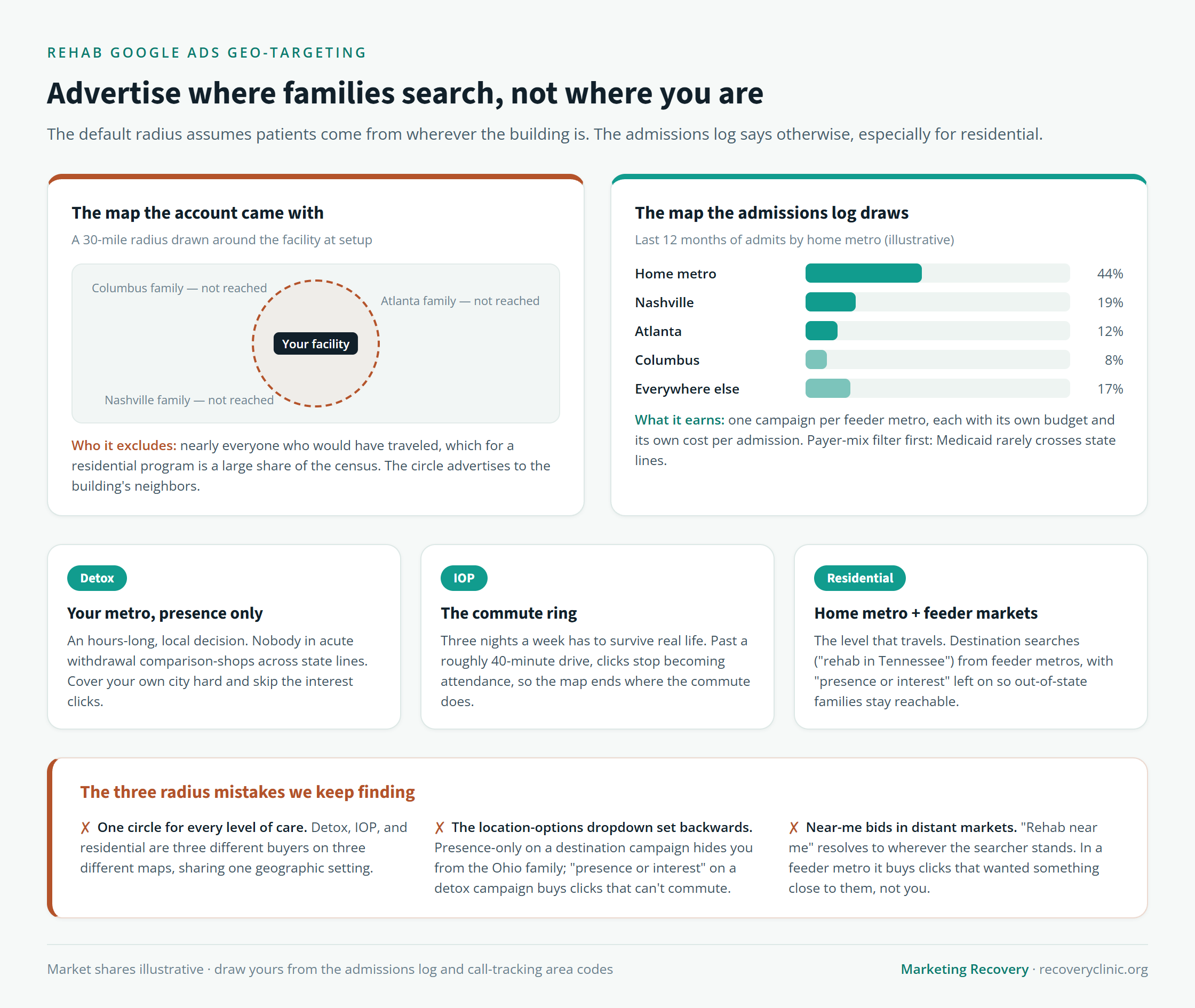
The map the account came with versus the map the admissions log draws. Market shares shown are illustrative, and the pattern, one home metro plus a few feeder cities, is what most residential programs find.
The setting that quietly decides everything
Inside Google Ads, one dropdown does more geographic work than the map itself. Location options offer "presence or interest," which is the default and includes people anywhere who show interest in your targeted area, or "presence," which means people physically there.
For treatment, this setting cuts both ways, and the right choice depends on which campaign it's attached to. A residential campaign targeting your facility's state with the default setting is accidentally right: the parent in Ohio searching "rehab in Tennessee" shows interest in Tennessee, and that click is exactly the one you want. Flip that campaign to presence-only and the Ohio family disappears from your reach while your budget stays the same. Meanwhile a detox campaign with the default setting has the opposite problem, paying for out-of-market clicks from people who will never make a 40-minute drive.
The search terms themselves carry geography too. "Rehab near me" resolves to wherever the searcher is standing, which is why bidding on near-me terms in a distant feeder market mostly buys clicks that wanted something close to them. Destination searches, "rehab in Nashville," "treatment centers in Arizona," are the feeder-market workhorses. We broke down which query types fill beds in the keywords that fill beds; the geographic layer sits on top of that same intent logic. And your branded campaign should run the widest map of all, because alumni, referrers, and researching families search your name from everywhere, and those are the cheapest, warmest clicks in the account.
Give every market its own scoreboard
A geographic strategy you can't measure per market will drift back into one blended number, and blended numbers hide failing markets inside winning ones. The structure that prevents it is unglamorous: one campaign per market, with tracked phone numbers so every call carries its geography. Then a monthly look at cost per admission by metro, the arithmetic we walked through in what a good cost per call looks like.
One center we work with went from near zero to 300 or more tracked calls a month, and the per-market split of those calls is what made the geographic decisions defensible instead of anecdotal. Two feeder metros earned bigger budgets. One long-suspected market turned out to produce calls that never became admissions, and it was cut without an argument, because the numbers made the argument.
If you're not sure what map your own account is running on, that's a ten-minute look. Send it over and we'll audit the location settings, the search-term geography, and the per-market math as part of a free account review, or read more about how we run Google Ads for treatment centers. Either way, draw the map from the admissions log, not around the building.
About the author
Zac Spencer is an online marketing specialist and the owner of Crave Media, based in Salt Lake City, Utah. Since 2013 he has managed hundreds of Google Ads accounts across dozens of industries, and founded Marketing Recovery, a specialized arm of Crave Media focused on marketing for licensed addiction treatment centers.