Google Ads · August 28, 2026
What a good cost per call looks like in treatment marketing

By Zac Spencer
Cost per call is the first number most treatment center operators look at on an ad report, and the one they misread most often. It sits right there on the dashboard, it moves every week, and it feels like the honest middle ground between a click (too early to matter) and an admission (too slow to manage by). So people manage to it. They ask the agency to get it down, and the agency usually can.
The problem is that a good cost per call for a rehab program has almost nothing to do with how low it is. It has to do with what the call turns into. A $90 call that never becomes an admission is $90 gone. A $450 call from an in-network family in your service area, who completes a verification of benefits the same afternoon, may be the best money you spent all month. On the dashboard, the first center is winning. On the census, it isn't close.
Start at the admission and work backward
The only way to decide what a call is worth is to know what an admission costs you to acquire through paid search, and what one is worth to the program once it's in a bed. On this blog we've used $6,000 to $10,000 per paid admission as a rough reality for detox and residential programs in competitive markets, and we broke down how to calculate cost per admission earlier this summer. Take your own version of that number and let it set the ceiling for everything upstream.
From there it's division. Say your program can tolerate $8,000 per paid admission and still run with margin. If roughly one in eight qualified calls admits, you can afford up to $1,000 per qualified call. If half the calls your ads produce turn out to be qualified, that's $500 per total call. Those two ratios are yours to measure, and they move the ceiling more than the click price ever will. A center where one in five qualified calls admits can afford a call that would sink a center converting one in fifteen.
So "what's a good cost per call" has no universal answer, and anyone who quotes you one without asking about your admit rate is guessing.
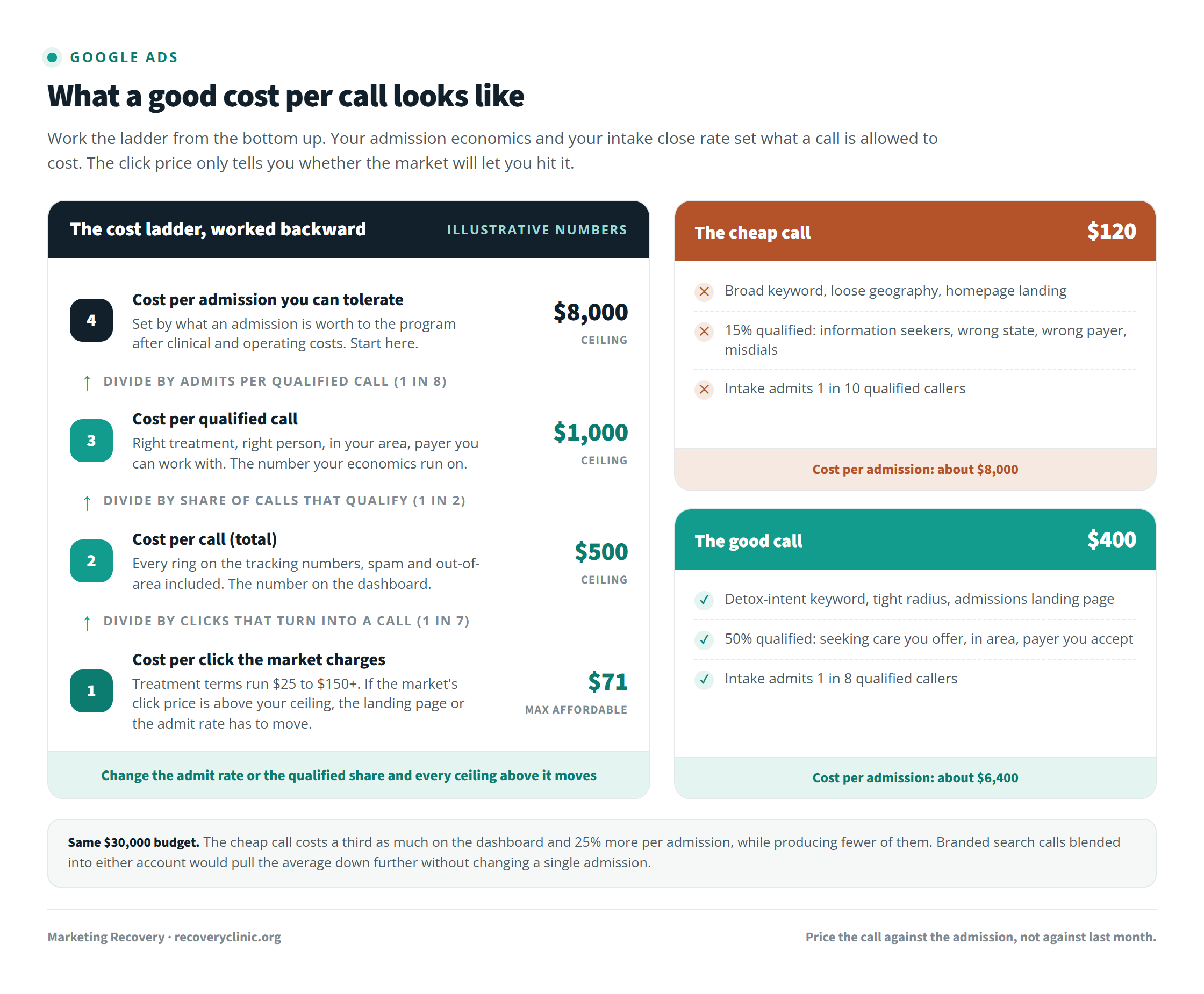
Work the ladder from the bottom up. Your admission economics and your intake close rate decide what a call is allowed to cost; the click price only tells you whether the market will let you hit it.
Three different calls hide inside one number
A report that shows "calls" is almost always counting three things as one. Total calls is everything the tracking numbers rang with, including the wrong numbers, the pharmacy reps, the job seekers, and the family in a state you don't serve. Qualified calls is the subset where someone was seeking treatment you offer, for a person you could admit, in a place you can serve, with a payer you can work with. Verified calls is the smaller subset again where intake completed a verification of benefits, which in practice is the point where an inquiry stops being a call and starts being a possible admission.
The cost per call on most dashboards is total calls. Your real economics run on the other two.
Rough marks to hold in your head, from accounts we've looked at and not from any published study: a well-built search campaign in this niche tends to run somewhere around half of its calls qualified, and a poorly built one can run well under a third. Same spend, same "calls" column, and one account is delivering twice the real inquiries. Nobody notices without call tracking that tags and scores each call. If your agency reports cost per call and can't produce cost per qualified call, the number they're managing to is the wrong one.
What a $75 click implies
Clicks in this category run anywhere from $25 to well past $150, and the terms that fill beds sit at the expensive end. That price sets a floor under your cost per call that no amount of optimizing can dig beneath.
Two things decide where the floor is: what you pay per click, and what share of clicks turn into calls. A focused admissions landing page with a number at the top and nothing in the way can turn something like one in seven or eight clicks into a call. A homepage with a navigation bar and a mission statement might do one in twenty. At a $75 click, that's the difference between a call in the $500 to $600 range and one pushing $1,500. Same keyword and bid, same market.
So when cost per call is high, check the landing page before you check the bids. Lowering bids buys cheaper clicks on broader terms, which makes call quality worse. Fixing the page keeps the intent and cuts the cost, and it's usually a one-time project.
The blended number that hides the real one
Most accounts report one cost per call for the whole account, and that single figure blends two campaigns that behave nothing alike. Branded search, where someone types your center's name, produces calls for a few dollars because the searcher already chose you. Non-branded search, "detox near me" and its cousins, produces calls at ten or twenty times the cost because you're competing for someone who hasn't chosen anyone yet.
Mix them and the branded calls drag the average down until non-branded looks affordable. Then branded volume dips for a month, the blended cost per call jumps, and everyone panics about a campaign that didn't change. We covered the mechanics in branded vs non-branded search for treatment centers. You need two cost-per-call figures, and the non-branded one is the number that tells you whether growth is affordable.
When an expensive call is fine
There are centers for which a $600 or $800 cost per call is a healthy number, and they aren't making a mistake. If your intake team admits one in five qualified calls, your payer mix is strong, and your average length of stay is long enough that an admission is worth well above what it costs to acquire, then expensive calls are just what your market charges for the right families. Paying up for detox-intent terms in a metro market is often the correct decision. Cutting spend to hit a prettier cost per call is the mistake in that scenario.
The tell that an expensive number is fine is downstream. Qualified rate is high, VOBs complete, admits follow, and cost per admission lands inside your range. When those hold, leave the campaign alone and feed it.
When a cheap call is a warning
The opposite case is the one that gets centers in trouble, because it looks like success. Cost per call drops, the report reads well, and nobody checks what changed.
Usually the campaign drifted toward broader, cheaper keywords, which pull in information seekers and out-of-area callers who ring the phone and never admit. Or geographic targeting loosened, or was never tight, so the calls come from three states away. Or the account is picking up spam and misdials that the tracking software counts as calls. Each of those lowers cost per call and raises cost per admission at the same time, and only one of those two numbers is on the front page of the report.
The other warning is a cheap call that intake dreads. If your admissions team says the phones are ringing but the conversations are short and the payer questions go nowhere, believe them. Intake hears the qualified rate change weeks before the monthly reconciliation shows it.
A worked example
Two hypothetical programs, same monthly budget. The numbers are illustrative, not client data.
Program A spends $30,000 and produces 250 calls at $120 each. The campaign is built on broad terms with loose geography, so only 15 percent of those calls are qualified, which is 37 or 38 real inquiries at roughly $800 apiece. Intake admits one in ten of them. That's about four admissions at around $8,000 each.
Program B spends the same $30,000 and produces 75 calls at $400 each. The campaign is narrow, in-area, and pointed at a landing page built for the call, so half of those calls are qualified: 37 or 38 inquiries at the same $800 apiece. Because the callers fit the program, intake admits one in eight. That's closer to five admissions at around $6,400 each.
Program A's cost per call is a third of Program B's, and Program A pays 25 percent more for every admission while producing fewer of them. On a report that only shows cost per call, the worse account is the one that gets congratulated. Notice, too, that cost per qualified call was identical across the two programs. The admit rate did the rest, which is where the room to improve usually sits.
Measuring it without a data team
You need three things. Call tracking that ties each call to its campaign, and ideally its keyword. A way for intake to mark each call qualified or not, even a single field in a shared sheet, filled in the same day. And a monthly reconciliation that connects qualified calls to admissions from your intake records. After that, cost per qualified call is a division problem, and the month-over-month trend tells you more than any single figure.
One treatment center we worked with went from near zero tracked calls a month to more than 300 as their campaigns matured, and the scoring is what let us cut the spend that was producing calls but not admits. The 300 was the visible result. What made the spend worth it was knowing which of those calls to keep buying.
The usual note applies: your program holds the license, accreditation, and LegitScript certification, and how patient information from those calls is handled sits with you and your compliance team. We help build campaigns and tracking that respect those obligations. We work only with licensed, accredited programs, and we never buy or broker leads.
Price the call against the admission
If I could only see one number on a treatment center's ad report, it wouldn't be cost per call. It would be cost per qualified call next to the admit rate, because together those tell you what the call is worth. Cost per call by itself tells you what the call cost, which is a different question and usually the less useful one.
Set your ceiling from your own admission economics, split branded from non-branded, get intake scoring calls, and then judge the number. If you suspect a cheap-looking cost per call is hiding an expensive cost per admission, request a free audit. We'll pull the qualified rate out of your existing Google Ads data and tell you straight whether the calls you're paying for are the calls you want.
About the author
Zac Spencer is an online marketing specialist and the owner of Crave Media, based in Salt Lake City, Utah. Since 2013 he has managed hundreds of Google Ads accounts across dozens of industries, and founded Marketing Recovery, a specialized arm of Crave Media focused on marketing for licensed addiction treatment centers.