Google Ads · July 17, 2026
Branded vs non-branded search for treatment centers

By Zac Spencer
Two families open Google looking for help on the same afternoon. One types the name of your center because a therapist wrote it on a card. The other types "alcohol detox near me" because they don't know a single facility by name yet. Both are searching. Both could become admissions. But the ads you'd run to reach them, and what each one costs you, are almost nothing alike.
That split is the difference between branded and non-branded search, and understanding it is the difference between a Google Ads budget that compounds and one that quietly overspends. Branded search rehab campaigns capture the people who already know you. Non-branded campaigns go find the ones who don't. A treatment center that treats them as the same line item is usually paying too much for one and starving the other.
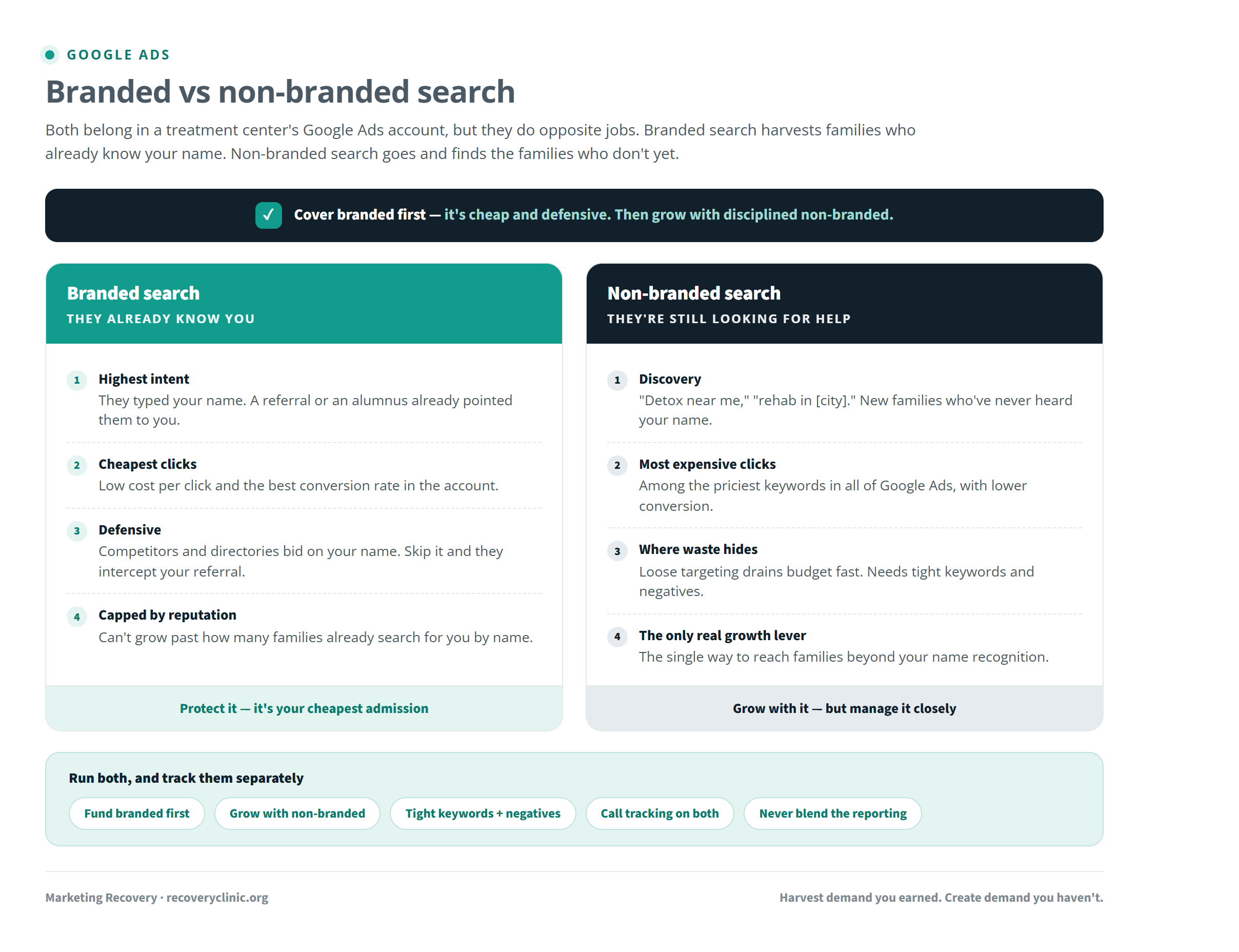
Branded vs non-branded search side by side. Both belong in the account, but they do very different jobs at very different prices.
What each type of search actually is
Branded search is when someone types your center's name, or a close version of it, into Google. "Sunrise Recovery Tennessee." "Sunrise rehab reviews." They already know you exist. Maybe an alumnus referred them, maybe a discharge planner at a hospital gave them your name, maybe they saw one of your other ads last week and came back to look you up. The point is you're not introducing yourself. You're being found by someone already reaching for you.
Non-branded search is everything else, the generic terms a family uses when they have a problem but no name attached to the solution. "Drug rehab in Nashville." "Dual diagnosis treatment." "Where to send my son for detox." These searches carry real intent, someone is looking for help, but they carry no loyalty. The family typing them hasn't heard of you, and neither has the seven other centers competing for the same click.
The honest way to picture it: branded search harvests demand you've already earned. Non-branded search creates demand you haven't. One is a defense, the other is offense, and a healthy account runs both.
Why branded search is cheap and converts
Branded clicks are usually the cheapest and highest-converting traffic in the whole account, and the reason is intent. Someone searching your name has already decided you're worth a look. They're far down the path. So they click, they call, and they convert at a rate no generic term can match. For one treatment center we worked with, the branded terms consistently closed at a higher rate and a lower cost per call than any discovery keyword in the account, which is the pattern almost everywhere.
That raises the obvious question: if you already rank first organically for your own name, why pay for the click? The answer is that you're often not the only one bidding on it. Competitors and lead-generation directories are allowed to run ads against your brand name, and plenty do. Skip your branded campaign and a family searching specifically for you can land on a competitor's ad sitting above your organic listing. You'd be paying, in lost admissions, to send your own hard-won referrals to someone else.
So branded campaigns are partly insurance. For a few dollars a click, you hold the top of the page for the searches most likely to become patients, and you keep a competitor from intercepting the family a referral source just sent you. It's some of the best-spent money in a treatment center account, and it's cheap precisely because you built the reputation that drives it.
The catch is that branded search can't grow past your name recognition. Only so many people search for you by name each month, and that number is capped by your reputation, your referral relationships, and whatever else is putting your name in front of families. To reach anyone beyond that circle, you need the other kind of search.
Why non-branded search costs more and matters anyway
Non-branded search is where new families find you, and it's also where budgets get burned. The terms are competitive, the clicks are expensive, and the conversion rate is lower because you're reaching people who've never heard of you and are comparing several options at once.
The expense is real. High-intent addiction treatment keywords are among the priciest in all of Google Ads, and a single click on a term like "residential alcohol treatment" can cost many times what a branded click does. That's the toll for reaching a family that doesn't know your name yet. It's also why non-branded campaigns punish sloppy targeting so hard, a wide net over the wrong keywords drains a budget fast with little to show for it.
But this is the only search that grows the center. Branded traffic is capped; non-branded is where you pull in families who would never have found you otherwise. The work is being selective, bidding on the searches that signal someone ready to get help in your area and your levels of care, and staying off the vague, tire-kicker, or research-only terms that spend money without filling beds. We broke down which searches are worth bidding on in our piece on the keywords that fill beds and the ones that waste budget, and non-branded is exactly where that discipline pays off.
Non-branded is also where the cost adds up fastest, so it's the side of the account where knowing your real cost per admission matters most. A center that can't tell which campaigns produce actual admissions is flying blind on its most expensive traffic.
How to split the budget
There's no single right ratio, but the logic is consistent. Cover branded first, because it's cheap, defensive, and converts. Then put your growth budget into a tightly targeted non-branded campaign, and let your real numbers move the split from there.
Protect your name. A branded campaign is inexpensive relative to what it saves, so fund it and keep it running. Don't assume your organic ranking has you covered, because it usually doesn't when a competitor is bidding.
Grow with non-branded, but stay disciplined. This is where the growth is and where the waste is, so it needs the closest management: tight keywords, negative keyword lists that cut the junk, and a steady eye on which terms actually produce calls. This is the harder half to run well, and it's where most of the cost of running treatment center Google Ads goes.
Measure both separately, or you can't manage either. Branded and non-branded should never sit in the same reporting bucket, because their costs and conversion rates are so different that blending them hides the truth. With call tracking wired in, you can see that branded is producing cheap calls while non-branded is producing pricier ones, and shift budget with real numbers instead of guessing. Managing that split is a core part of the Google Ads work we do for treatment programs, always with the license, accreditation, and LegitScript certification staying with the center, and no leads bought or brokered.
Where to put your first dollar
If you're just turning on Google Ads, cover your brand name first. It's the cheapest, highest-converting traffic you'll find, and leaving it exposed means paying in lost admissions to whoever is bidding against you. Then build a careful non-branded campaign to reach the families who don't know you yet, and watch the two sets of numbers separately so you can move the budget toward whatever is actually producing admissions.
If you're not sure how your current campaigns split, or whether a competitor is bidding on your name right now, that's worth a look. Request a free audit and we'll show you where your ad budget is going, branded versus non-branded, and where it could work harder.
About the author
Zac Spencer is an online marketing specialist and the owner of Crave Media, based in Salt Lake City, Utah. Since 2013 he has managed hundreds of Google Ads accounts across dozens of industries, and founded Marketing Recovery, a specialized arm of Crave Media focused on marketing for licensed addiction treatment centers.