Websites · September 25, 2026
Treatment center website photos that earn trust

By Zac Spencer
Every photo on your site makes a claim
A family vetting your center looks at the pictures before they read a word. The bedroom shot tells them where their daughter will sleep. As far as a parent is concerned, the people laughing on the patio are her housemates for the next month. Treatment center website photos make promises whether anyone meant them to or not.
That's the trouble with stock. Picture a mother at midnight who drops your hero image into Google Lens and finds the same sunlit therapy circle on a string of other rehab sites. She's learned something about you, and it isn't what the photo was supposed to say.
When we covered what a treatment center website needs to turn visits into calls, we said real facility photos beat stock and staff pages need faces. That advice fit in two sentences. Doing it without exposing a client, or putting up a seal you're not entitled to, takes the rest of this post.
Real facility photos beat polished stock
Stock photography has a place. It's fine as a blog header illustrating an idea. It fails the moment it implies "this is our building" or "these are our clients," and on a treatment site almost every photo implies one or the other.
The families checking you have heard about patient brokering and billboard rehabs, and a lot of them now verify before they call. They open Street View. They click through the photos on your Google Business Profile in a second tab. A palm-lined pool on the homepage and a brick office park on the map is a mismatch they catch in seconds.
We'd put it bluntly: a plain, well-lit photo of your real group room will do more for you than a gorgeous stock photo of somebody else's. Bring in a professional photographer if you can. If you can't, a recent phone and a sunny morning will get you most of the way.
What to shoot depends on the level of care. For detox, families want to see the medical side, so photograph the nursing station (no charts or screens in frame), the intake room, and a detox bedroom as it looks on a normal day. Residential families are picturing weeks of daily life: bedrooms, the dining room, outdoor space, group rooms. Outpatient is more practical. An IOP client wants to know where to park and which door to walk through, so shoot the entrance, the lot, and the waiting area.
Bedrooms are where centers get into trouble. If the homepage shows only the one private suite and most clients sleep two to a room, a family arrives on admission day feeling misled before the first group has started. Show the room they're likely to get.
And photograph the front door. It's the most underrated image on a treatment site, because it's the spot where a frightened person will stand on day one, deciding whether to go in.
If you run more than one facility, each building needs its own photo set, matching its own Google profile. Reusing the flagship's gallery across five buildings is a mistake we flagged in location pages for multi-site treatment organizations.
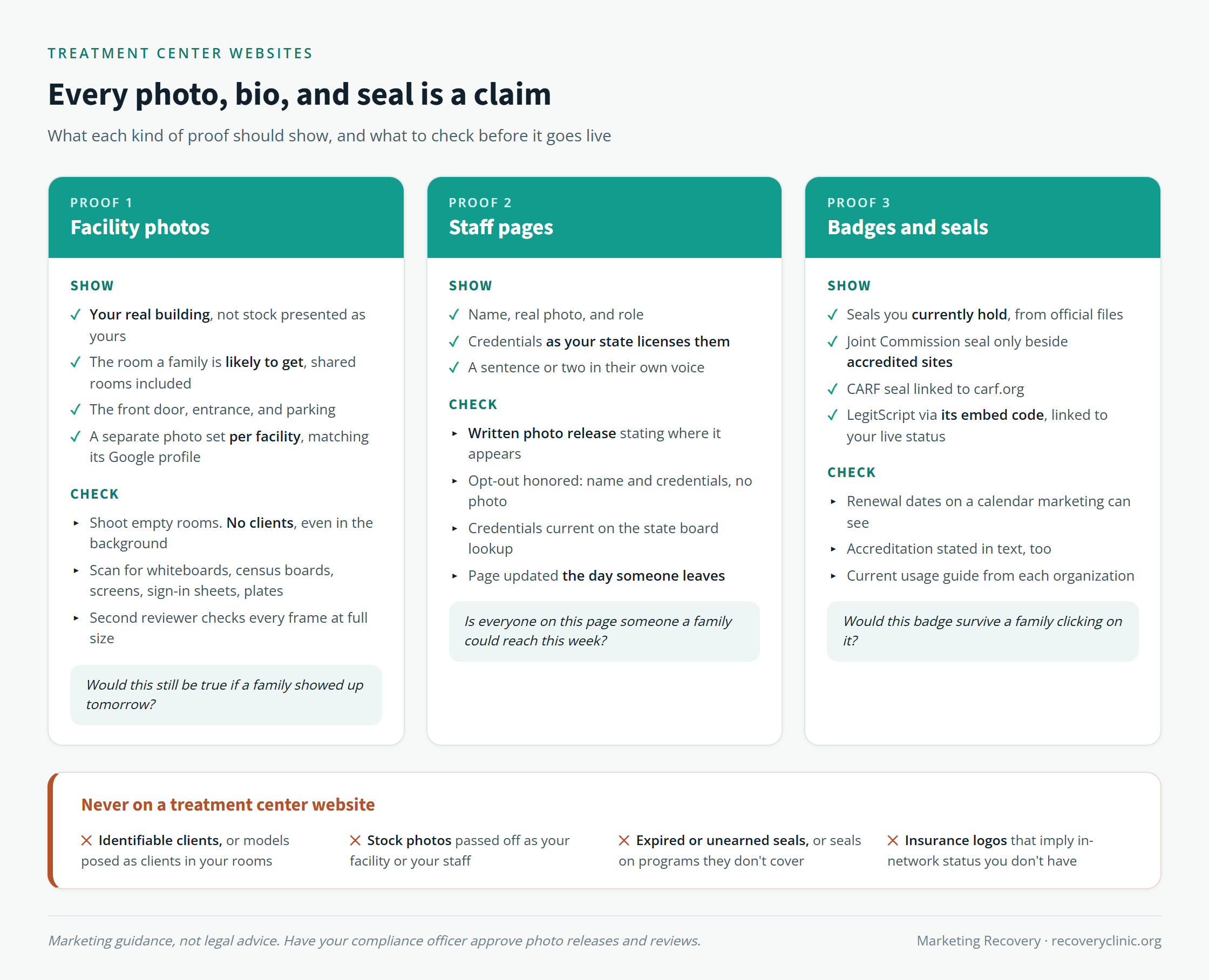
What facility photos, staff pages, and badges should show on a treatment center website, and the checks each one needs before it goes live.
Shoot the building, never the clients
This is the rule the rest of the post hangs on. No current clients in marketing photos, including in the background or shot from behind.
The reasoning is the same one behind testimonials. Full-face photographs are on HIPAA's list of identifiers that have to come out before health information counts as de-identified, and 42 CFR Part 2 protects the bare fact that someone is a patient of a substance use program. A recognizable client in a group-room photo is a public statement that this person was in treatment. Blurring is weaker protection than it looks. People recognize a jacket, a tattoo, the way someone sits.
Nor does "they said it was fine." A verbal okay from someone in their second week of residential isn't the consent the rules have in mind, for the same power-imbalance reason we laid out in getting alumni testimonials the compliant way. Alumni who want to be seen can go through that written authorization process. Current clients stay out of frame.
Most exposures in facility photos aren't faces, though. They're in the background:
- a whiteboard with first names and group assignments
- the census board at the nursing station
- a label on a med cart, or a computer screen left on
- the sign-in sheet at the front desk
- a car with a readable plate in the parking lot
Schedule the shoot for when rooms are empty, such as during an off-site outing or in a wing that's closed for the day. Walk every room before the camera comes out. Then have someone other than the photographer look at every frame at full size before it's published, ideally your compliance officer, who should also sign off on the release forms. (We're marketers, not lawyers, and the privacy rules for photos are a question for them, not us.)
One more gray area: people posing as clients. Staff photographed in their real roles is fine. Models staged as patients in your group room carry the same problem as an actor delivering a testimonial, which is that the image tells families something untrue about who you treat.
Staff pages that stay true
The staff page answers the question under every other question a family has: who will be taking care of my person? Give each person a name, a real photo, their role, and their credentials spelled out the way your state licenses them. A sentence or two in their own voice helps more than a paragraph of bio.
Families can check those credentials on the state licensing board's lookup, and some do. List only credentials the person holds today.
Staff photos need consent too. Get a written photo release that says where the image will appear, and let people opt out without penalty. Some clinicians are in recovery themselves and would rather not be findable by a photo search. Others have safety reasons you don't need to hear. A name and credentials with no photo is fine. A stock headshot standing in for a real employee is not.
Then keep the page current, which is where most staff pages fail. A medical director who left in March and is still smiling from your site in September is a false claim that one phone call can expose. Add "update the website" to the offboarding checklist, right next to turning off their building access.
Badges only for what you hold
Seals are shorthand proof, but only while they're real and current. We covered the rules for talking about accreditation in how accreditation supports marketing trust. On the website itself, the display rules come from each organization's own usage guidelines, and they're stricter than most designers assume.
The Joint Commission's Gold Seal can be used only by accredited or certified organizations, and only next to the services or sites the accreditation covers. If one of your five locations holds it, the page has to make clear which one. The seal can't be redrawn or have slogans added. The only words its guidelines allow beneath it are "Accredited by The Joint Commission" (or "Certified by," for certification).
CARF's promotional guidance asks that its seal be reproduced exactly as provided, and that the seal on a website link to carf.org.
LegitScript's seal is optional, and certification works without it. If you use it, use the embed code LegitScript supplies, which links to your live certification status page. A saved copy of the image doesn't, and it keeps displaying after a certification lapses. LegitScript itself warns families that a seal alone doesn't prove a business is currently certified.
These guidelines get revised, so work from the current usage guide each organization gave you, not whatever version is sitting in your web designer's downloads folder.
The badges that get centers in trouble usually aren't the accreditation seals, though. They're the insurance logo strip, which a family reads as "they're in network with my plan." If you're out of network with half the logos on that strip, it's a misleading claim, and insurers tend to have their own rules about logo use. List the plans you're in network with in text, and send everyone else to benefits verification. Lapsed association memberships belong in the same bin, along with "Top Rehab" award badges from sites that sell them to anyone who pays.
Captions and file size still count
Two small details decide whether good photos also help you in search. Write alt text that says what's in the frame ("shared bedroom in the residential house, two twin beds, window facing the garden") instead of "rehab facility image 3." And compress every file before upload. A gallery of 6 MB photos is how a trustworthy site becomes a slow one on a parking-lot cell signal.
Show the building they'll walk into
Sooner or later, somebody checks every image on a treatment site against the real thing. Usually it's a family pulling into your lot on admission day. So the test for each photo, each staff bio, and each seal is whether it would still be true if they showed up tomorrow.
When we review a site as part of our website work for treatment centers, the photo-and-proof pass is one of the first things we do, because a mismatch there undercuts every other page. If you'd like that read on your own site, request a free audit and we'll flag the photos, staff details, and badges that could cost you a family's trust.
About the author
Zac Spencer is an online marketing specialist and the owner of Crave Media, based in Salt Lake City, Utah. Since 2013 he has managed hundreds of Google Ads accounts across dozens of industries, and founded Marketing Recovery, a specialized arm of Crave Media focused on marketing for licensed addiction treatment centers.