SEO · September 11, 2026
Location pages for multi-site treatment organizations

By Zac Spencer
The invisible second facility
A pattern we keep running into: a treatment organization opens a second facility, then a third, and the website never catches up. The corporate site ranks fine in the city where the flagship sits. The newer locations get a shared "Our Locations" page with three addresses on it, and in their own cities they may as well not exist. A family in that town searches "detox near me," and the organization that runs a licensed facility ten minutes away loses to a smaller competitor whose entire website is about being there.
Treatment center location pages are how you fix that, and the rule is blunt: every physical facility gets its own full page, or that facility is invisible in local search. Not a row in a table. Not a pin on a map embedded on the corporate homepage. A real page, with everything a family and a search engine need to know about that specific building.
This is a different problem from the service-area pages we covered in the programmatic SEO post. That post was about one facility deciding which nearby-city pages deserve to exist, and when a page is a doorway. Multi-site organizations have the opposite situation. The facilities are real, licensed, and staffed. The pages just don't exist, or exist as thin stubs under a corporate brand that hogs every ranking signal for the flagship's city.
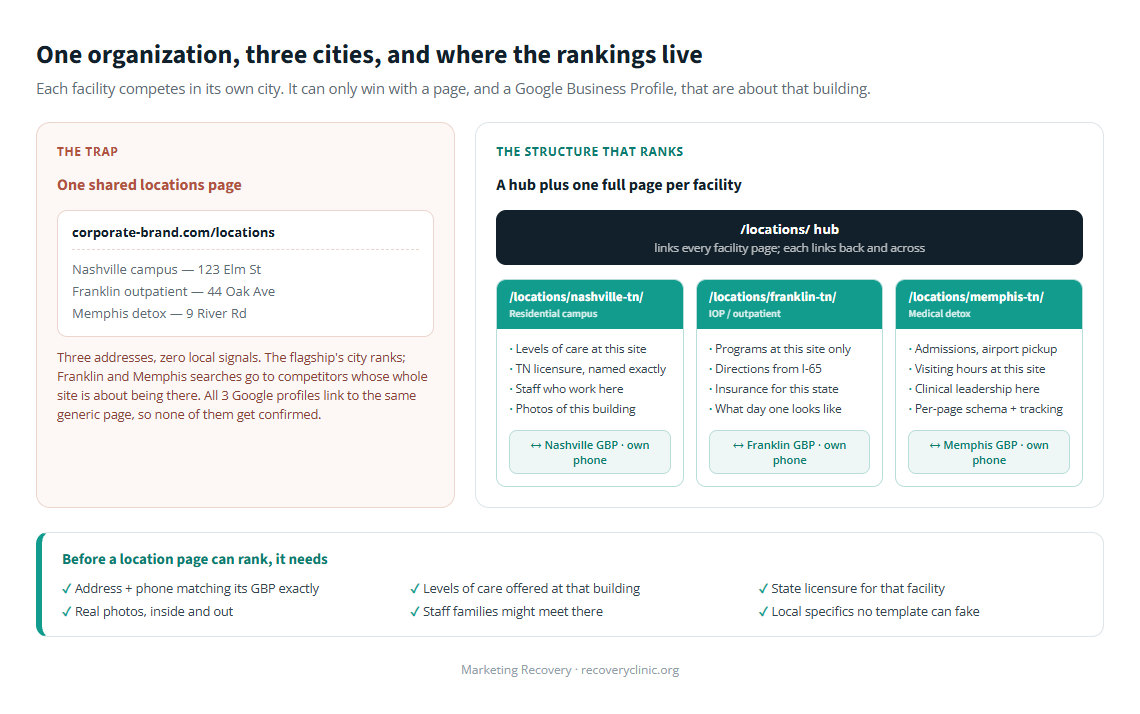
One page per facility, each carrying its own local signals, beats one corporate locations page carrying none. The checklist band shows what each page needs before it can rank.
Why the corporate site loses local searches
Google's local results are city-scoped. When someone in Franklin searches for an IOP, Google looks for pages and profiles that are about treatment in Franklin. A corporate homepage that says "locations across Tennessee" is about the organization, not about Franklin, so the map pack passes it over. The same logic we walked through for local SEO for treatment centers applies at every one of your addresses independently. Each facility competes in its own city, against that city's competitors, with whatever signals point at that specific address.
The mechanics matter here. Each facility should have its own Google Business Profile, and each profile needs a website link that lands on that facility's page, not the homepage. That pairing is the backbone of multi-location local SEO. When four profiles all link to one generic page, Google has no way to connect the Franklin profile to Franklin content, and families who click through get a page that never mentions their town. Both of them notice.
What a real treatment center location page carries
The test for every element: could this only have been written about this facility? A page that passes is unmistakably real to Google and, more to the point, to a parent reading it at 1 AM.
The non-negotiables are the concrete ones. Full address and a facility-specific phone number, matching that facility's Google Business Profile exactly. The levels of care offered at that building, because they usually differ by site, and a family driving to your detox listing only to learn detox happens at the other campus is a failure you caused. State licensure for that facility, named the way the state names it. The insurance situation, which can vary by state for regional organizations. Photos of that actual building, inside and out, not the brand photoshoot from the flagship. Staff who work there, especially the clinical and admissions leadership a family might meet.
Then the layer that separates a page that ranks from a page that exists: the local specifics only someone who works there could write. Driving directions from the nearest interstate. Which airports serve out-of-state admissions and how pickup works. Visiting hours and what the first day looks like at that site. This is also exactly the material AI assistants quote when a family asks about options in that city, which is why thin location pages cost you twice now.
One thing to resist: pasting the same 800 words of program description onto every location page and swapping the city name. Google is good at recognizing templated near-duplicates, and the pages end up competing with each other for nothing. Share the brand shell if you like, but the body of each page has to be about the building. If two of your facilities genuinely offer identical programming, write about what differs anyway. The staff differs. The referral relationships differ. The building differs.
Structure that helps every page
The architecture is simple and worth doing properly. A locations hub at something like /locations/ links to every facility page. Each facility page links back to the hub, across to its sister facilities where relevant ("our residential campus in Nashville" from the outpatient page), and down to any program detail pages for that site. Facility URLs should be readable and stable: /locations/franklin-tn/ beats /location-2/. If your organization operates under one brand, keep everything on one domain. Splitting each facility onto its own microsite divides your authority into pieces just when you need it pooled.
For organizations at the larger end, add LocalBusiness or MedicalOrganization schema per location page, each with that facility's own address and phone, so the corporate entity and the facilities stay unambiguous to crawlers.
A word on measurement, because multi-site reporting hides problems: track calls per facility page, not just calls to the organization. One treatment organization we worked with grew from near zero to 300 or more tracked calls a month, and the per-location breakdown is what made the number useful. It shows which facility pages pull their weight and which city needs work, which is the difference between an SEO report and a decision.
The mistakes that quietly cap you
The most common one is centralizing everything. One admissions number on every page, one contact form, one photo set, one tone. Operationally convenient, and it strips out every signal that makes a location page local. The second is the burying problem, where facility pages exist but sit four clicks deep with no hub, so neither families nor crawlers find them. The third is letting a closed or relocated facility's page and profile linger. In this industry a stale address does more than confuse Google. A family showing up at a building you left is a reputational event, and profile inconsistency is one of the triggers we covered in the Google Business Profile suspension post.
None of this requires a big site. Three facilities means three real pages, a hub, three clean profiles, and honest per-site tracking. It's a few weeks of focused work, and it tends to outperform months of corporate-level content because it meets the search where it happens, in the facility's own city.
See what families in each city find
The fastest way to know whether your locations are invisible is to check what actually comes back. Run the free AI visibility check for each facility's city, not just your headquarters, and see whether AI assistants name your organization or a competitor at every address you operate. If the picture isn't what you want, request a free audit and we'll map what each location page is missing, facility by facility.
About the author
Zac Spencer is an online marketing specialist and the owner of Crave Media, based in Salt Lake City, Utah. Since 2013 he has managed hundreds of Google Ads accounts across dozens of industries, and founded Marketing Recovery, a specialized arm of Crave Media focused on marketing for licensed addiction treatment centers.