A family choosing a treatment center is making one of the highest-stakes purchasing decisions of their lives with almost no way to judge the product. They can't tour the clinical program. They can't interview the medical director. They can't tell from a website whether the "evidence-based care" every center promises is real in one place and a phrase in another.
So they look for proxies, and accreditation is the strongest one that exists. A Joint Commission Gold Seal or a CARF accreditation is a third party with no stake in the admission saying: we inspected this organization against published standards, and it passed. In a field where families have been burned by patient brokering and billboard rehabs, that outside voice does marketing work nothing you say about yourself can do.
This post covers where accreditation earns its keep in treatment center marketing, and the compliance rules for talking about it. One thing to state plainly up front, because it's the mistake that gets centers in trouble: accreditation belongs to the center. A marketing agency can help you say it correctly and put it where families will see it. Nobody in marketing can grant it, speed it up, or substitute for it.
What the two big names mean
The Joint Commission (many people still say JCAHO) and CARF International are the two accreditors families are most likely to recognize in behavioral health. Both work the same basic way: the organization applies, gets surveyed on site against a standards manual covering clinical practice, safety, staffing, and governance, and then has to keep earning it, with accreditation cycles that run one to three years depending on the accreditor and program.
The differences matter less for marketing than the overlap. Either seal means an outside surveyor walked the halls, pulled charts, and checked the program against standards the center didn't write. That's the sentence, in whatever words you choose, that a family actually needs to hear.
What accreditation is not: a licensure substitute, an outcome guarantee, or a ranking of quality among accredited centers. Keep those distinctions straight internally, because the marketing rules below all flow from them.
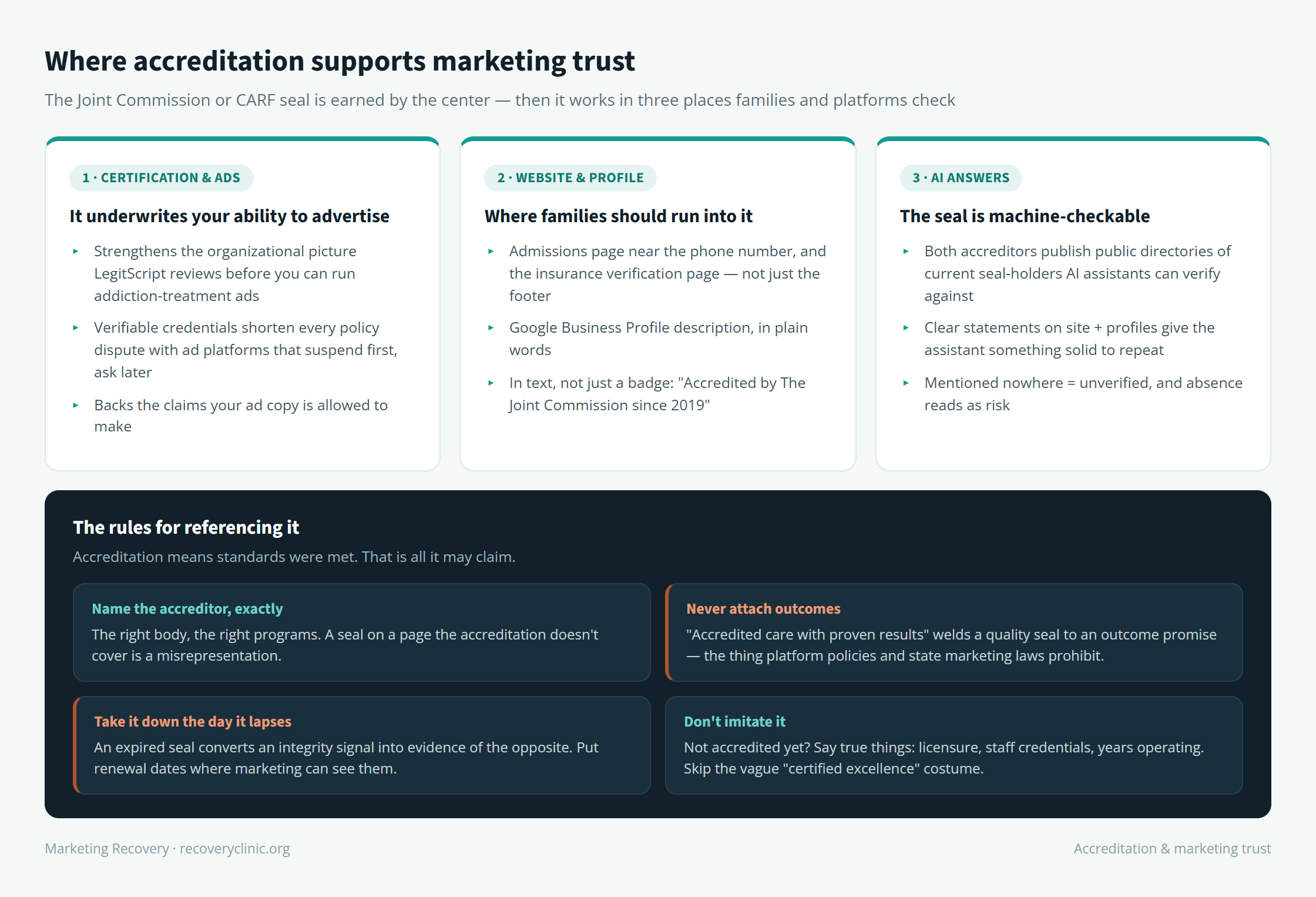
The three places an accreditation does marketing work, and the rules that keep referencing it compliant.
It underwrites your ability to advertise at all
Before accreditation persuades a single family, it does quieter work: it holds up your certification file. Advertising addiction treatment on Google or Meta requires LegitScript certification, and LegitScript's review looks at whether your organization is what it claims to be: licensure, ownership transparency, clinical staffing, and the credentials behind your program. Accreditation from a recognized body strengthens exactly the picture that review is trying to form.
It keeps mattering after approval. Ad platforms in this vertical suspend first and ask questions later, as we covered in why Google suspends treatment center ad accounts, and an organization whose public claims are backed by current, verifiable credentials is simply a harder target for a policy misunderstanding. Accreditation doesn't make you suspension-proof. It makes every dispute about who you are shorter.
Where families should run into it
On most treatment sites the seal sits in the footer. It belongs where decisions happen. The admissions page, near the phone number. The insurance verification page, where a nervous family is deciding whether to hand over personal information. Accreditors provide official versions of their seals to licensed organizations along with usage guidelines; use those files, not a screenshot someone saved three redesigns ago.
Your Google Business Profile and the major directories are the next stop, since families vet centers there before they ever reach your site. Accreditation belongs in your profile description in plain words, alongside the review reputation we covered in getting Google reviews without breaking HIPAA: the seal says an inspector trusted you, reviews say families did, and a center that can show both is answering the two questions every family is silently asking.
Say it in words, too, not just imagery. "Accredited by The Joint Commission since 2019" in your site copy does more than a badge alone, because text is what gets read aloud, quoted by admissions teams, and picked up by the machines in the next section.
AI answers made the seal machine-readable
When a family asks ChatGPT or Gemini to help vet a center by name, the assistant reaches for facts it can verify, and accreditation is one of the few quality signals in this industry that is independently checkable: both major accreditors publish directories of who currently holds their seal. A center whose accreditation is stated clearly on its site, its profiles, and those registries gives the assistant something solid to repeat. A center that mentions it nowhere reads as unverified, and in this field, absence reads as risk.
We walked through that vetting stage in the family AI-search journey, and accreditation is one of the cheapest wins in it, because the hard part (earning the seal) is already done. The marketing failure is centers that hold a current accreditation and mention it in a PDF nobody indexed.
The rules for talking about it
Referencing accreditation is compliance-sensitive, and the rules are short enough to memorize.
Name the accreditor and get the details right. "Joint Commission accredited" when you hold CARF, or a seal on a program the accreditation doesn't cover, is a misrepresentation even when it's sloppiness rather than deceit. If only your residential program is accredited, don't let the badge sit on the IOP page implying otherwise.
Never attach outcomes to it. Accreditation means standards were met, and that is all it may claim. "Joint Commission accredited" is fine. "Accredited care with proven results" welds a quality seal to an outcome promise, and outcome promises are exactly what platform policies and state marketing laws in this industry prohibit.
Keep it current, and take it down the day it lapses. An expired seal on a live website is worse than no seal, because it converts an integrity signal into evidence of the opposite. Put renewal dates on a calendar that marketing can see, not just compliance.
And don't rent credibility you haven't earned. A center that isn't accredited yet should say true things (state licensure, staff credentials, years operating) rather than dressing pages in vague "certified excellence" language that imitates the real thing. Families have learned to check.
The seal only amplifies what's already there
Accreditation supports marketing trust. It won't build a marketing strategy or answer the phone, and we've seen accredited centers lose admissions daily to less-credentialed competitors who simply respond faster and explain themselves better. The seal is a multiplier on visibility and follow-through, which is why it shows up in this blog as one input among many rather than a strategy of its own.
If you hold an accreditation, the audit question is cheap: does it appear, correctly and in text, at every point where a family or an algorithm evaluates you? Ask us for a free audit and we'll show you where it's missing, along with everything else Google and the AI assistants currently see when a family checks you out.

About the author
Zac Spencer is an online marketing specialist and the owner of Crave Media, based in Salt Lake City, Utah. Since 2013 he has managed hundreds of Google Ads accounts across dozens of industries, and founded Marketing Recovery, a specialized arm of Crave Media focused on marketing for licensed addiction treatment centers.