Strategy · September 8, 2026
Sober living and outpatient marketing, where the rules differ

By Zac Spencer
Two businesses that only look alike
From the street, a sober living home and an outpatient program can seem like neighbors in the same industry. Both serve people in recovery, both get found by desperate families, and both get lumped under "rehab" in casual conversation. But sober living marketing runs under a different set of rules than outpatient marketing, because one of these businesses is housing and the other is healthcare, and regulators, ad platforms, and referral partners all treat that line as the line.
Get the two playbooks confused and the failure modes are ugly: a sober living home making clinical claims it has no license to back, or an outpatient program marketed like a landlord filling beds. This post walks the line between them.
Housing or healthcare, the line that sets the rules
A sober living home (a recovery residence, in the trade) provides structured, substance-free housing: house rules, accountability, peers in recovery, often a house manager. In most states, that's not licensed healthcare, because no treatment is being delivered under that roof.
An outpatient program is the opposite case. An IOP or PHP is licensed clinical care with credentialed staff, treatment plans, and, usually, insurance billing. Everything about how it can describe itself flows from that license.
Everything in the marketing follows from which side of the line you're on. The license determines what you can claim, the claims determine what the platforms let you run, and the business model determines who you're even talking to: an outpatient program sells care to a patient and an insurance company, while a sober living home rents structure and stability, usually for cash, by the week or month.
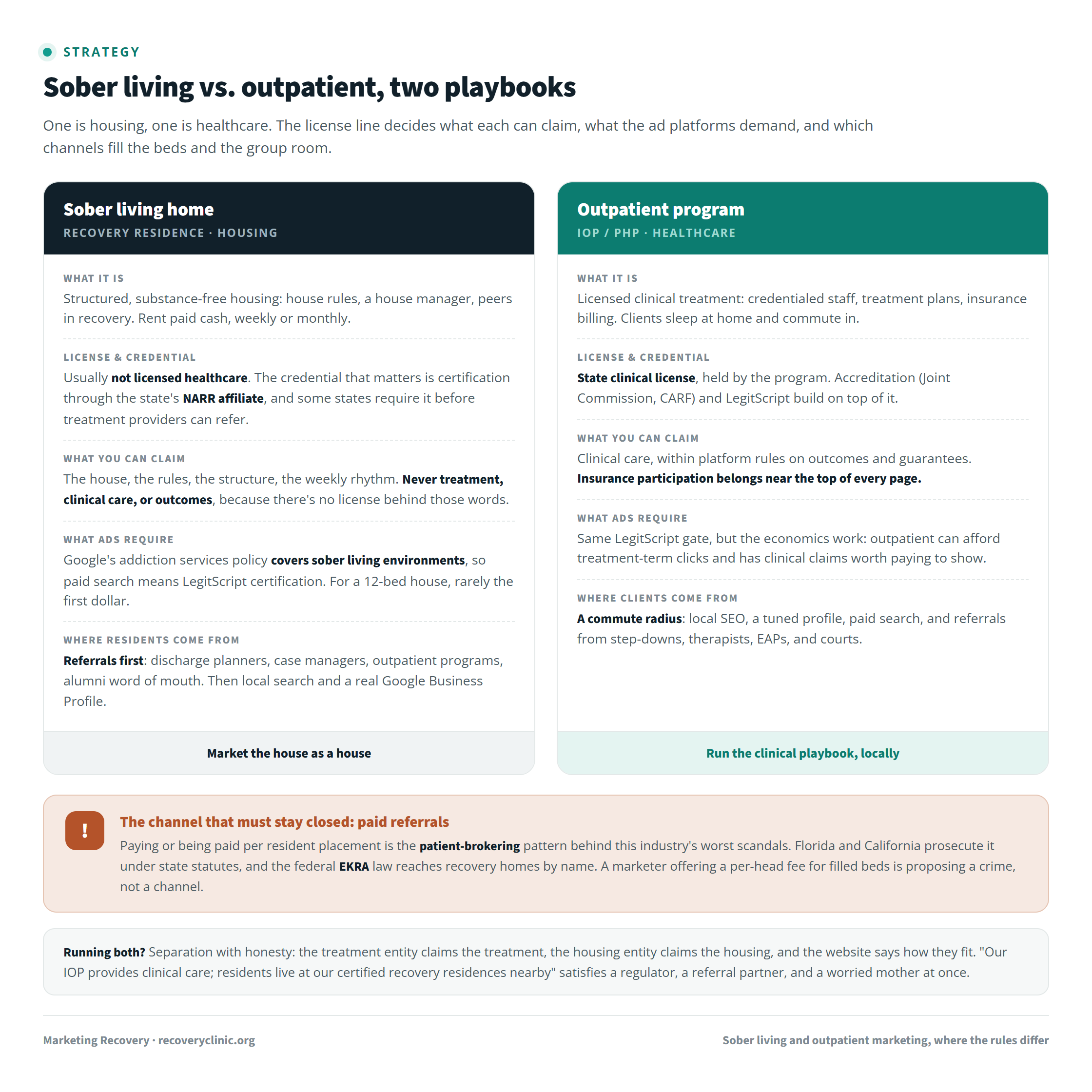
Housing on one side, healthcare on the other. The license line decides the claims, the ad requirements, and the channel mix.
What a sober living home can say
The honest pitch for a good sober living home is strong on its own: structure, accountability, a substance-free house, peers who are further along, a manager who notices. Families want every one of those things, and a website that describes the actual house, the actual rules, and the actual weekly rhythm will out-convert a vague one.
What an unlicensed residence can't do is drift into treatment language. "We treat addiction," "our program heals," "clinical support on site," success-rate percentages: each of those is a claim that requires a license the house doesn't hold, and in several states that drift is a statutory violation, not just a bad look. The safe and honest frame is what the house is, not what it cures. If residents attend an IOP down the road, say that, and name the arrangement plainly.
The credential worth marketing is certification through your state's NARR affiliate (the National Alliance for Recovery Residences standard). It's voluntary in many states, but it's the closest thing sober living has to the accreditation logic we described for treatment centers: a third party vouching for standards, in a category where families have been burned before. Some states now require it before licensed treatment providers can refer to you at all, which makes it a referral asset as much as a trust badge.
The ad platforms draw no distinction
You might expect sober living, as unlicensed housing, to escape the advertising rules that govern treatment. Google goes the other way. Its addiction services policy explicitly covers sober living environments, which means running Google Ads for a recovery residence in the US requires the same LegitScript certification gate that treatment centers pass through, and LegitScript maintains a certification track for recovery residences specifically. Meta's rules run in the same spirit.
So paid search is available to a certified sober living home, but for most, it's the wrong first dollar anyway. The searches are lower-volume than treatment terms, and the payoff of certification for a 12-bed house rarely races ahead of the cheaper channels below. An outpatient program can justify the certification and the ad budget; a standalone recovery residence usually gets there later, if at all.
Where residents come from
Most beds in a good sober living home fill through referral, and that pipeline is the real marketing plan. Discharge planners and case managers at residential programs need trustworthy step-down housing every single week. Outpatient programs want stable housing for clients who live in chaos. Alumni tell each other where the good houses are. A monthly touchpoint with a dozen referring professionals, a one-page fact sheet they can hand a family, and a reputation for taking the house rules seriously will fill beds for years.
The second channel is local search. "Sober living in [city]" and "halfway house near me" are Google Business Profile queries, and the local playbook we laid out for treatment centers ranking in their city carries over almost wholesale: accurate profile, real photos of the house, consistent name and address, and reviews handled with the same care for privacy that applies across recovery marketing.
The channel that must stay closed is paid referrals. Paying, or being paid, for resident placements is the patient-brokering pattern that produced this industry's worst scandals, and it's now a crime in the places it flourished. Florida and California prosecute it under state brokering statutes, and the federal EKRA statute reaches recovery homes by name. If a marketer proposes a per-head fee for filling your beds, that's not a channel. That's an exit sign.
Outpatient runs the clinical playbook
Outpatient marketing is treatment marketing, with the geography turned up. We covered the level-of-care logic in why detox, residential, and IOP need different marketing: IOP clients sleep at home, so the real market is a commute radius, the searcher is often employed and privacy-conscious, and local SEO plus referral relationships beat big paid budgets. The license permits clinical claims, within the platform rules on outcomes and guarantees, and insurance participation belongs near the top of every page, because "do you take my plan" is the first question an outpatient prospect asks.
The two channel mixes end up looking different for structural reasons. Outpatient can afford paid search economics and can talk about care. Sober living wins on referrals, local presence, and word of mouth, and mostly can't say the things expensive clicks are bought with.
When one organization runs both
Plenty of operators pair an IOP with recovery housing, and the combination is clinically sensible and operationally common. The marketing rule for the pair is separation with honesty: the treatment entity claims the treatment, the housing entity claims the housing, and the website says out loud how they fit together. "Our IOP provides clinical care; residents live at our certified recovery residences nearby" is a clean sentence that satisfies a regulator, a referral partner, and a worried mother at the same time.
What tangles organizations up is blurring it, marketing the house as if the license covered it, or quietly bundling rent into claims about care. The blurred version reads better in a headline and worse in an audit. Keep the entities distinct on paper and in copy, and the pairing becomes a genuine advantage: families get a coordinated answer, and each side feeds the other referrals it can stand behind.
Market the house as a house
A sober living home doesn't need to borrow treatment language to be worth choosing. A well-run house is the product, and the families searching at midnight can tell a landlord from a lifeline.
If you run a residence, an outpatient program, or both and want a second set of eyes on which claims, channels, and certifications fit which entity, request a free audit and we'll map it with you.
About the author
Zac Spencer is an online marketing specialist and the owner of Crave Media, based in Salt Lake City, Utah. Since 2013 he has managed hundreds of Google Ads accounts across dozens of industries, and founded Marketing Recovery, a specialized arm of Crave Media focused on marketing for licensed addiction treatment centers.