Google Ads · November 10, 2026
Setting a rehab Google Ads ad schedule for the holidays

By Zac Spencer
It's 9:40 PM on Thanksgiving. A woman parked in her parents' driveway searches for detox near her brother's apartment, sees your ad, and taps the call button. The phone rings eight times and goes to voicemail. She doesn't leave a message. She goes back to the results and taps the next ad.
You paid for that click, somewhere between $25 and well past $150 in this category, and nobody on your team will know the call happened unless someone reads the missed-call log. A paid click that rings an unanswered phone is the most expensive click in the account: you paid full price, and the family learned your number doesn't pick up. Your rehab Google Ads ad schedule is the setting that decides how often that happens between now and New Year's.
Whether to spend in December at all is a separate question, covered in addiction treatment seasonal demand. This post is about the hours: when your ads run, when the call button shows, and who picks up.
Start with the roster, not the ad account
Before anyone touches Google Ads, get the real admissions roster for every day from Thanksgiving (Thursday, November 26) through New Year's Day (Friday, January 1): who is on, and from what time to what time. Not the "24/7" in the website footer.
Holiday rosters are where the gaps live. Christmas Eve and New Year's Eve both fall on a Thursday this year, so a lot of programs will run thin across two four-day stretches. The overnight coordinator takes Christmas off, and the on-call phone goes to a clinician who is also covering a unit.
Sort every hour of those five weeks into one of three buckets:
- A person who can screen, take insurance information, and set a next step picks up.
- An answering service picks up and warm-transfers to someone on call within a few minutes. Count this as covered only after you've tested the transfer at the hour in question.
- Nobody picks up live. Voicemail, a message-taking service that calls back in the morning, or a phone that rings out.
The ad account cares about the third bucket. In the rosters we've reviewed, even programs that advertise 24/7 often have overnight weekend hours sitting in it, and the holidays add more.
What a Google Ads schedule can and can't do
A campaign's ad schedule sets the days and hours your ads can show. The default is all day, every day. You can narrow it in 15-minute blocks, and you can attach a bid adjustment to each block, anywhere from -90% to +900% according to Google's bid adjustment help page.
The schedule runs on the account's time zone, not the searcher's or the facility's. If an agency in another state set your account up years ago, check it, because a schedule built for 8 PM Eastern is an hour off in an account set to Central.
A campaign schedule also repeats weekly. It knows "Thursday," not "Thanksgiving," and there's no field that tells it November 26 is different from November 19. So holiday changes get made by a person on a date and reversed afterward. Put each one on the admissions calendar with a name next to it, including the change back.
The limit that surprises people most is bidding. Smart Bidding ignores those adjustments, and Google says so plainly: its strategies "don't use your manual bid adjustments (for example, +20% on Saturdays)," though "they do respect your Ad Schedule settings." Put a -50% adjustment on Christmas night in a detox campaign running Maximize Conversions or Target CPA and nothing changes. Only the on/off hours count.
Don't run call assets in hours nobody answers
The call asset is the phone number and call button on your ads, which lets a mobile searcher call without visiting your site. In our experience it's where most of a treatment account's after-hours waste comes from, because a call button is a promise that a person is there.
Google gives you the control. Under the asset's advanced options, you can schedule a call asset to show only on certain days and hours. Google's own example, from the call assets help page, is "only when your business is answering phone calls." Asset scheduling also takes start and end dates, which makes it the closest thing Google offers to a holiday-specific setting.
If an hour sits in the third bucket, the call asset shouldn't show in that hour. We don't make an exception for the message-taking service, either. A family calling a detox line at 11 PM is not leaving a message for a callback at 9 AM, and a paid call that ends in a message is still a missed call from where they sit.
Turning off the call asset doesn't mean turning off the ad. The ad can keep running and send the click to your landing page instead, where the form, a text line if you have one, and honest hours copy take over. We walk through what has to sit behind each of those channels in live chat, text, and after-hours coverage for treatment centers. A page that says "admissions returns calls from 7 AM, or text us now" gives a family a choice. Eight rings doesn't.
Two places to check once the call asset is scheduled. If you run location assets, they can put your Business Profile's phone number on the ad too, and that number has its own hours to get right. And for any campaign built around calls instead of site visits, the ad schedule is the call schedule.
Bid down or switch off
Whether a campaign should be live at 2 AM on December 26 depends on what's behind the phone and how you bid. On Manual CPC or Maximize Clicks, a schedule bid adjustment works. A -90% adjustment overnight keeps a thin presence on your most valuable terms while spending little. On Smart Bidding you're down to two levers, the schedule and the call asset.
By level of care, this is how we'd usually set it:
- Branded search stays on all night. People search your name over the holidays, and if you're not there, a lookalike directory or a competitor bidding on your name may be.
- Detox depends on whether detox admits overnight. If it does, leave everything on and test the overnight phone yourself before the 26th. If it doesn't, keep the ad running to the landing page and turn the call asset off for those hours.
- Residential research terms ("residential treatment for alcohol," "how long is rehab") can usually go dark overnight during the holiday weeks. Those families are planning, and they'll search again in the morning.
- IOP runs on work calendars. Many IOP offices are closed on the holidays themselves, and the campaign can follow the office.
Don't count on Smart Bidding to sort this out. A 15-second missed call won't meet the default 60-second length for Google's "Calls from ads" conversion, so the system may eventually learn those hours convert poorly, but it keeps buying clicks while it learns.
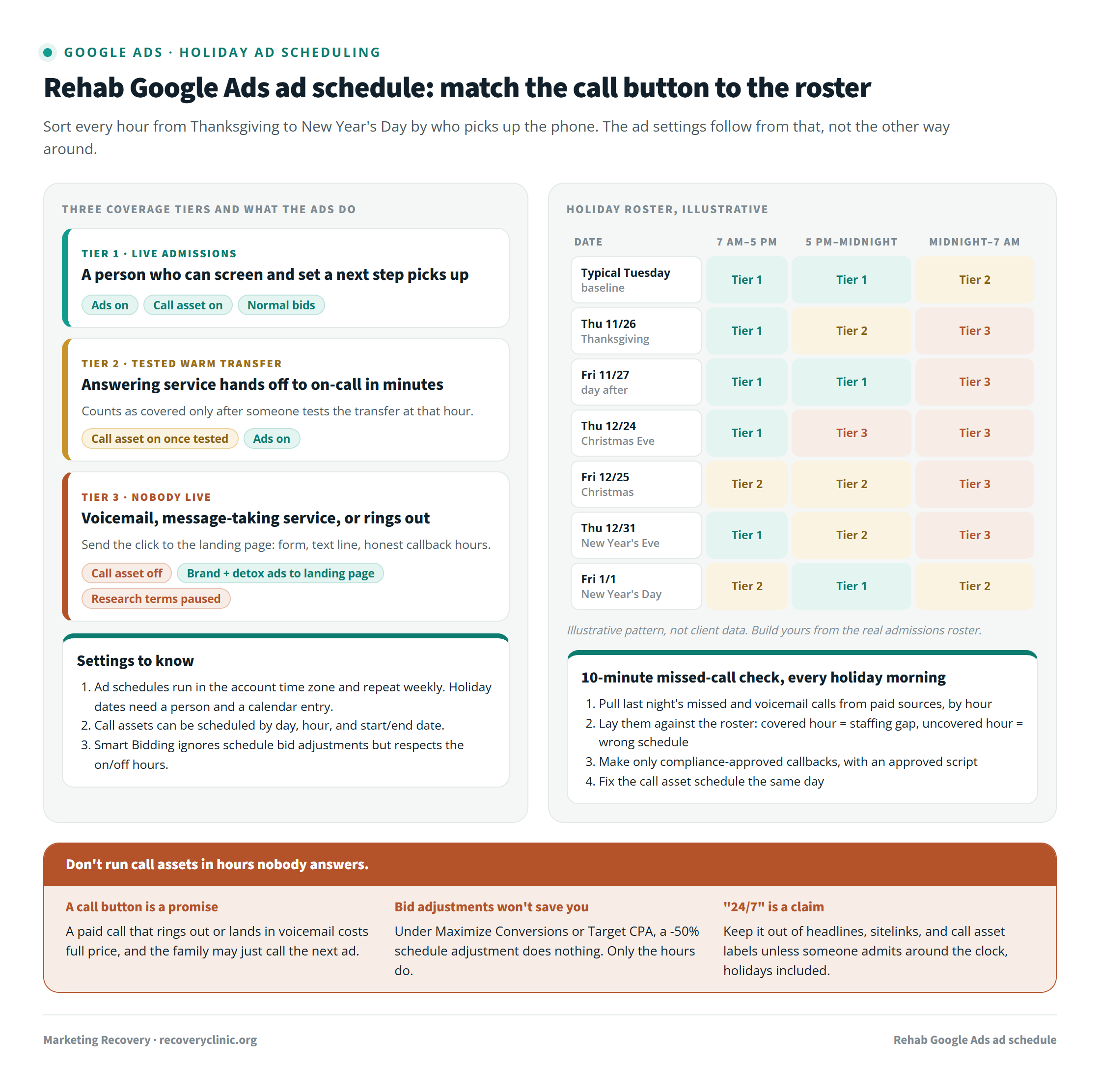
Matching a rehab Google Ads ad schedule and call asset hours to whoever is on the phone. The calendar is illustrative; build yours from your own roster.
Read the missed calls every morning
Two sources cover this, and they answer different questions. If call reporting is on, Google Ads uses Google forwarding numbers on your call assets and logs every call that comes through them. The call details report lists each call's start time, duration, area code, campaign, and a status of missed or received. Google's call details help page shows where to find it, under Insights and reports, then Report editor, then Call details. Count calls and call conversions separately. A phone call has no length requirement. A call conversion does, so your total calls will always run higher than your conversions, and the gap between them is where the short, unanswered calls hide.
Your own call tracking platform covers what Google can't: the website's tracked numbers, which coordinator answered, voicemails, and hang-ups in the queue. Since admissions calls carry health information, that vendor should be under a business associate agreement.
During the holiday weeks, give one person a 10-minute check every morning:
- Pull last night's missed and voicemail calls from paid sources, by hour.
- Lay them against the roster. A missed call in a covered hour is a staffing problem. A missed call in an uncovered hour means the call asset or schedule is wrong.
- Follow up on the callbacks your compliance officer has approved, using a script they've signed off on. The person who called may share that phone with family, so the voicemail you leave has to work if someone else hears it.
- Fix the schedule the same day.
Then divide paid spend by answered calls instead of total calls. That number is uglier, and it's the one that ties to admissions. Our breakdown of what a good cost per call looks like explains why cheap calls are often the worst ones; an unanswered call is the extreme case.
When 24/7 really means 24/7
Plenty of centers advertise 24/7 admissions, and fewer have tested it on a holiday. Before Thanksgiving, have someone outside the admissions team call the tracking number on your ads at 2 AM on a weekend night, then again on Christmas Eve. Count the rings. Note who picks up, and whether they can take insurance details and set a next step or only take a message.
If the honest answer is "voicemail after midnight," change the copy before you change the schedule. "24/7" in a headline, a sitelink, or a call asset label is a claim, and the ad has to keep it. Google only lets certified programs advertise addiction treatment in the U.S. at all: its healthcare and medicines policy requires LegitScript certification plus Google's own certification. That certification belongs to your program. Protect it with ads that describe the program as it runs on December 25, not on a well-staffed Tuesday in March.
The fix doesn't have to be a bigger roster. "Admissions available 7 AM to midnight, every day including holidays" is a fine thing to say, and families can plan around it. A promise of around-the-clock coverage that falls apart at 1 AM is worse than no promise.
Show the call button only when someone's there
Go back to the woman in the driveway on Thanksgiving night. If nobody was going to answer at 9:40 PM, the best version of that ad would have had no call button. She'd have landed on a page with a form, a text line, and an honest time for a callback. Maybe she'd have used it and maybe not, but she wouldn't have sat in the car listening to your phone ring.
The roster for November 26 through January 1 exists somewhere already, probably in a scheduling spreadsheet the marketing side has never seen. Get a copy this week and build the call asset schedule from it.
Setting schedules, call assets, and call reporting around a real admissions roster is part of our Google Ads management for treatment centers. Your licensing, accreditation, and LegitScript certification stay with your program, and we never buy or broker leads. If you'd like someone to compare last December's missed calls against your ad schedule before Thanksgiving, request a free audit.
About the author
Zac Spencer is an online marketing specialist and the owner of Crave Media, based in Salt Lake City, Utah. Since 2013 he has managed hundreds of Google Ads accounts across dozens of industries, and founded Marketing Recovery, a specialized arm of Crave Media focused on marketing for licensed addiction treatment centers.