AI Search Visibility · November 3, 2026
When AI gets your treatment center's facts wrong

By Zac Spencer
Take a fictional program, Juniper Ridge Recovery, a residential and IOP center outside Columbus. A mother asks ChatGPT whether Juniper Ridge takes Ohio Medicaid. It says yes and gives her a phone number. Juniper Ridge dropped Medicaid in 2024, and the number belongs to a location that closed two years ago. She never reaches admissions, and nobody at the center ever learns she tried.
When AI has wrong information about your treatment center, that's usually how it plays out. The error is quiet. The family doesn't complain, they just move to the next name on the list, and AI is now a normal step in how families find rehab, so it happens more than most admissions teams would guess.
Every one of these errors came from somewhere. In nearly every case we've traced, the somewhere is a page or listing the center can find and change.
Why AI has wrong information about your treatment center
An AI assistant doesn't know anything about your program on its own. It repeats what it read, and it reads from a few places.
ChatGPT, Perplexity, Gemini, and Google's AI Overviews all search the live web for questions like "does Juniper Ridge take Medicaid." They pull from whatever ranks or gets indexed for your name: your site, your Google Business Profile, directory listings, news, old PDFs. When they aren't searching, they fall back on what the model learned in training, which can be a year or more out of date. OpenAI's own help page on ChatGPT search warns that results and citations "can be incomplete, outdated, or incorrect," and Google's AI Overviews help page says flatly that overviews "can and will make mistakes."
None of the platforms publish exactly which sources win for local facts, and the mix changes. When BrightLocal ran 800 local searches through ChatGPT in late 2024, 58% of the sources were business websites and 15% were directories. That's a single study from ChatGPT search's first month, so treat it as a rough picture. The broad point holds up in our own checks, though: when an AI gets a treatment center wrong, the bad fact is usually sitting somewhere on the open web, often on a page the center forgot it had.
The errors that cost the most
Four mistakes account for most of what we find when we run treatment centers through AI assistants, and they aren't equally costly.
Insurance
This is the expensive one. A wrong "yes, they take Aetna" sends a family into an admissions call that ends in disappointment, and a wrong "no" removes you from a search before the family ever calls. Insurance errors are also the stickiest, because payer lists show up in more places than any other fact you have. There's your insurance page, a blog post from 2022 announcing a new contract, three or four directories, insurer provider directories, and sometimes a press release on a local news site.
Contracts change and those pages don't. In the audits we've done, the wrong insurance answer almost always traces back to a page that was right when it was published. If your billing team signed or dropped a payer this year, assume at least one page on the web still has the old list.
Levels of care you don't offer
AI assistants blur levels of care. A residential program gets described as offering detox, an IOP gets credited with PHP, or a center that refers out for medication-assisted treatment gets listed as providing it. Sometimes the source is a directory that uses checkboxes broader than your license. Sometimes it's your own page that says "we help clients through every stage of recovery," and the model filled in the rest.
This one carries compliance weight. You can't advertise services you aren't licensed to provide, and a family that calls expecting medical detox is a family you'll have to turn away at a hard moment. Our post on marketing each level of care covers how to describe them precisely.
The old phone number
Usually from a directory listing someone made years ago, or a tracking number from a campaign that ended. If the old number still rings somewhere, fine. If it's disconnected, or reassigned, that's a lost call every time.
Closed, moved, or merged
A second location that closed, an old address from before a move, a former name from before an acquisition. AI will sometimes merge the old and new versions of your center into one confused answer, or tell a family you're closed.
Trace the error to its source
Before you fix anything, find out where the wrong fact lives. Fixing your website does nothing if the bad answer came from a directory.
Start with the AI itself. Ask the same question in ChatGPT, Perplexity, Gemini, and Google, then open the citations. Perplexity and Google show sources by default, and ChatGPT shows them when it searched. If the answer cites a page, you've found your suspect. If it cites nothing, ask it "where did you find that?" The reply isn't always reliable, but it often points in the right direction.
Then search the wrong fact word for word. Put the old phone number in quotes in Google and Bing. Search your center's name plus the payer you dropped. This turns up the forgotten pages fast: an archived location page, a PDF brochure, a 2021 guest post on a recovery blog.
The usual suspects, roughly in the order we check them:
- Your own site, including old pages that still exist but aren't in the menu, PDFs, and blog posts that mention insurance or services
- Your Google Business Profile, plus Bing Places and Apple Business Connect
- SAMHSA's FindTreatment.gov, which builds its listings from the annual N-SUMHSS survey
- Psychology Today and other directories where your center has a profile
- Rehab directory sites, including lead-generation sites built to look like neutral directories
- Insurer provider directories and your state's licensing or behavioral health directory
Directories show up on this list a lot, for the same reasons AI often names a directory instead of your center: they're structured and they've been around for years, which makes them look trustworthy to a model.
Keep a simple sheet as you go: the wrong fact, which AI said it, the source URL, and who controls that source. That last column decides what you can fix and how fast.
Fix it upstream, not in the chat
Every platform has a feedback button. Google has thumbs down and "Report a problem" on each overview, Perplexity has a flag icon under each answer, and ChatGPT has its own thumbs down. Use them, but don't expect much. We've never seen a single feedback click correct a business fact in a way we could measure, and none of these buttons changes the page the AI read. Correcting the chat is the least useful thing you can do. Correct the source, and the answer usually follows the next time the AI searches.
What fixing the source looks like depends on who owns it.
Your own site
Update the facts, and don't stop at the page you remember. An old location page or PDF with no reason to exist should come down, with its URL redirected to the right page. Then put your core facts (levels of care, payers you're in network with, address, admissions number, hours) in one plain-language place on your site and keep it current. Our post on the structured data and content AI assistants cite covers how to format that page so models quote it.
Your Google Business Profile
Anyone can suggest an edit to your profile, including marking it closed or changing the phone number. Google's help page on profile edits says that when a suggestion needs your review, you have 4 days to accept or reject it, and after that Google may publish it if it's supported by other public information, "such as your business website."
That clause cuts both ways. A stale directory listing can look like supporting evidence for a wrong edit, so cleaning up the directories protects the profile too. Somebody on your team should own those notification emails, and it shouldn't be an inbox nobody opens.
FindTreatment.gov and directories you've claimed
SAMHSA refreshes FindTreatment.gov listings every year from your N-SUMHSS survey response. Its FAQ says changes to names, addresses, phone numbers, and services are made weekly for facilities that report them, by email, phone, or an online form. If you skipped the survey, fix that first; completing it each year is what keeps you listed. Psychology Today and most rehab directories let you edit your own profile. The hard part is finding them all, since many of the centers we audit have a listing some former marketing manager set up and nobody has the login for.
Directories you don't control
Send a correction request and keep a record. Some will update. Some won't, and a few lead-generation sites have little reason to. You won't win all of these, so outnumber them: the correct fact should appear in more places, and more trusted places, than the wrong one.
Two compliance notes. Anything you publish about insurance should come from your billing team in their words, since "in network with" and "we work with" mean different things to a family. And the level-of-care language on your site should match your license, approved by your clinical or compliance lead. We help find and fix the listings. The license and the accuracy of what it covers stay with your program.
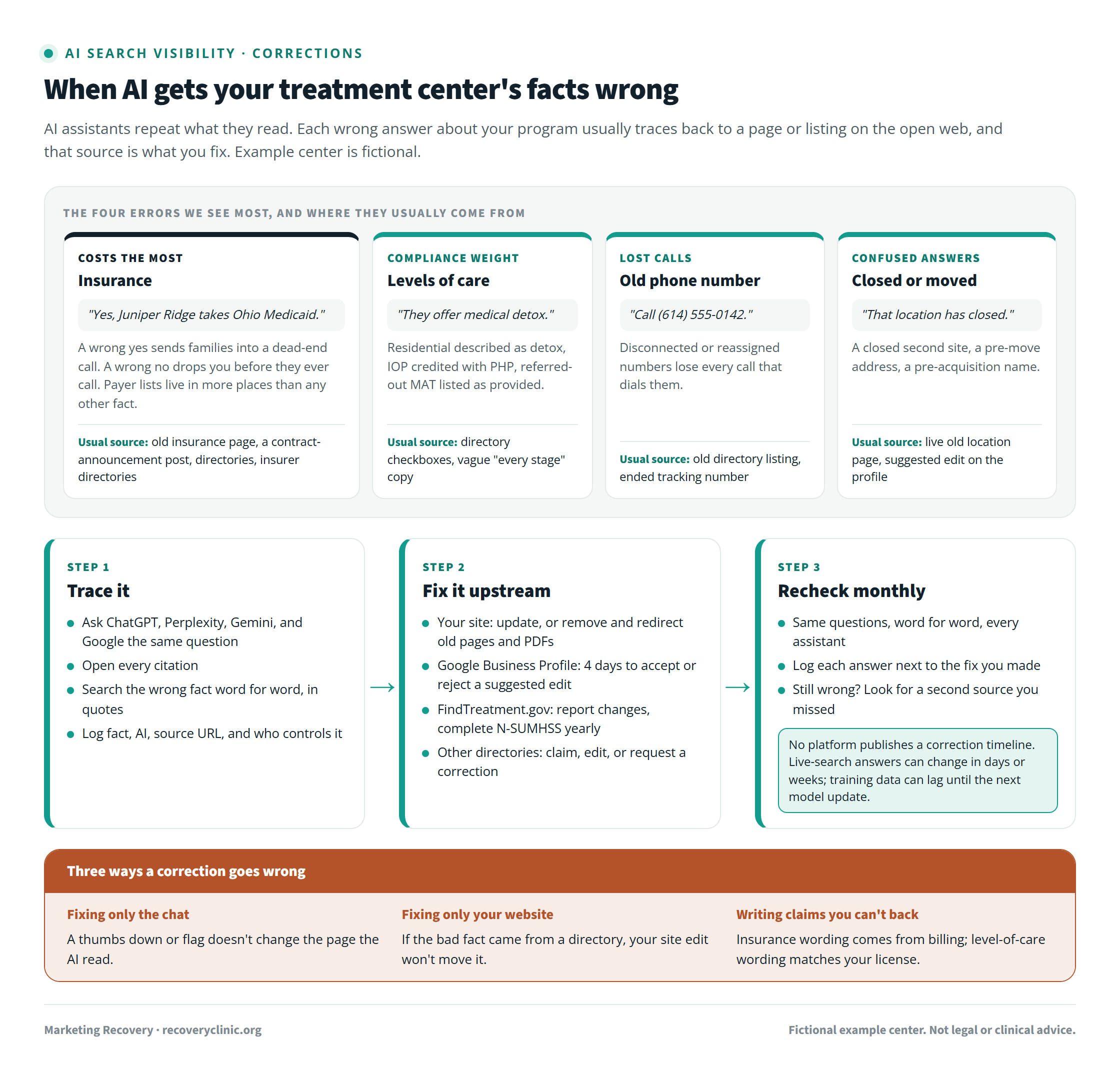
The four errors that most often show up when AI gets a treatment center's facts wrong, where each one usually comes from, and the order to work them.
Recheck on a schedule
Corrections don't show up in AI answers on a timetable anyone publishes. When the AI searches the live web, a fixed source can change the answer within days or weeks. When it leans on training data, the old fact can linger until the next model update. Google's systems recrawl on their own schedule.
So recheck the same questions monthly, word for word, and log what each assistant says next to the fix you made. If the wrong answer persists after the source is clean, search again for a second source you missed. In our experience there usually is one.
For the first pass, our free AI visibility check runs the searches families type against a live, web-searching AI and shows what it says about your center. Listing and citation cleanup is also part of our SEO work for treatment centers, if you'd rather hand it off.
Fix the page the AI read
That mother asking about Medicaid never saw a source. She saw an answer, and the answer came from a 2023 insurance page Juniper Ridge forgot was still live. A thumbs down wouldn't have touched it.
We work only with licensed, accredited programs, and we never buy or broker leads. If AI is telling families the wrong things about your center and you'd like help tracking down where it's reading them, request a free audit.
About the author
Zac Spencer is an online marketing specialist and the owner of Crave Media, based in Salt Lake City, Utah. Since 2013 he has managed hundreds of Google Ads accounts across dozens of industries, and founded Marketing Recovery, a specialized arm of Crave Media focused on marketing for licensed addiction treatment centers.