AI Search Visibility · September 4, 2026
The structured data and content AI assistants cite

By Zac Spencer
Why AI names some centers and not others
When an AI assistant answers "medical detox near Memphis that takes Blue Cross," it is not judging clinical quality. It can't. What it can do is check facts, and the centers it names are the ones whose facts are easy to find, easy to read by machine, and identical everywhere it looks. Structured data is a treatment center's half of that bargain: the markup, the plainly stated policies, and the consistent listings that let a model verify you instead of guessing about you.
We walked through the questions families ask on the way to that moment in the family AI-search journey. This post is about the raw material on your side of it. There are two layers, and centers usually invest in the wrong one first. The invisible layer is schema markup, labels in your site's code that tell a machine what kind of organization you are. The visible layer is the content itself, the concrete sentences a model can lift and repeat. You need both, and the visible layer does more of the work than most SEO conversations admit.
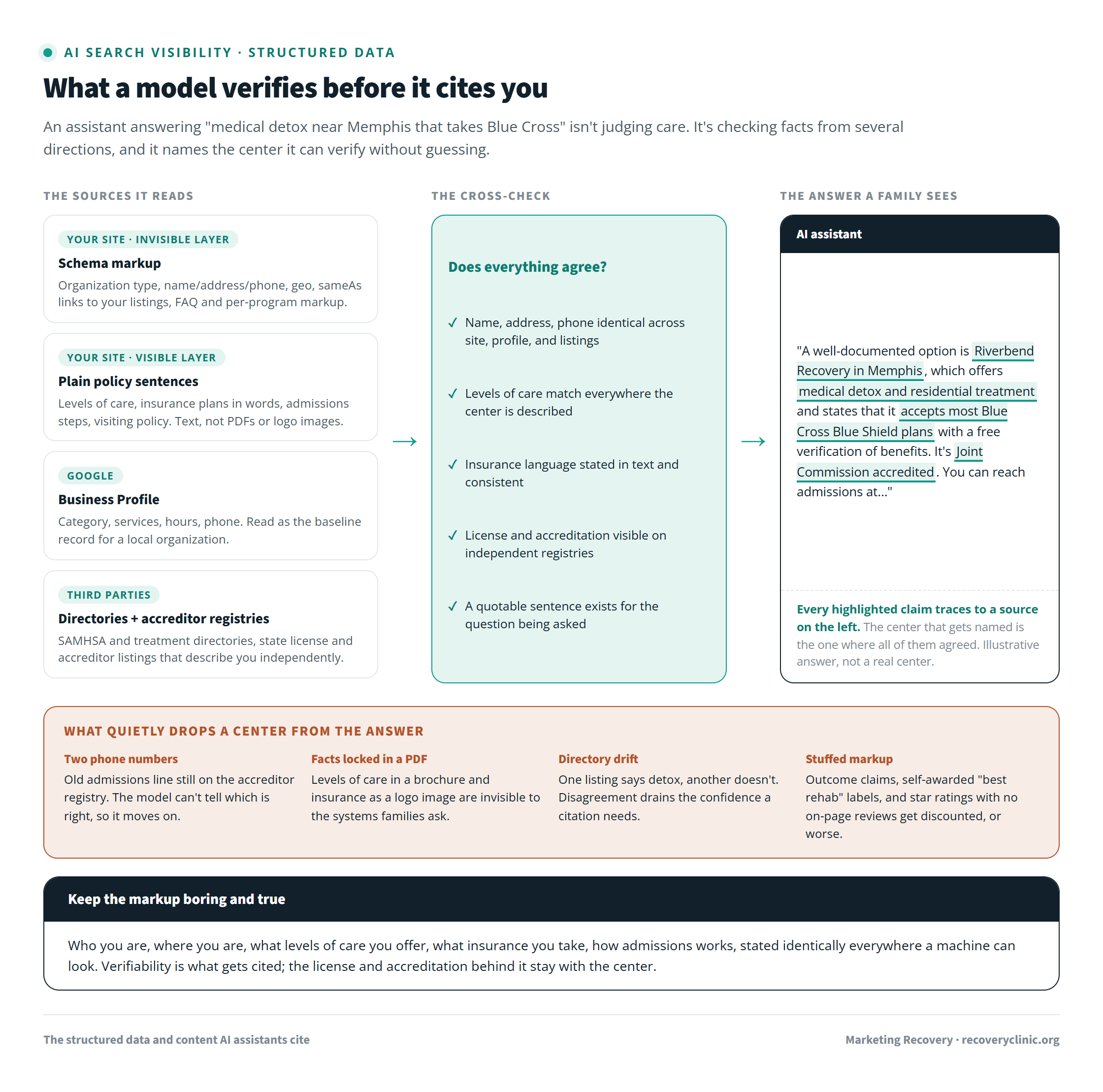
The sources an assistant cross-checks before it names a treatment center, and the mismatches that quietly remove one from the answer.
Schema markup that fits a treatment center
Schema markup is a vocabulary for labeling what's already on the page: this is our legal name, this is our address, these are our hours, this is a frequently asked question and its answer. Search engines have read it for years, and the systems behind AI answers inherit that same preference for labeled, unambiguous data.
Four types earn their place on a treatment center site. An organization type that says what you are, where "MedicalOrganization" or a local-business medical subtype beats a generic business label, with your name, address, phone, and geo coordinates matching your Google Business Profile word for word. A "sameAs" list pointing to your profiles on the directories and accreditor registries that describe you, which hands the model the exact thread to pull when it cross-references. "FAQPage" markup on your genuine questions pages, since a marked-up question-and-answer pair is about the most quotable shape content can take. And a "Service" or program listing for each level of care you offer, on the page about that level of care.
Two honest caveats. Schema is not a ranking factor, and adding it to a thin site changes little. It makes good content unambiguous, which is a different job from making content good. And it takes an hour of a developer's time or a decent plugin, which is exactly why it's worth doing and exactly why it won't differentiate you on its own. The labels only matter if what they label is worth citing, which is where the visible layer comes in.
The plain sentences models quote
Ask an assistant whether a specific center takes a specific insurance plan and watch what it does: it quotes. "According to their website, they accept most Blue Cross Blue Shield plans and offer a free verification of benefits." A model can only do that if the sentence exists, in text, on a page it can reach.
This is where treatment center websites fail, and rarely because the information is secret. The levels of care live in a brochure PDF. The insurance list is an image of logos with no text. Visiting policy is "call for details." Every one of those choices makes a fact invisible to the systems families now ask first. The fix is unglamorous writing: one page per level of care that says who it's for and what a day looks like, an insurance page that names the plans you take in words, an admissions page that describes the actual steps, a visiting and contact policy stated as facts with the consent caveat where it applies.
We made the fuller argument for this kind of content in the questions families search that centers never write about, and the AI angle only sharpens it. One question, one page, answered in complete sentences a model could read aloud. That's the shape that gets cited.
The same facts everywhere the model looks
Assistants don't take your website's word for anything important. Before naming you, the systems they draw on cross-reference: your site against your Google Business Profile, both against the directories AI leans on, all of it against accreditor and state listings. Agreement builds the confidence a model needs to put your name in an answer. Disagreement drains it.
The disagreements we find are almost never lies. They're drift. The center moved its outpatient program across town and updated the website but not the directory. The phone number on the accreditor's registry is the old admissions line. One listing says detox, another doesn't mention it. A model that sees two phone numbers and two service lists doesn't pick the right one; it often just picks a center without the conflict. So the maintenance habit that protects your AI visibility is dull: a quarterly pass through every place your center is described, checking name, address, phone, levels of care, and insurance language against a single source of truth. It's the same discipline that anchors the local-search work in our SEO service, pointed at a newer kind of reader.
What to keep out of your markup
A compliance note, because this niche doesn't get to skip it. Structured data is a place people try to stuff things, and for a treatment center that's a risk, not a growth hack. No outcome claims or success rates anywhere in markup or FAQ answers. No aggregate star ratings marked up unless the reviews genuinely live on that page. No labeling yourself "best rehab" in your own data; models discount self-praise and platforms penalize it. And nothing in an FAQ answer you wouldn't want quoted verbatim to a family in crisis, because quoting verbatim is the whole point.
Keep the markup boring and true: who you are, where you are, what levels of care you offer, what insurance you take, how admissions works. The license and accreditation behind those facts stay yours to hold; no marketer can add them, and no markup can substitute for them.
Find out what AI already says
Before fixing anything, it's worth seeing the current answer. Run the free AI visibility check and you'll see whether assistants recommend your center or hand your city's searches to someone else, which tells you whether your problem is markup, content, or consistency. And if the answer is wrong and you want a plan for changing it, request a free audit and we'll go through your site and your listings together.
The centers AI cites are not the ones with the best copywriting. They're the ones a machine can verify from three directions and quote without guessing. Make your facts easy to check, and you become the safe answer.
About the author
Zac Spencer is an online marketing specialist and the owner of Crave Media, based in Salt Lake City, Utah. Since 2013 he has managed hundreds of Google Ads accounts across dozens of industries, and founded Marketing Recovery, a specialized arm of Crave Media focused on marketing for licensed addiction treatment centers.