AI Search Visibility · October 2, 2026
AI Overviews and the drop in treatment center clicks

By Zac Spencer
Clicks are down and the phones are fine
The monthly report says organic clicks fell 20% from last year. Your admissions director says the phones sound the same as they always have. Both of them can be right, and for a lot of programs right now, both are. A big share of the change in AI Overviews treatment center traffic comes from searches that were never going to ring your phone in the first place.
When we wrote about whether AI is sending families to your competitor, Google's AI Overviews got a single sentence. They deserve more than that, because they're the part of AI search most likely to show up in your own analytics, as a dip that looks like failure and often isn't.
So before anyone panics over the organic line, it helps to know what the studies measured and which of your searches are exposed.
What AI Overviews do to treatment center traffic
The best independent evidence comes from two places. Pew Research Center tracked the real browsing of 900 U.S. adults in March 2025. When a Google results page showed an AI summary, people clicked a regular search result on 8% of visits, against 15% when no summary appeared. They clicked a link inside the summary itself on 1% of visits. And they ended their browsing session entirely more often after a page with a summary (26% versus 16%).
Ahrefs measured the same effect from the publisher side, using Search Console data across 300,000 keywords. Its first study found a 34.5% lower click-through rate for the top-ranking page when an overview was present. When it re-ran the study on December 2025 data, the gap had grown to 58%. Those two snapshots are nine months apart.
Google disputes the framing. In August 2025, Search head Liz Reid wrote that total organic click volume had been "relatively stable" year over year and that Google was sending slightly more "quality clicks," meaning visits where people don't bounce straight back. The post didn't include numbers. Our read is that Google and the researchers are describing different clicks. The ones disappearing are quick, answer-seeking visits. The ones left tend to come from people further along, and in treatment, further along is the family that's about to call.
Which treatment searches get an overview
Ahrefs looked at 146 million results pages and published the triggers in November 2025. Medical queries triggered an overview 44.1% of the time, more than double the rate across all keywords. Local searches triggered one only 7.9% of the time. Commercial keywords sat at 4.3% and transactional ones at 2.1%. Pew found the same tilt from the searcher's side: 60% of queries that started with a question word produced a summary, while only 8% of one- or two-word searches did.
Map that onto how families search. "How long does alcohol withdrawal last" and "what happens on the first day of detox" are long, medical, question-shaped searches, the kind most likely to get an overview. "Detox near me," "rehab in [city]," and your center's name are short, local, or branded, the kind least likely to. Results vary by query and change week to week, so search your own terms in a private window before trusting any of this.
The education clicks were your blog traffic. A parent who read your withdrawal-timeline article at midnight got real value from it, and you counted a session. Very few of those sessions turned into a call that night, though. The call usually came days later, from a different search, often the center's name.
Why clicks can fall while calls hold
When an overview answers the withdrawal question, the parent never visits your article. That's a lost session. Whether it's a lost family depends on what happens next.
If your page was one of the sources the overview drew from, your center's name may have sat right there in the answer. If the parent comes back on Thursday and searches you by name, or searches "detox near me" and sees your Google Business Profile, the call still happens. It just arrives through a door your organic sessions chart doesn't watch. Plenty of those calls never touch the website at all; families tap the call button on your profile and the visit is never recorded.
For many programs the picture looks like this. Informational clicks drop. Branded searches and local-pack calls hold steady, and sometimes they grow. The organic line on the report slopes down while the admissions log looks normal.
That isn't guaranteed. Some centers really are losing ground, and for them the click drop is the first warning they'll get.
Our opinion, and we'd defend it to any board: organic sessions should come off the top line of a treatment center's monthly report. As the headline number, they now punish you for something you can't control and hide the things you can.
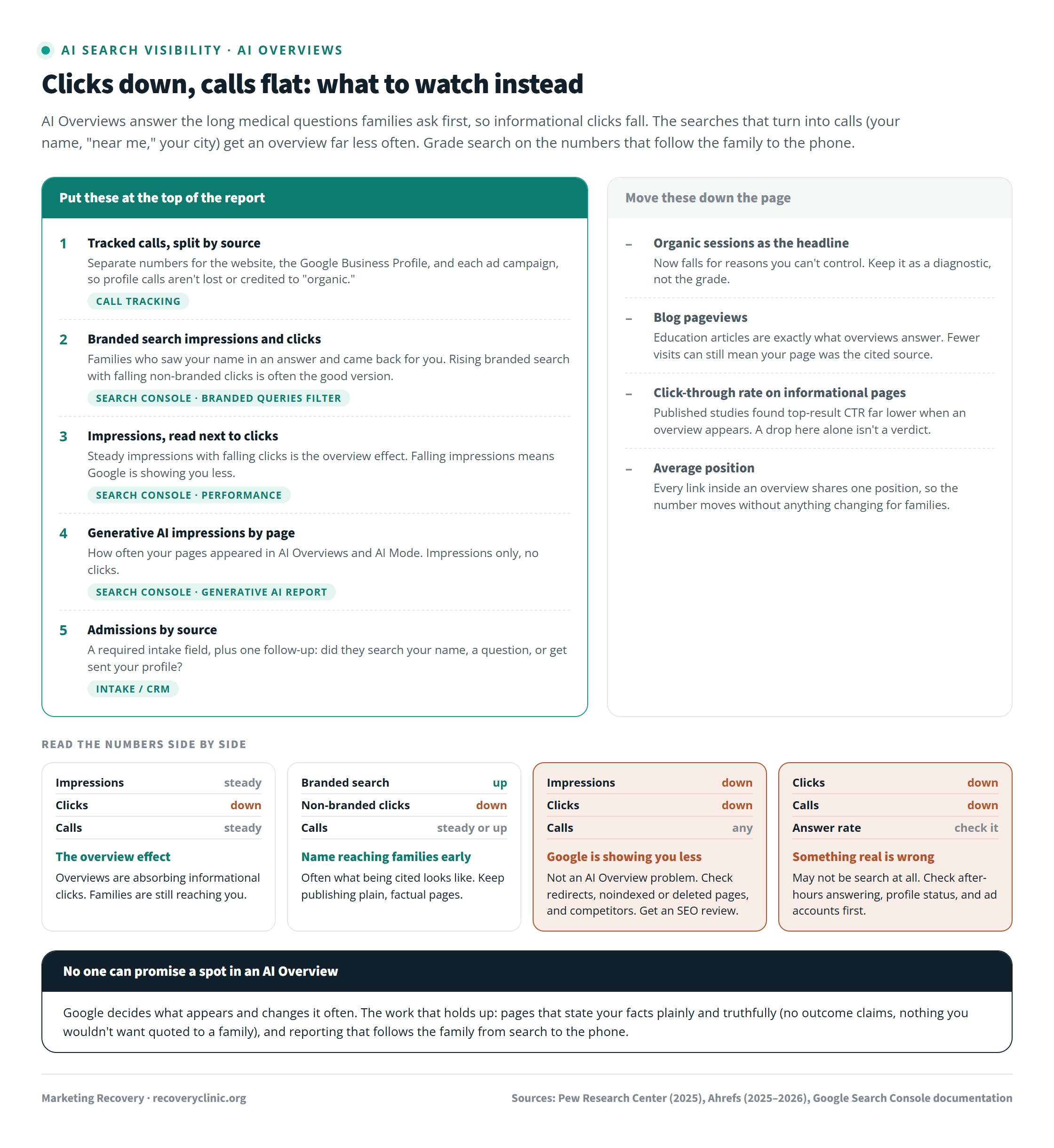
The numbers to put at the top of a treatment center search report once AI Overviews start absorbing informational clicks, and how to read four common patterns.
What to measure instead of clicks
Most of the replacement scoreboard is free, inside tools you already have.
Calls, split by where they came from
Tracked calls are the number that pays the bills, so start there. Give your website, your Google Business Profile, and each ad campaign their own tracking number, so a call from your profile isn't credited to "organic" or lost entirely. We covered the setup in call tracking for treatment centers. If profile calls rise while website sessions fall, families are finding you and skipping the site, which is fine.
Branded search
When a family reads an overview, sees your name, and searches for you later, that shows up as a branded query. Search Console now separates these for you. Google added a branded queries filter to the Performance report in November 2025 and made it available to all eligible sites in March 2026. Google sorts the queries with an AI-assisted classifier, so misspellings of your name count too. It only works on top-level domain properties with enough search volume, and a small single-site program may not see it yet.
Watch branded impressions and clicks month over month. A center whose non-branded clicks fall while branded searches climb is usually being discovered somewhere upstream, very possibly inside an AI answer. The paid side has the same split, which we covered in branded vs non-branded search.
Impressions, read next to clicks
Impressions say whether Google is still showing you, and the widening gap between impressions and clicks is where AI Overviews show up in your data.
Search Console counts a link inside an overview as an impression when it's scrolled or expanded into view, and all links in an overview share a single position, per Google's help documentation. Since June 2026 there's also a Search Generative AI performance report showing how often your pages appeared in AI Overviews and AI Mode, by page, country, device, and date. Google rolled it out to all sites on August 31, 2026. It reports impressions only, no clicks, and that data is already folded into your regular totals. It's still the first direct look most centers have had at whether their pages are being used in AI answers.
Admissions by source
Ask every admitted family how they found you, and record it in a field intake can't skip. Most will say "Google." The follow-up question is where it gets useful: did they search your name, or a question, or did someone send them your profile? Two words in a dropdown won't show you an AI Overview. A sentence typed by an intake coordinator sometimes will.
Reading the patterns side by side
If impressions are steady, clicks are down, and calls are steady, that's the overview effect, and you can mostly leave it alone. Same if branded searches are climbing while non-branded clicks fall. That's your name reaching families before they visit.
The pattern to worry about is impressions falling along with clicks. AI Overviews don't cause that. An overview still counts your link as an impression when it shows, so if impressions are dropping, Google is showing you less, period. The usual causes are duller than AI: a site migration that broke redirects, program pages that got noindexed during a redesign, a level-of-care page someone deleted, or a competitor who spent the last year building the pages you didn't. Pull the Pages tab in Search Console, sort by the biggest impression losses, and the culprit is often in the first few rows. This is the pattern that needs an SEO review, and soon, because every month it runs the hole gets deeper.
Clicks down and calls down is a different problem, and it may not be search at all. Check who answers the phone after hours and whether the Google Business Profile is still live before you blame Google's AI.
Keep writing the educational pages
The article that no longer gets the click is often the source the overview cites, and being cited is how your name reaches a family at 1 AM. Pew's 1% figure means you shouldn't expect much traffic from that citation. You should expect familiarity, which tends to show up later as a branded search.
What changes is how you write it. Overviews and AI assistants lift clear, factual sentences, so the pages that get used are the ones that state their facts plainly. We walked through that in the structured data and content AI assistants cite. And because the sentence may be quoted word for word to a frightened family, everything on the page has to be true today: no outcome claims, no "best rehab," nothing you wouldn't want read back to you.
A note on promises. Nobody can guarantee a center a spot inside an AI Overview, or guarantee that clicks will recover. Google decides what appears and changes it often. What a marketer can do is make your pages easy to cite and your reporting honest about what's happening.
Stop grading search by the click
The click used to be a fair stand-in for a family considering you. On medical questions it mostly isn't anymore. Google now answers the withdrawal question itself, and sometimes it names you while it does. The family that calls on Thursday never shows up in your session count, and the admissions log is where you'll see them.
If you want to know whether AI answers already mention your center, run the free AI visibility check and see what an assistant says when a family asks about treatment in your city. And if your clicks are falling and you can't tell which pattern you're in, request a free audit. We'll read your Search Console and call data together and tell you plainly whether you have a problem.
About the author
Zac Spencer is an online marketing specialist and the owner of Crave Media, based in Salt Lake City, Utah. Since 2013 he has managed hundreds of Google Ads accounts across dozens of industries, and founded Marketing Recovery, a specialized arm of Crave Media focused on marketing for licensed addiction treatment centers.