SEO · November 17, 2026
Why treatment center pages are not indexed by Google

By Zac Spencer
Thirty-one pages Google looked at and passed on
A treatment center publishes 40 new pages over the summer: a page per city it serves, a few program pages, some FAQs. In November someone opens Search Console and finds 31 of them sitting under "Crawled - currently not indexed." The first instinct is to paste each URL into the inspection tool and hit Request indexing, one after another, until the daily limit runs out.
That instinct is understandable, and it rarely works. When treatment center pages are not indexed, the report is usually describing a decision Google made after reading them, and no button in Search Console reverses a decision.
Some statuses are real bugs you can fix in an afternoon. Others are Google's opinion of the content. Telling the two apart is most of the job.
Where the Page indexing report lives
In Search Console, open Indexing in the left menu and click Pages. The chart up top shows two totals, Indexed and Not indexed. Under it is a table called "Why pages aren't indexed," with one row per reason and a count of affected URLs. Click any row to see example URLs.
Change one filter before you read anything. The report defaults to "All known pages," which includes every stray URL Google has found: old tracking links, printer versions, a staging subdomain somebody forgot. Switch it to "All submitted pages" and you see only the URLs in your sitemap, the ones you've told Google you care about.
Keep Google's own expectation in mind while you read it. The Page indexing report documentation says plainly that you "should not expect all URLs on your site to be indexed, only the canonical pages." A Not indexed total above zero is normal. A Not indexed total full of pages you built to bring in admissions isn't.
Crawled vs discovered, currently not indexed
These two statuses cause most of the confusion, and they mean different things.
"Discovered - currently not indexed" means Google knows the URL exists but hasn't fetched it yet. Google's documentation says it typically wanted to crawl the page but expected that to overload the site, so it rescheduled. A small treatment center site is rarely heavy enough to overload anything, so a page sitting here usually means it's new, or nothing about it gave Google a reason to hurry. When dozens pile up, treat it like the next status.
"Crawled - currently not indexed" means Google fetched the page, read it, and left it out. Google calls this a common message and says it "doesn't necessarily indicate an issue that needs attention." For one or two pages, fine. For most of a city-page rollout, it's a verdict.
Google has been fairly direct about that lately. On a July 2026 episode of Search Off the Record, John Mueller said that when Google's systems are "seriously worried about the quality of a website," they reduce the number of pages they index. On November 10, someone asked him on Bluesky whether a site with lots of pages in both statuses should noindex them, redirect them, or wait. His answer: "Usually this is a sign that Google's quality systems are unconvinced about your site (or convinced in the way that you don't want)." He added that just making the site smaller "doesn't significantly raise the overall quality of the site."
Keep that second line in mind if someone proposes a cleanup that only deletes things.
Duplicates on city and program pages
The next cluster to check is the canonical statuses. Two show up on treatment center sites constantly.
"Duplicate without user-selected canonical" means Google decided the page is a copy of another one and picked the other as the version to show. "Duplicate, Google chose different canonical than user" means you told Google which page was the original with a canonical tag, and Google disagreed.
Both usually trace back to templated pages. A "Drug Rehab Near Plano" page and a "Drug Rehab Near Frisco" page that share 90% of their words, with the city swapped in three places, look like one page to Google. So do a "Detox" page and a "Medical Detox" page written by different people saying the same thing. We covered how to decide which city pages deserve to exist in programmatic SEO for treatment centers; this report is often where the ones that shouldn't have been built show up.
A canonical tag is a suggestion, and Google's guide to consolidating duplicate URLs treats redirects and rel="canonical" as strong signals and sitemap inclusion as a weak one. It also says not to use noindex to steer canonical selection within a site, since noindex blocks the page from Search entirely. If two pages truly cover the same thing, pick one, redirect the other to it, and move anything useful from the loser onto the winner.
Orphan pages Google barely knows about
Some pages sit in "Discovered" for months because nothing on the site links to them. They're in the sitemap, so Google knows they exist, but no menu, program page, or blog post points there. From Google's side, a page the site itself never links to doesn't look important.
City pages are the usual orphans. They get published, added to the sitemap, and never linked from the location or program pages a visitor would click through. A facility page for a real second building, the kind we described in location pages for multi-site treatment organizations, should be reachable from the main navigation or the levels-of-care pages, not only from a footer link list.
The URL Inspection tool's Discovery section will show the sitemaps and referring pages Google knows about for a URL. Google notes that an empty value doesn't prove no link exists, so use it as a hint, then check your own navigation.
Why the bar is higher for rehab sites
Treatment content falls under what Google calls YMYL, "Your Money or Your Life." Its guidance on helpful content says its systems "give even more weight" to strong experience, expertise, authoritativeness, and trust for topics that could significantly affect someone's health or safety. Addiction treatment is about as clear an example as exists.
So a thin page carries more risk on a rehab site than it would on a pizza shop's. The same guidance asks whether content is mass-produced, or produced on many topics "in hopes that some of it might perform well in search results." A stack of near-identical city pages answers that question for Google before anyone reads them.
What earns a page its place is the specific stuff only your center can write: which levels of care are offered at that building, the state license named exactly, real photos, how intake works, what a family should expect on the first call. Our content marketing post goes deeper on which questions are worth a page.
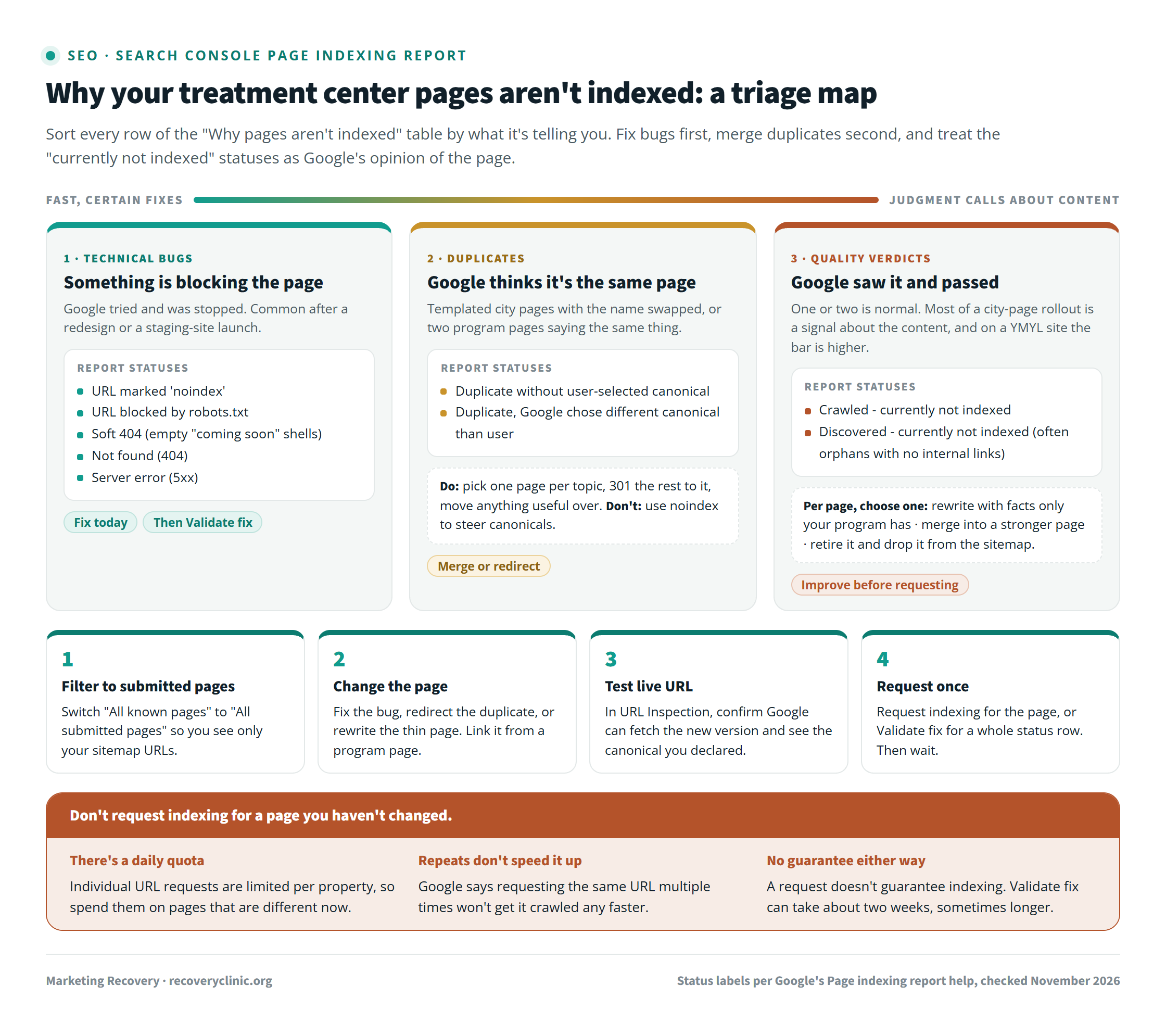
Sort the Page indexing report by what each status is telling you. Bugs get fixed today; duplicates get merged; quality verdicts get a better page before anyone asks Google again.
Don't request indexing for a page you haven't changed
Our view: a page Google won't index is usually a page that doesn't deserve to be indexed yet. Fix it or merge it before you ask again.
The tools back that up. Google's recrawl guide says there's a quota for individual URL submissions, that "requesting a recrawl multiple times for the same URL won't get it crawled any faster," and that a request doesn't guarantee inclusion "instantly or even at all." The URL Inspection documentation repeats the point: indexing typically takes a day or so, can take much longer, and the request carries no guarantee.
So Request indexing for an unchanged thin page asks Google to read the same page again and reach the same answer. Spend that time on the page. For each one stuck in "Crawled - currently not indexed," choose one of three moves:
- Rewrite it with facts specific to your program until it couldn't belong to any other center
- Merge it into a stronger page and 301 redirect the old URL
- Retire it, if it never needed to exist, and pull it from the sitemap
Then run Test live URL in the inspection tool to confirm Google can fetch the new version, and request indexing once. For a whole group of pages under one reason, fix them all and click Validate fix on that row of the report. Google says validation can take up to about two weeks and sometimes much longer.
What to fix first
Work from real bugs toward judgment calls, because the bugs are fast and certain.
- Check "URL marked 'noindex'" for pages you want found. A noindex left over from a staging site or a plugin setting is one of the most common self-inflicted problems we see after a redesign.
- Check "URL blocked by robots.txt," "Soft 404," "Not found (404)," and "Server error (5xx)" for anything that should be live. Soft 404s on a rehab site are often empty program or location pages that render a "coming soon" shell.
- Resolve the duplicate statuses by picking one page per topic and redirecting the rest.
- Link every orphan from somewhere a visitor would click.
- Only then take on the "Crawled" and "Discovered" lists, page by page, with the rewrite-merge-retire choice above.
If the site is new, give it time before reading too much into any of this; our first 90 days of treatment center SEO lays out what normal looks like early on.
Earn the index, then ask for it
Back to those 31 pages. The cheap move is to request indexing for all of them and wait. The move that works is to merge the twenty that say the same thing into the handful of cities you truly serve, rewrite those with details only your admissions team knows, link them from your program pages, and then request indexing once each.
It matters past the blue links, too. Google's AI Overviews can only cite pages that are indexed, and other AI assistants that search the web tend to lean on the same trusted pages. If you want to see whether AI recommends your center or a competitor when families ask, run the free AI visibility check. For help sorting your own Page indexing report, our SEO work for treatment centers starts there, and you can request a free audit. We work only with licensed, accredited programs, and we never buy or broker leads.
About the author
Zac Spencer is an online marketing specialist and the owner of Crave Media, based in Salt Lake City, Utah. Since 2013 he has managed hundreds of Google Ads accounts across dozens of industries, and founded Marketing Recovery, a specialized arm of Crave Media focused on marketing for licensed addiction treatment centers.