Strategy · September 29, 2026
Agency vs in-house marketing for a treatment center

By Zac Spencer
Most treatment centers reach this question the same way. Census dipped, the referral pipeline slowed, and somebody in the leadership meeting asked whether it's time to hire a marketing person or bring in outside help. The treatment center marketing agency vs in house decision gets framed as a cost comparison, and cost is part of it. The bigger part is which work you need done, and who can do that work well inside a vertical with rules most marketers have never met.
We're an agency, so read this with that in mind. We'll still tell you where an in-house team is the better answer, because there are real cases where it is, and a center that picks the wrong model tends to find out slowly and expensively.
What one hire has to cover
Start by listing the jobs, because "marketing" at a treatment center isn't one job. It's paid search inside Google's addiction services policy, SEO on a site Google holds to its highest quality standard for health content, a Google Business Profile per facility, call tracking, a website that converts at 2 AM, reviews handled without disclosing anyone's treatment, and reporting that ties all of it back to admissions.
Each of those is learnable. Very few people have learned all of them, and fewer still have learned them in addiction treatment. A capable generalist from another industry will run a clean Google Ads account and then get it suspended for a landing page claim that would have been fine for a dental practice. Your ad account is where that person learns the rules, and the cost of that education shows up as paused campaigns and empty beds.
So the real choice is about what your center is shorter on. A hire gets you someone close to admissions. An agency gets you people who have seen the same problem on dozens of other accounts.
What in-house does better
An in-house marketer sits down the hall from admissions. No agency can fully match that.
They hear which calls came in and why the good ones didn't convert. They know on Tuesday that the women's residential wing has four open beds and the men's side is full, and they can shift the ad budget that afternoon. They can walk over and ask the intake coordinator why last week's calls from the insurance verification form were mostly out-of-network. An agency sees those things through a dashboard and a monthly call, a week or two late.
For one treatment center we worked with, tracked calls grew from near zero to more than 300 a month. At that volume, the most useful marketing work is often listening to calls and fixing what happens after the phone rings, and that's work that benefits from someone in the building.
In-house also wins on institutional memory. Staff turnover in treatment is high, and an in-house marketer who has been through a LegitScript renewal, two accreditation surveys, and a facility opening knows where every login and every approval lives.
Then they resign. The knowledge walks out with them, and if the ad account, the tracking numbers, or the domain registrar sits under their personal email, so do the assets. Put every account in the center's name on day one, with at least two admins, no matter who runs it.
Where an agency earns its keep
A good treatment-focused agency has watched the same policy change hit a dozen accounts at once. It has seen which landing page language triggers a disapproval, how long a GBP reinstatement tends to take, and what a healthy cost per call looks like in a market like yours. We wrote about why Google suspends treatment center ad accounts, and most of what's in that piece came from seeing the pattern repeat across accounts, not from reading the policy page once.
It also buys you a team instead of a person. Paid search, SEO, web development, and reporting are different skills, and a single-facility center rarely has enough work to keep four specialists busy. With an agency, the center gets a slice of several specialists' time instead of all of one generalist's.
The Bureau of Labor Statistics put the median pay for marketing managers at $166,790 in May 2025. Treatment center marketing roles vary a lot by market and title, and plenty pay less, but whatever the salary is, the fully loaded cost adds benefits, the software stack (call tracking, SEO tools, analytics), and the months it takes a new hire to get up to speed. Put that total next to the agency proposals you've been quoted, and compare the two for the same scope of work.
An agency won't be in your clinical meetings, and its attention is split across clients. A bad one can hold your accounts hostage, which is why month-to-month terms and asset ownership matter more than whatever the sales deck promises.
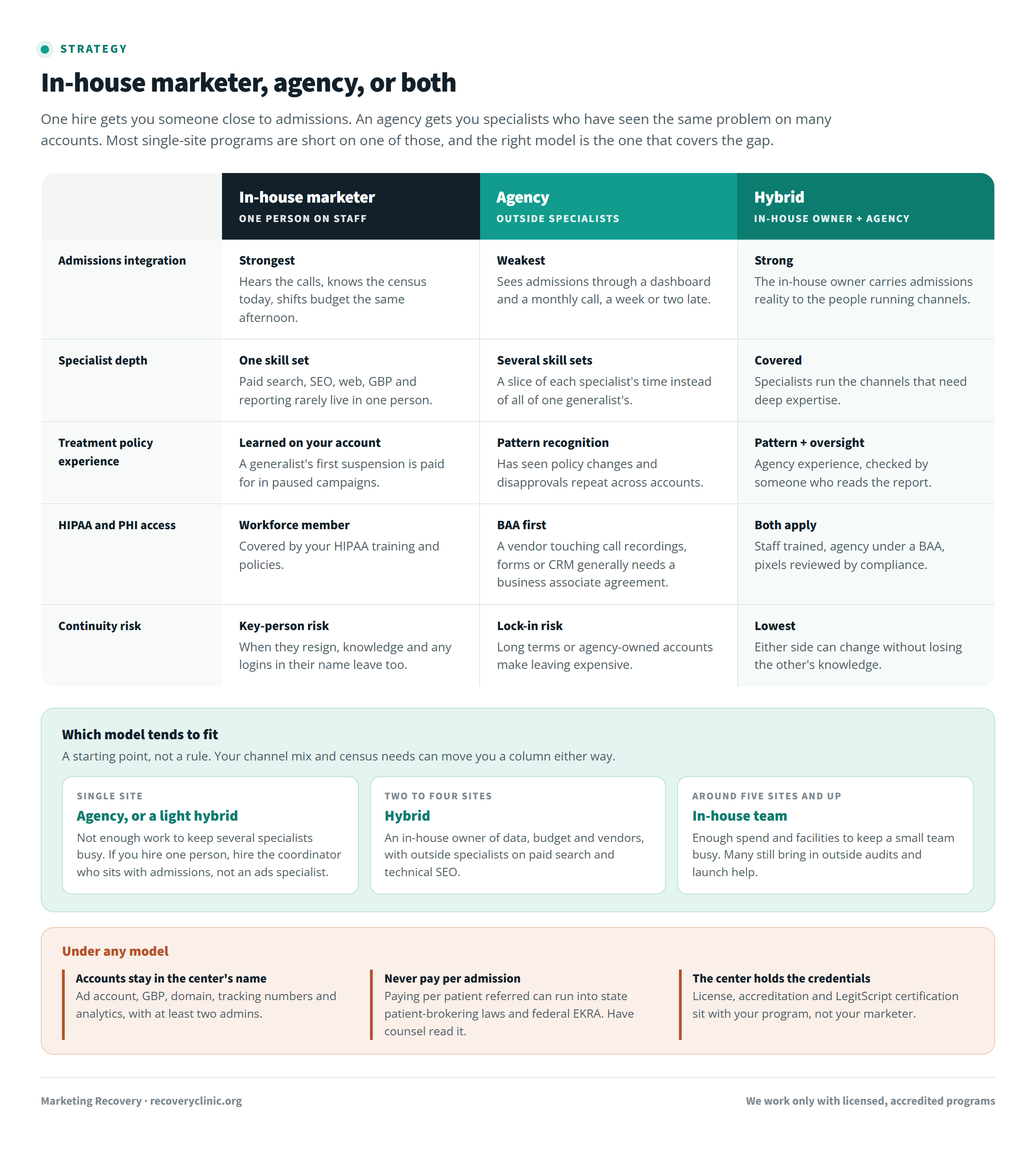
How an in-house marketer, an agency, and a hybrid setup compare for a treatment center, and which model tends to fit at each stage.
The compliance questions to ask either way
Whichever route you take, the regulatory load stays with the center. Your program holds the license, the accreditation, and the LegitScript certification. Neither an employee nor an agency can hold those for you, and nobody should promise to "get you certified." What the marketer does is build the site and campaigns so they meet what the platforms check for.
The privacy side is where the two models differ in practice. An in-house marketer is part of your workforce under HIPAA and goes through your training. An outside vendor that will touch protected health information, such as recorded admissions calls, verify-insurance form submissions, or your CRM, generally needs a business associate agreement before it gets access. If the agency you're talking to seems unfamiliar with the term BAA, that tells you something. Tracking pixels on pages where families enter health details raise a similar question whoever installs them, and that one belongs with your compliance officer and counsel. We're marketers, not lawyers.
Then there's the line that matters most in this industry. Never pay anyone, employee or agency, per admission or per patient referred. Paying for patient referrals can run into state patient-brokering laws and the federal Eliminating Kickbacks in Recovery Act, and some vendors dress it up as "performance pricing." If a proposal ties payment to admissions, get counsel to read it before anyone signs. Pay for the work, not for the patient. We work only with licensed, accredited programs, and we never buy or broker leads.
The hybrid most centers end up with
For a lot of single-site and two-site programs, the answer ends up being both: one in-house owner plus outside specialists.
The in-house person owns the admissions data, the calendar, the budget, and vendor management. They're the one who knows the census and listens to calls. The agency runs the channels that take deep specialization, typically paid search and technical SEO, and reports to that person against numbers they both agree on.
If you're making one hire, our opinion is that it shouldn't be a Google Ads specialist. Hire the person who can sit with admissions, read a report critically, and hold outside vendors accountable. A strong coordinator with an agency behind them usually outperforms a lone channel specialist with nobody watching the rest.
This also fixes the most common agency failure, which is an account with nobody on the center's side paying close attention. Agencies do better work when someone on the other end reads the report and calls with questions. We certainly do.
When a full in-house team makes sense
Multi-facility organizations are where in-house starts to win outright. Somewhere around five locations, give or take, you have enough paid spend, enough content to produce, and enough facilities to manage that a small team (a marketing director, a paid media manager, a content lead, and someone on local listings and reviews) stays fully busy. Brand consistency across sites gets easier when the same people touch every one.
Even then, many large operators keep outside help for specific jobs: a yearly audit of the ad accounts by someone who sees other operators' accounts, a site rebuild, or overflow during a new facility launch.
The other case is a center with an unusual mix of channels. If most admissions come from in-person referral relationships with hospitals, courts, and EAPs, the marketing work leans toward business development and community outreach, and that's done by people who live in your market.
How to decide
Work through it in this order:
- Write down every marketing job you need done this year, and which ones need someone in the building.
- Estimate your budget honestly. If you haven't sized it yet, our guide to a treatment center marketing budget walks through it against cost per admission.
- Price the fully loaded in-house version and the agency version for the same scope.
- Decide who will own the admissions data and hold vendors accountable, because somebody has to.
- Confirm that every account, number, and domain will stay in the center's name under either model.
Keep the scoreboard in the building
Whichever model you choose, the thing that should never leave your center is ownership of the numbers. Admissions by source, cost per admission, and which calls turned into beds belong to someone on your staff, even if an agency runs every campaign.
If you'd like a second opinion on where your center's gaps are, you can see how we split this work on our services page, or request a free audit and we'll tell you which parts of your marketing need a specialist and which ones need someone down the hall from admissions.
About the author
Zac Spencer is an online marketing specialist and the owner of Crave Media, based in Salt Lake City, Utah. Since 2013 he has managed hundreds of Google Ads accounts across dozens of industries, and founded Marketing Recovery, a specialized arm of Crave Media focused on marketing for licensed addiction treatment centers.