Somewhere in the agency conversation, usually right after the good part, a treatment center marketing contract lands in front of you with a twelve-month term on it. The pitch that comes with it is always some version of the same thing: marketing takes time, so we need a year to do it properly.
The first half of that is true. Search work does take months to compound, and anyone promising admissions in week three is selling you something. The second half doesn't follow. An agreement that locks you in for a year doesn't make the work take less time. It moves the risk of the work not landing off the agency and onto you.
We work month to month, so read this knowing where we sit. The argument still holds up, and the parts worth arguing about turn out to be buried in the clauses, not the term.
Why agencies want the full year
The case for the long contract has real parts to it, and they're worth understanding before you push back on it.
Onboarding is front-loaded and expensive. The first thirty to sixty days of a treatment center engagement are largely unbillable-feeling work: auditing the site, untangling old listings, rebuilding tracking, reviewing the ad account for whatever got it into trouble before. An agency that does that properly and then loses the account in month three has lost money on you.
Forecasting matters to them too. Agencies with predictable revenue can staff properly, and an agency that can't predict next quarter tends to be an agency scrambling. That instability eventually reaches your account.
And there's a real strategic argument. If the plan calls for building organic visibility, that plan only makes sense across quarters. A center that pulls the plug at month four gets the cost of SEO with none of the return, which is a bad outcome for everyone.
None of that is dishonest. The problem is the solution it arrives at.
What a treatment center marketing contract protects
A twelve-month term solves the agency's risk problem by transferring it to you. If the work is good, you'd have stayed anyway and the contract did nothing. If the work is bad, the contract is the only reason you're still paying.
Put plainly, a long lock-in only has an effect in the scenario where you want to leave. That's the whole function of it. The continuity and planning it supposedly protects happen on their own when results are showing up.
The practical damage is subtler than getting stuck with a bad vendor. It's what the lock-in does to attention. Accounts under contract get the attention that's left after the accounts that could walk. Nobody plans it that way, and it happens in every agency, because human beings prioritize what they could lose. Month to month keeps your account in the second group.
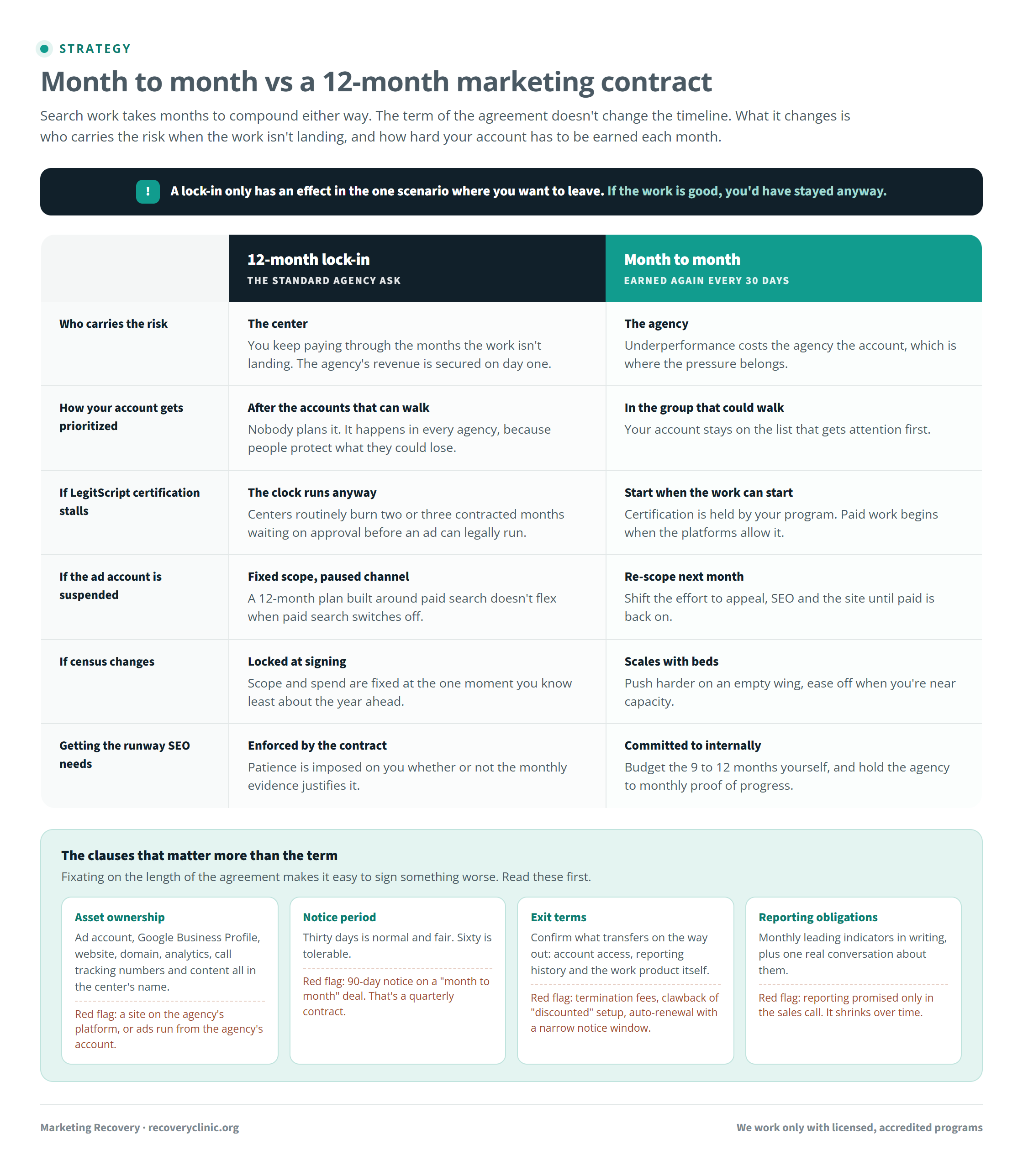
What a twelve-month lock-in changes, what it doesn't, and the clauses in a treatment center marketing contract that matter more than the length of the term.
Why this niche makes the lock-in worse
Treatment marketing has failure modes that most industries don't, and a fixed annual term handles them badly.
Certification can stall your start. No treatment program can advertise on Google, Meta, or Microsoft until it holds LegitScript certification, and that certification belongs to your program, based on your licensing and accreditation. We can help prepare a site and campaigns to meet what the platforms look for, but we don't hold or grant the certification. Centers regularly sign a twelve-month agreement, then spend the first two or three months of it waiting on approval while the invoices run. A month-to-month arrangement lets you start paying when the work can start.
Ad accounts get suspended. Even certified programs run into it, and a suspension can pause paid search for days or weeks while an appeal works through. We wrote about why Google suspends treatment center ad accounts and what to do in the first 48 hours. A twelve-month scope built around paid search doesn't flex when paid search is switched off.
Census moves, and your marketing should move with it. A center running near capacity has different needs than one with a wing of empty beds, and that can change in a quarter. Annual agreements tend to fix the scope and the spend at the moment of signing, which is the one moment you know least about the year ahead.
And the cost of a wrong quarter is higher here than almost anywhere. With clicks running roughly $25 to $150 and admissions worth several thousand dollars each, a quarter of undirected spend is real money that could have filled beds. Sizing that spend deliberately is the whole subject of our piece on a treatment center marketing budget.
The "SEO takes time" argument, answered
The strongest defense of the annual contract is that organic work compounds and needs runway. That's true, and it still doesn't require a lock-in.
The timeline belongs to the work. The contract is a separate question about what happens if the work isn't being done. A good agency earns month seven from what it delivered in months one through six, and there's plenty to show in that window even before rankings move: pages built and indexed, technical problems cleared, Google Business Profile fixed, impressions and distinct queries climbing in Search Console, calls from the listing rising. Our breakdown of the first 90 days of treatment center SEO lays out what should exist at each stage.
If an agency can show that progress, no center in its right mind leaves at month four. If it can't show that progress, the contract is doing the only work being done.
There's a version of the long commitment that's fine, and it's the one you make rather than sign. Commit internally to giving SEO nine to twelve months, budget for it, and hold the agency to monthly evidence. You get the patience the channel needs and keep the ability to walk that the contract would have taken.
The clauses that matter more than the term
Fixating on the term makes it easy to sign something worse. The provisions that decide whether you're truly free are usually elsewhere in the document.
Ownership of assets is the one to read first. The Google Ads account, the Google Business Profile, the website and its hosting, the domain, the call tracking numbers, the analytics properties, and the content produced for you should all be owned by your center and merely managed by the agency. An agency that builds your site on its own platform or runs ads from its own account has a stronger hold on you than any twelve-month term, because leaving means starting over. Call tracking numbers are a quiet one here, since tracked numbers that belong to the agency take your call history with them when you go.
Notice periods deserve a look. Thirty days is normal and fair. Sixty is tolerable. Ninety days on a month-to-month agreement is a quarterly contract wearing different clothes.
Then check the exit terms. Look for early termination fees, clauses that claw back "discounted" setup work if you leave early, automatic renewal that requires written notice in a narrow window, and anything that says content or campaigns come down when the relationship ends. Also confirm what you get on the way out: account access transferred, reporting history, and the work product itself.
Reporting obligations belong in writing too. A monthly report that shows the leading indicators, not just three vanity keyword rankings, and one real conversation about it. If reporting is only a promise in the sales call, it tends to shrink over time.
What we do
We work month to month with the treatment centers we serve, and every asset stays in the center's name. That's not generosity. It means we have to show up with something worth paying for every month, which is the arrangement that produces the best work anyway.
It also means we say no sometimes. If a center wants admissions next week and isn't certified yet, or wants results we can't honestly forecast, month to month makes that conversation happen at the start where it belongs. We work only with licensed, accredited programs, and we never buy or broker leads.
If you're weighing an agreement right now, or you're inside one and wondering what your options look like, request a free audit and we'll go through what's being done on your account and what you own. You can also check whether AI recommends your center when families search, which takes a couple of minutes and tells you something useful about where you stand regardless of who you end up hiring.

About the author
Zac Spencer is an online marketing specialist and the owner of Crave Media, based in Salt Lake City, Utah. Since 2013 he has managed hundreds of Google Ads accounts across dozens of industries, and founded Marketing Recovery, a specialized arm of Crave Media focused on marketing for licensed addiction treatment centers.