The call usually starts the same way. The profile had 212 reviews on Friday and 196 on Monday, nobody got an email, and the executive director wants to know who to call at Google. For a treatment center, Google reviews disappearing feels personal, because a lot of those reviews came from alumni and families who don't post about rehab anywhere else.
There's rarely anyone to call. Most missing reviews were taken down by Google's spam systems, a few were deleted by the people who wrote them, and only a small share are worth fighting for. Below: how to tell which is which, the patterns that get treatment center reviews filtered, and what an appeal can and can't do.
Check whether they're really gone
Rule out the ordinary explanations first. A reviewer can delete or edit their own review at any time, and if they close their Google account, every review they wrote goes with it. People in early recovery sometimes clean up their online footprint, and in our experience a few missing alumni reviews a year come from exactly that.
Counts also drift between Search, Maps, and your dashboard, sometimes for days. And if the whole profile was suspended, the reviews stop showing until it's reinstated, which is a separate problem with its own fix (Business Profile suspensions in healthcare). Export or screenshot your review list once a month. Next time the number drops, you'll know exactly who left.
Google reviews disappearing is usually the spam filter
Google blocked or removed more than 240 million policy-violating reviews in 2024, according to its own Maps blog, and the 2025 figure was 292 million, per its Maps content transparency report. Most of those never appear in public. They're caught before they post, which is why a review a family swears they left never shows up at all.
Timing is what confuses owners. In that same post, Google said it can now "revisit reviews more frequently to identify new abuse patterns even months after they were originally posted." So a review that's been sitting on your profile since spring can come down in October, and nothing about your profile changed that week. The filter got better at spotting a pattern you were already in.
Google doesn't publish its signals. Its prohibited content policy does list the behaviors it's hunting for, and four of them show up in treatment center profiles again and again.
Review bursts after alumni events
An alumni picnic, a sobriety-milestone dinner, a family weekend. Someone puts a QR code on the table, and thirty reviews land in one evening from phones sitting on the same guest Wi-Fi, many from accounts that have never reviewed anything before. Every one of those reviews may be honest. Together they look like a campaign, and the policy bans content "posted from multiple accounts by or at the request of one person."
How much weight Google gives a shared network or a single evening, we can't say. In the profiles we've audited, the ones that collect reviews in spikes lose far more of them than the ones with a steady trickle.
Staff, former staff, and their families
Google's policy names "current or former employment" as a conflict of interest. That's harder in this field than most, because a lot of your techs, peer support specialists, and admissions staff are alumni. A recovery coach who went through your program in 2021 and joined the team in 2023 has a real story, and Google still treats a review from them as an employee review. The same goes for the owner's spouse, the clinical director's sister, and anyone at an agency you've hired. (No marketing agency should ever write a review for a client. We don't.)
The FTC agrees from a different direction. Its rule on fake reviews and testimonials, announced in August 2024, bars businesses from using reviews by officers, managers, or employees that don't clearly disclose the connection. A Google review has no place for that disclosure. Staff and their families shouldn't review you, full stop.
Incentives, even small ones
Google bans offering "payment, discounts, free goods and/or services" in exchange for any review, positive or negative. A $10 coffee card counts. So does an alumni hoodie, a raffle entry, or a discount on a family program "for anyone who leaves us a review." If a review mentions what the person got for writing it, that's the easiest removal Google will ever make.
The FTC rule only bans incentives tied to a particular sentiment. Google bans all of them, so clearing the federal bar doesn't keep a review up.
Review gating
This one usually hides inside software. A post-discharge survey asks how the stay went, sends the happy answers to your Google review link, and routes everyone else to a private feedback form. Google's policy says businesses can't "discourage or prohibit negative reviews, or selectively solicit positive reviews." Plenty of reputation platforms still offer this routing as a setting, so log in and check yours. The same policy also prohibits pressuring people to review "while on the premises," which rules out handing someone the lobby tablet at discharge.
When the penalty hits the whole profile
Losing individual reviews is the mild version. When Google decides a profile has been collecting fake engagement, its restriction policy lists three penalties: the profile can't receive new reviews for a set period, the existing reviews can be unpublished for a set period, and the profile can show a warning telling people that fake reviews were removed. Google says it emails the owner before applying a restriction, and the restriction can be appealed.
For a treatment center, that warning is the worst outcome on this list. A family deciding whether to trust you with their son reads "fake reviews were removed" as a verdict on the whole program, and no one-star review does that much damage. Google had those alerts live in the U.S., U.K., and India by April 2025.
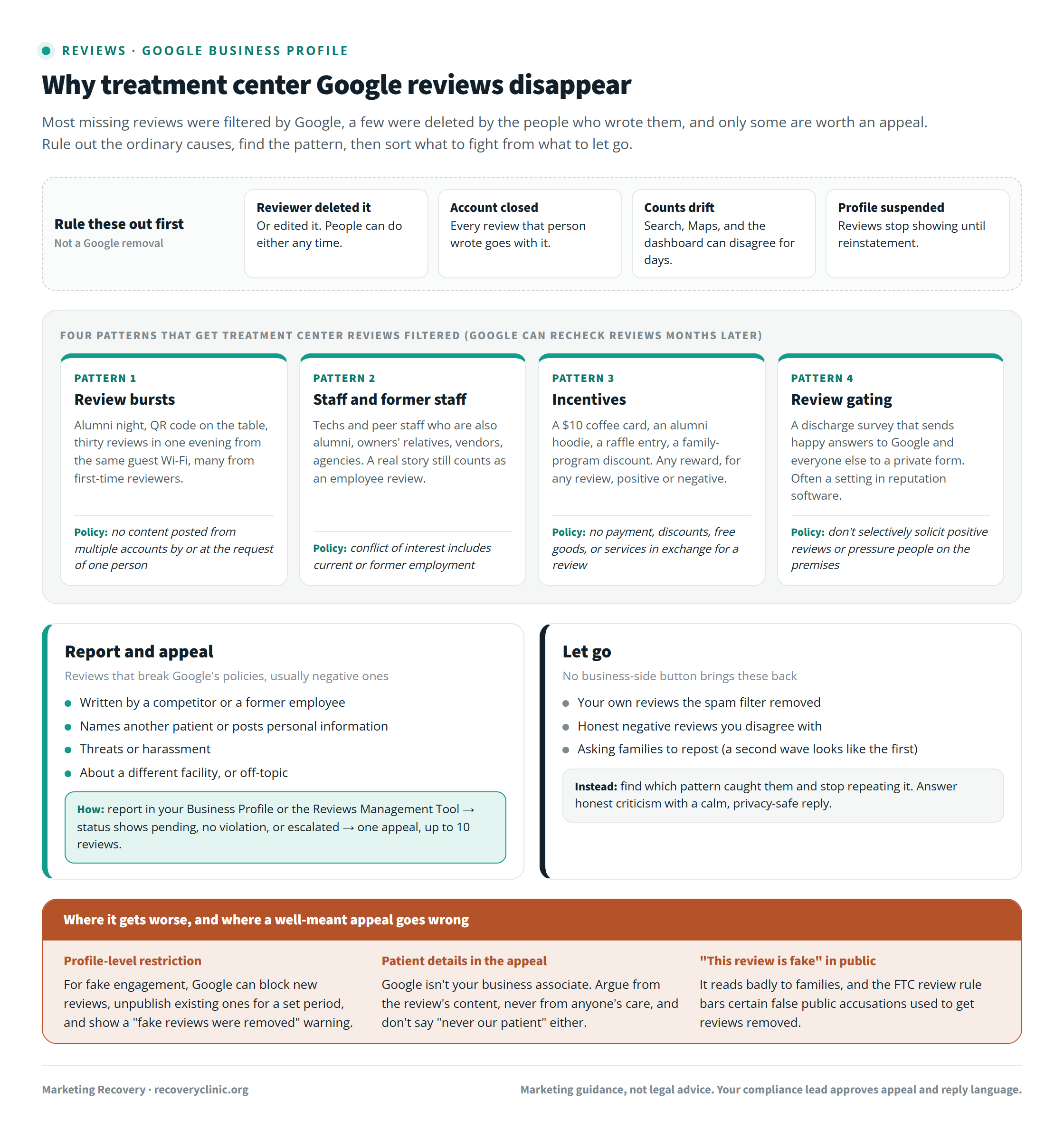
The four patterns that most often get treatment center reviews filtered, and a quick sort of which disappearing reviews are worth an appeal.
What you can appeal and what to let go
Google's appeal process exists to take down reviews that break its policies. It won't put your own filtered reviews back, and knowing that up front saves a lot of wasted afternoons.
Worth reporting and appealing
These are reviews that violate policy, almost always negative ones. A review from a competitor or a former employee with a grudge. One that names another patient or posts someone's personal information. Threats or harassment. A review that's plainly about a different facility, or a rant about addiction treatment in general that has nothing to do with your location.
You report them from your Business Profile or through Google's Reviews Management Tool, which also shows the status of each report: decision pending, reviewed with no violation found, or escalated. Google says reports usually take several days. If it decides a review doesn't violate policy, you get one appeal, and you can include up to 10 eligible reviews in it. Use it on your strongest cases and don't spend it on reviews you simply disagree with. Google's own instruction is not to report a review just because you don't like it.
Better to let go
Your own filtered reviews, mostly. We don't know of a button that lets a business restore a review Google's spam systems removed. If thirty reviews from an alumni night disappeared, the useful question is which pattern caught them, and the fix is to stop repeating it.
Don't ask those families to post again. A second wave from the same people a week after the first one came down looks even more like the pattern the filter just caught, and you may hand it more to remove. Let the honest ones go and build a steadier stream going forward.
Honest negative reviews go in this pile too. Unfair isn't a policy violation. Put the energy into a calm public reply instead; our post on responding to negative reviews without violating HIPAA has a framework your team can reuse.
Keep patient information out of the appeal
An appeal goes to Google, and Google isn't your business associate. "This person left against medical advice after three days" is a disclosure of patient information, even in a form only Google reads. "This person was never our patient" is too, since denying a treatment relationship tells Google something about who was and wasn't in your care.
Argue from the review's content instead. It names a third party. It contains a threat. The reviewer's profile shows they work for a competing program. Your compliance lead or counsel should approve the appeal language you use, the same way they approve your public reply templates.
The public side has a trap of its own. Replying "this review is fake" can backfire with families, and the FTC rule prohibits certain false public accusations used to get a negative review removed. Report quietly, and keep the public reply to the same privacy-safe language you'd use on any review.
Build reviews the filter leaves alone
The profiles that keep their reviews are boring. Requests go out at a steady pace through the year, tied to natural moments like a family program wrap-up or an alumni check-in, sent individually, with no gift attached and no survey deciding who gets the link.
A few rules make that easier to hold. Put in writing that staff, former staff, their families, and your vendors don't review the center. Take the review QR code off event tables, where it turns one evening into a burst, and send the link the next day instead. Turn off any routing in your reputation software that screens by sentiment. Our guide to getting Google reviews without breaking HIPAA covers how to ask without confirming anyone was ever a patient.
Four honest reviews a month for a year will outlast forty in one night. We'd take the four every time.
Collect reviews Google will keep
That executive director with 196 reviews on Monday usually doesn't need a contact at Google. They need to know whether it was the alumni-night QR code, the techs' reviews, or the survey tool, and then to stop doing it.
Our Google Business Profile work for treatment centers includes a review audit: what's been filtered, which pattern likely caused it, and a request process built to hold up. We only work with licensed, accredited programs, and your program holds the license and the compliance obligations. This isn't legal advice; your compliance lead should approve anything you send Google or post in public. If your review count has been sliding and you'd like to know why, request a free audit.

About the author
Zac Spencer is an online marketing specialist and the owner of Crave Media, based in Salt Lake City, Utah. Since 2013 he has managed hundreds of Google Ads accounts across dozens of industries, and founded Marketing Recovery, a specialized arm of Crave Media focused on marketing for licensed addiction treatment centers.