Reviews · August 14, 2026
Responding to negative reviews without violating HIPAA

By Zac Spencer
A one-star review of a treatment center lands differently than a one-star review of a restaurant. The stakes are higher, the emotions behind it are heavier, and the person writing it might be a former patient in a hard moment, a family member who expected a different outcome, or someone who was never inside your building at all.
And unlike the restaurant, you can't tell your side. Responding to negative reviews as a treatment center means writing in public with HIPAA and 42 CFR Part 2 looking over your shoulder, where a single warm, well-meant sentence can turn into a federal privacy violation. Healthcare providers have paid federal settlements for exactly this. The rules don't leave you helpless, though. There's a way to respond that protects patient privacy, satisfies Google, and reads well to the people who matter most: the families reading the exchange later.
Why you can't tell your side
HIPAA's rule for public replies is blunt. You cannot confirm that any specific person was your patient, and a review response is about as public as a disclosure gets. The reviewer can post anything they want about their own care, because privacy law binds the provider, not the patient. The moment you reply with something that acknowledges they were in your program, you've disclosed protected health information, even if everything you said was kind.
Substance use treatment adds a second layer. Records covered by 42 CFR Part 2 are protected more strictly than general medical information, which is why review advice written for dentists doesn't transfer to detox and residential programs. The enforcement history here is real: the HHS Office for Civil Rights has settled with providers over review responses that revealed patient information, including cases where the reply was defending the practice against a review the provider felt was unfair.
That's the trap in "setting the record straight." The review may be one-sided, exaggerated, or flatly wrong about what happened. It doesn't matter. Correcting the story requires talking about their care, and talking about their care in public is the violation. The unfairness is genuinely frustrating, and the answer is still no.
Every reply passes the stranger test
The working rule for any response: write a reply that would read exactly the same whether the reviewer was a patient, a patient's cousin, or a stranger who confused you with another facility. If the reply only makes sense addressed to a former patient, it fails.
"We're sorry your stay didn't meet your expectations" fails the test. So does "our clinical team followed your discharge plan." Even "we're glad you completed the program" in response to a mixed review fails it. Each one confirms the treatment relationship.
What passes: "We take all feedback seriously, and we're sorry to read this." Nothing in that sentence says the person was ever in your care. It's the only honest thing you're legally allowed to say, and said plainly, it reads as composed rather than cold.
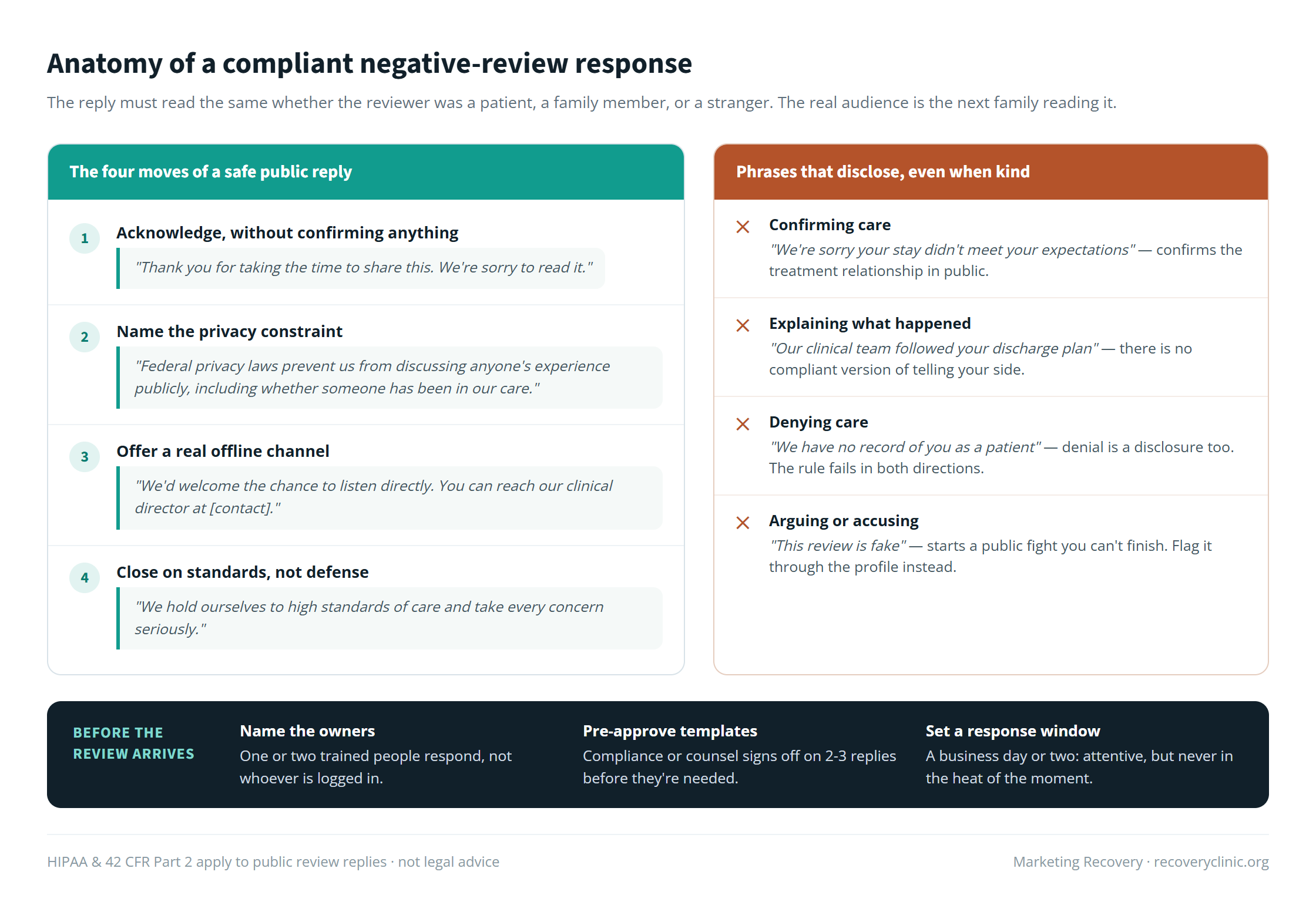
A compliant reply never confirms the treatment relationship, moves the conversation offline, and is written for the next family reading it, not the reviewer.
A reply framework your team can reuse
A compliant negative-review response has four moves, and they fit in three or four sentences.
Acknowledge the feedback without confirming anything: "Thank you for taking the time to share this. We're sorry to read it." Name the privacy constraint, because it explains your restraint to everyone watching: "Federal privacy laws prevent us from discussing anyone's experience with our program publicly, including whether someone has been in our care." Offer a real offline channel: "We'd welcome the chance to listen directly. You can reach our clinical director at [number or email]." And close on your standards without arguing: "We hold ourselves to high standards of care and take every concern seriously."
Notice what the framework never does. It never says "your treatment," "your stay," "your discharge," or "our records." It never explains what happened, because there is no compliant version of explaining what happened. And the offline offer has to be genuine; a phone number that rings to nowhere reads worse than no reply at all.
One more trap worth naming, because it feels safe and isn't: don't reply with "we have no record of you." Denying a treatment relationship is the same kind of disclosure as confirming one, and it commits you publicly to a claim you may not be able to check. The stranger test fails in both directions.
The reader you're writing for
The reviewer is rarely the audience. Most negative reviews are never edited or removed, and the person who wrote one in anger is unlikely to be argued out of it in a comment thread. The audience is the mother scrolling your profile at 1 a.m. three months from now, deciding whether to call.
She isn't put off by the existence of a bad review. A profile with nothing but five stars can read as curated. What she's reading for is how you handled it. A calm reply that respects privacy, offers a human contact, and skips the defensiveness tells her the program is run by adults who stay steady under criticism, which happens to be the exact quality she's hoping for in the people who might care for her son. An argumentative reply tells her the opposite, and no star rating recovers from it.
That's why response speed and tone beat rebuttal every time. You're not winning the exchange. You're being watched having it.
When the review is fake or crosses a line
Some reviews aren't feedback. Competitors post them, ex-employees post them, and sometimes a review names staff, includes threats, or describes another patient. Those you don't answer in public with accusations; a "this review is fake" reply just starts a fight you can't finish, and if the reviewer does turn out to have been a patient, you've cornered yourself.
The compliant path is removal. Flag the review through your Google Business Profile for violating Google's content policies, which cover harassment, off-topic rants, conflicts of interest, and impersonation. Document what you submitted and when. Removal is slow and Google declines more requests than it grants, so pair the flag with a standard privacy-safe public reply in the meantime. For reviews that are genuinely defamatory, a lawyer's letter to the platform is the escalation, but that's a decision for counsel, not the marketing team. Keeping your profile in good standing matters here for a second reason: healthcare profiles already live closer to suspension triggers than most categories, and a public brawl in your reviews is attention you don't want.
Build the process before the review arrives
The centers that get this wrong are almost never malicious. They're understaffed, someone with the profile login sees a painful review at 9 p.m., and a heartfelt, disclosing reply goes up before anyone with compliance training sees it.
The fix is boring and structural. Decide who owns review responses, and make it one or two named people rather than whoever's logged in. Have your compliance officer or attorney approve two or three response templates in advance, one for general negative reviews, one for reviews that mention clinical details, one for suspected fakes. Set a response window of a business day or two, fast enough to look attentive, slow enough that nobody replies in the heat of the moment. Everything else about review strategy, including how to build the positive side of your profile compliantly, we covered in how treatment centers get Google reviews without breaking HIPAA; the two posts are halves of the same system, and both feed the Google Business Profile that families judge you by.
The usual disclaimer applies here too: this is marketing guidance, not legal advice, and your compliance or legal team should sign off on your templates before they're used.
Steady is the strategy
You will get a negative review eventually. Every treatment center does, because you work with people and families in the hardest season of their lives, and some of those stories end angry no matter how good the care was.
What's in your control is the response: never confirm, never argue, always offer a door, and let the next family watch you stay steady. If you want a second set of eyes on your current profile, your reviews, and how your responses read, request a free audit and we'll go through it with you.
About the author
Zac Spencer is an online marketing specialist and the owner of Crave Media, based in Salt Lake City, Utah. Since 2013 he has managed hundreds of Google Ads accounts across dozens of industries, and founded Marketing Recovery, a specialized arm of Crave Media focused on marketing for licensed addiction treatment centers.