Google Ads · October 9, 2026
Is Performance Max a fit for treatment center ads

By Zac Spencer
Sooner or later a Google rep calls your treatment center with a recommendation. Your account is "limited," your optimization score is 71%, and the fix is a Performance Max campaign. The pitch sounds reasonable: one campaign, every Google channel, and Google's AI finds the families for you.
Performance Max can work for a treatment center. In a lot of the accounts we audit, though, it got switched on early, before the conditions it needs were in place, and its report looked better than the admissions log for months before anyone compared the two. Whether it fits your program comes down to a handful of things Google's pitch doesn't mention.
What Performance Max does with your budget
A Performance Max campaign takes one budget and spreads it across Search, YouTube, Display, Discover, Gmail, and Maps. You hand Google headlines, descriptions, images, video if you have it, and a conversion goal. Google decides which channel each dollar goes to, which assets get combined into which ad, and which person sees it.
That's the trade. You give up most of the levers a Search campaign has, like which keywords you bid on, which ad shows for which search, and how much goes to YouTube versus the search results page. In exchange you get reach and automation. For an online store with thousands of products and a clean purchase signal, that trade is often a good one. A treatment center has a few levels of care, a small number of admissions a month, and a conversion signal that's messy unless someone works to clean it up. The trade looks different from that side.
Search terms visibility is better, still not complete
For its first few years, Performance Max mostly hid which searches triggered your ads. You got "search term insights," grouped into themes, and very little you could act on. Treatment advertisers hated it, because in this category the search term is everything. "Alcohol rehab near me" and "rehab tech jobs" can look similar to an algorithm and couldn't be further apart for your budget.
That has improved. Google raised the cap on Performance Max negative keywords from 100 to 10,000 per campaign in March 2025, and in April 2025 it announced a full search terms report and channel performance reporting for Performance Max, with the same level of search-term detail Search campaigns get.
So the old complaint is out of date. You can now see what people typed and block what you don't want. Two gaps remain. Negative keywords and the search terms report only cover the Search side of the campaign. They tell you nothing about the YouTube video or mobile app where the next ad lands. And like any search terms report, low-volume queries tend to get withheld for privacy. In a niche where many searches are long, personal, and rare, expect a real share of your spend to sit behind that curtain.
Branded cannibalization makes it look better than it is
This is the problem we run into most. Performance Max is allowed to bid on searches for your own center's name. Those are the cheapest, highest-converting searches in the account, because the family already knows who you are. When Performance Max takes them, its cost per conversion looks excellent, and the campaign gets credit for calls your brand campaign or your organic listing would have produced anyway.
Google's own rule is that a Search campaign with a keyword that exactly matches the person's query is preferred over Performance Max. That helps, but it only holds when the exact-match keyword is eligible to serve. If your brand campaign runs out of budget by 2 PM, or a misspelling of your name isn't in it, Performance Max can step in.
Start by keeping a dedicated brand Search campaign with exact-match keywords and enough budget that it never caps out. Then apply a brand exclusion for your own name to the Performance Max campaign, which tells it to stay off searches about your brand (for Performance Max, brand exclusions cover Search and Shopping inventory). Smaller centers sometimes aren't in Google's brand library yet and have to request it, which takes time. In the meantime, add your name and its common misspellings as negatives.
After that, read Performance Max results with branded traffic pulled out. If 40 of the campaign's 60 conversions last month came from people typing your center's name, you didn't learn anything about finding new families, and you paid more for calls you'd have gotten anyway. We covered why the two kinds of search need separate budgets and separate reporting in branded vs non-branded search for treatment centers.
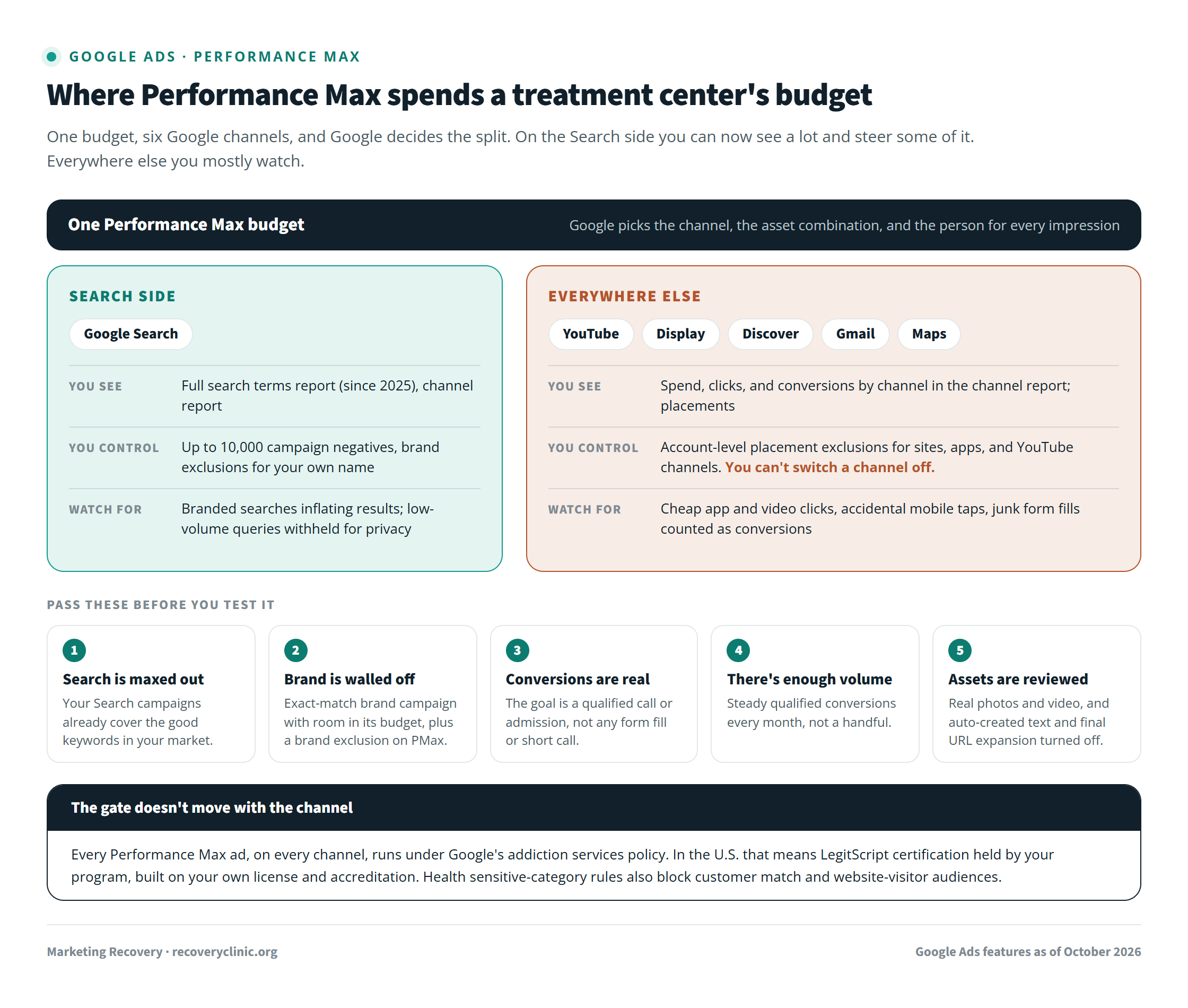
Where Performance Max spends a treatment center's budget, what you can see versus what you can control, and the checks worth passing before you test it.
Display and YouTube under the addiction services policy
We get nervous about everything off the search results page. When a family searches "detox for opioids in Ohio," they're asking for help. When your ad shows in a free puzzle game on a teenager's phone, nobody asked anything. Display and YouTube clicks in this category tend to be cheaper and much less likely to turn into a real admissions call, and accidental mobile taps can fill a form queue with junk.
You can't turn those channels off inside Performance Max. You can see how each one performs since the channel report arrived, and Google started testing channel sliders in August 2026 that loosen or tighten the cost target per channel. That's an alpha test most accounts can't see, and even there a slider only nudges a channel up or down. It can't switch one off. What you do have is account-level placement exclusions, which since early 2026 apply to Performance Max and let you block specific sites, apps, and YouTube channels across the whole account.
The compliance gate doesn't change with the channel. Google restricts recovery-oriented drug and alcohol addiction services, and in the U.S. a provider has to be certified through the LegitScript program before those ads run. That certification sits with your program, built on your license and accreditation. We help get the account and the landing pages ready for what the platforms check, but we can't certify you and nobody else can either. Every asset group, image, and auto-generated video in a Performance Max campaign runs under that same policy and the healthcare and misrepresentation rules around it. If you're not sure where your center stands, our LegitScript certification guide walks through it.
Two more policy details shape how well Performance Max can work for you. Google's health personalized advertising policy lists addiction counseling as a sensitive category and blocks advertiser-curated audiences in it, including customer match and your data segments built from website visitors. Those are the audience signals Performance Max leans on in other industries, so here it starts with less to learn from. And Performance Max turns on several automated features by default, including automatically created text and final URL expansion, which can send traffic to pages you never reviewed for ads. For a treatment center we'd switch both off and keep every landing page one your compliance team has signed off on.
When Performance Max can make sense
None of this means never. Performance Max tends to earn a test when a few things are already true.
- Your Search campaigns are mature and hitting the ceiling of good keywords in your market, so the cheap growth on Search is gone.
- Conversions are tracked to qualified calls or verified admissions, not raw form fills. Performance Max chases whatever you call a conversion, so a goal that counts spam forms and 8-second calls teaches it to buy more of them.
- Steady conversion volume. Google doesn't publish a minimum, but a campaign producing a handful of qualified calls a month gives the algorithm very little to learn from.
- Brand is walled off with a brand Search campaign plus a brand exclusion.
- You have real creative: honest photos of your facility and staff, and ideally a short video, so Google isn't stitching together stock images into something that looks like every lead-gen site in the category.
Multi-location programs with several levels of care and solid call tracking are the most common fit we see. A single 24-bed residential program running $15,000 a month in ad spend usually gets more from tightening its Search campaigns and its keyword list than from adding a campaign type it can't steer.
For most treatment centers, Performance Max should be the last campaign you add, never the first. We'd hold that line even with a rep on the phone promising a lift. Search tells you what families typed, what you paid, and which calls came from it, and without that record you have nothing to judge Performance Max against.
How to run a fair test
If you do test it, keep the test honest. Give Performance Max its own budget carved out of new money or a clearly defined slice of non-branded spend, not the brand budget. Run it for at least six to eight weeks, because the first couple of weeks are mostly the system learning. Judge it on qualified calls and admissions by source with brand traffic excluded, not on the cost per conversion in the Google Ads dashboard. Check the channel report and placements every week in the first month and add placement exclusions as you find junk.
Then compare it to what the same money would have done on Search. If Performance Max brings in new families at a cost per admission you can live with, keep it. If its best numbers came from brand searches and Display taps, you've learned that for the price of a few weeks of spend.
Let Search prove it first
So when the rep calls about that 71% optimization score, ask one thing back: how much of the proposed campaign's spend would go to searches for our own name? If nobody can answer, the account isn't ready. Performance Max needs the same certification, clean conversion data, and reviewed landing pages a good Search account needs, and it gives you less to look at once it's running.
Setting up that foundation and deciding when a test is worth running is the day-to-day work of our Google Ads management for treatment centers, with licensing, accreditation, and certification staying with your program and no leads bought or brokered. If a rep is pushing Performance Max on your account and you want a second opinion, request a free audit and we'll show you where your current spend is going first.
About the author
Zac Spencer is an online marketing specialist and the owner of Crave Media, based in Salt Lake City, Utah. Since 2013 he has managed hundreds of Google Ads accounts across dozens of industries, and founded Marketing Recovery, a specialized arm of Crave Media focused on marketing for licensed addiction treatment centers.