Strategy · November 6, 2026
Treatment center referral tracking beyond the ads

By Zac Spencer
Picture a monthly admissions report for a residential program. Google Ads gets credit for 14 admissions and organic search for 9. Then come two more lines: "Referral," 31, and "Other," 22. More than half the month's census sits in two buckets nobody can read, and those happen to be the two the outreach team spends its whole week on.
In the programs we've looked at, that report is typical. Treatment center referral tracking tends to be careful wherever money is spent on clicks and loose everywhere else, even though therapists, EAPs, hospitals, courts, and alumni often send more admissions than every ad campaign combined. The ad side has tracking numbers and conversion tags. The referral side has a free-text box that says "friend" or "Dr. S."
The fix is mostly discipline at intake, and none of it requires new software.
Why referral tracking breaks at intake
Ad tracking works because a machine does the recording. A family clicks an ad, calls a tracking number, and the call platform logs the campaign before anyone says hello. Our post on call tracking for treatment centers covers how that side works.
Referrals don't come through a tracking number. A therapist hands a client your main number on a sticky note. A hospital social worker calls the business development rep's cell phone. A mother hears about you from her sister, Googles your name, and calls from the number on your branded ad. Unless the admissions coordinator asks the right question and records the answer the same way every time, that call gets credited to whatever system happened to be watching, or to nothing.
Three things usually go wrong. The question is asked differently by each coordinator, or not at all when the call is a crisis. The answer goes into a free-text field, so one hospital shows up under six spellings. And nobody owns the list, so "Other" grows every month until it's the biggest source on the report.
Build the intake fields first
Most of the value comes from one small change: replace the free-text "how did you hear about us" box with a few fixed fields that every coordinator fills the same way.
Source category
Make this a dropdown. Keep the list short enough to read in two seconds and specific enough to act on. A list that works for most programs:
- Therapist or private practice clinician
- EAP
- Hospital or emergency department
- Another treatment program (step-down, step-up, or transfer)
- Court, probation, or drug court
- Alumni
- Family or friend
- Insurer case manager
- School, employer, or clergy
- Online (search, ads, AI assistant, directory)
"Other" can stay on the list, but treat it as a warning light. If more than about one call in twenty lands there, the list is missing a category your market uses, and you should add it.
Referrer name
When the category is a professional source, the coordinator picks the specific person and organization from a list in your CRM. Nobody types a name in. Typing is how "St. Mary's," "Saint Marys ED," and "SMMC - Jen" become three referrers on a report that should show one.
If the referrer isn't in the list yet, the coordinator flags it, and whoever owns the list adds the record that week.
The channel the call came through
This is a separate field, and it's the one most programs skip. The source is who sent them. The channel is how they reached you: a tracked ad number, the main line, a web form, a rep's cell, a walk-in. Your call tracking platform can fill much of this automatically.
Keeping the two apart settles the argument that otherwise eats every marketing meeting. When the therapist told the family to call and the family found the number through your branded ad, both things are true. Record both. For crediting the admission, we give it to the referrer. The ad helped the family find a phone number, but the therapist is the reason they were looking, and an admissions report that credits the ad will slowly talk you out of funding the outreach that produced the call.
The wording of the question
"How did you hear about us?" gets you "the internet." Ask "Who suggested you call us?" and you'll usually get a name. Have coordinators ask it once, near the end of the screening call, in the same words, and accept "I found you myself" as a real answer. In a crisis call, the question can wait for the follow-up. The field can't stay blank forever, though, so set a rule that it's completed before the admission is closed out in the CRM.
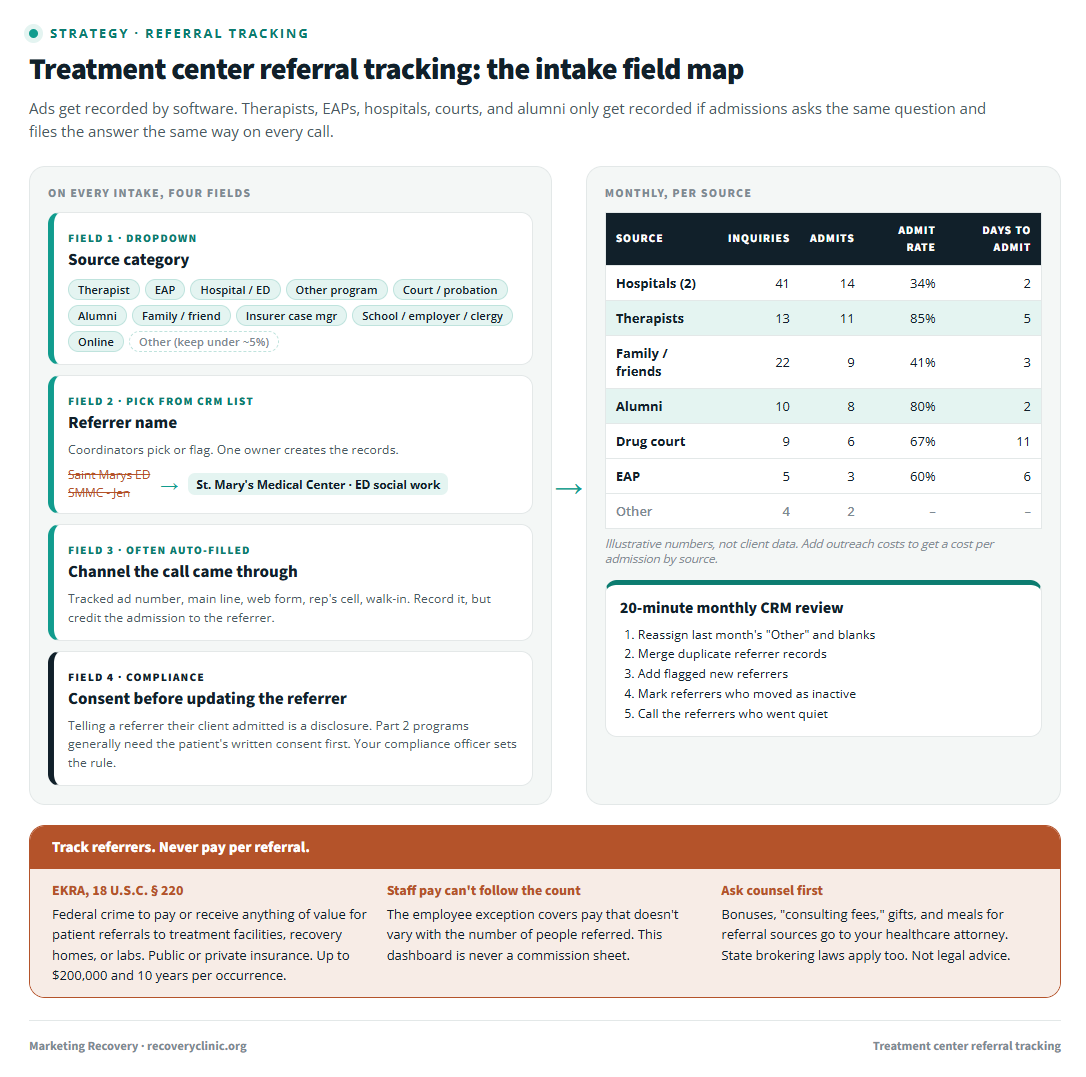
The four intake fields behind clean treatment center referral tracking, and the per-source numbers they produce.
The numbers to keep for each source
Once the fields are clean, the monthly report can show each source the way it shows a campaign. Four numbers per category, and per referrer for your top twenty or so:
- Inquiries (calls, forms, and direct referrals from that source)
- Admissions
- Admit rate, admissions divided by inquiries
- Days from first contact to admission
Admit rate is where the report gets interesting. A hospital that sends twelve inquiries and admits two is telling you something different from a therapist who sends three and admits three. Often the hospital is referring people who need a level of care you don't offer, or a payer you aren't in network with. That's a twenty-minute conversation with the discharge planner about who you can take and who you can't, and it'll do more for the relationship than another drop-off of brochures.
Watch concentration too. If one hospital accounts for a third of your admissions, a single staffing change in its social work department can empty beds you thought were safe. Keep the hospital, and let the number decide where the next quarter of outreach time goes.
Referral channels also have costs, and they belong in the same math as your ads. Outreach salaries, mileage, conference booths, and CRM seats all count. Divide those by referral admissions and you get a cost per admission for outreach that sits next to the ad number. The cost per admission post walks through the formula. In our experience referral admissions usually come out cheaper than paid search. Do the division before you say so in a budget meeting.
Keep the CRM clean
A referral list decays fast. Clinicians change practices and case managers leave; a hospital merges and its social work department gets a new name and a new phone tree. A list nobody maintains is wrong within a year.
Give one person ownership of the referrer records, usually the outreach lead or an admissions manager, and lock edit rights so coordinators can pick and flag but not create. Then hold a short monthly review:
- Read every intake marked "Other" or left blank last month and reassign what you can.
- Merge duplicate referrer records.
- Add the new referrers coordinators flagged.
- Mark referrers who moved or left as inactive, so history stays but they drop off the pick list.
- Pull the referrers whose inquiries dropped to zero this quarter.
That last step tends to pay for the whole exercise. A therapist who sent four clients a quarter and then went quiet has usually changed jobs, had a bad experience with your intake team, or found another program. You won't know which until someone calls, and without per-referrer numbers that call tends to happen about six months late.
Two privacy notes. Referral data sits next to patient information, so it belongs in a system covered by a business associate agreement, not a shared spreadsheet. And telling a referrer that their client was admitted is a disclosure. For substance use disorder programs, 42 CFR Part 2 generally requires the patient's written consent before you share it, which is why the field map includes a consent check. Your compliance officer should set the rule for what goes back to referrers and when.
Track referrers, never pay per referral
This is where referral tracking gets a treatment center into trouble, so it deserves plain language.
The Eliminating Kickbacks in Recovery Act (18 U.S.C. § 220), passed in October 2018 as part of the SUPPORT Act, makes it a federal crime to knowingly and willfully pay or receive anything of value in exchange for referring a patient to a clinical treatment facility, recovery home, or laboratory. It applies to services covered by a "health care benefit program," which 18 U.S.C. § 24(b) defines as any public or private plan, so commercial insurance counts along with Medicare and Medicaid. The penalty is a fine of up to $200,000, up to 10 years in prison, or both, for each occurrence. The older federal Anti-Kickback Statute covers federal health care programs, and several states have their own patient brokering laws. Florida's (§ 817.505) is the one most operators have heard of.
EKRA's exception for employees and contractors covers pay that isn't determined by, and doesn't vary with, the number of people referred. Read that next to a per-referrer dashboard and the risk is obvious. The same report that tells you which hospital admits best could become a commission sheet the moment someone ties an outreach rep's bonus, or a referrer's "consulting fee," to the count. Courts are still working out how parts of EKRA apply to marketing staff, which is one more reason not to improvise.
So keep the purposes separate in writing. You track referral sources to see where admissions come from and which relationships need attention. You pay outreach staff for the work, with compensation counsel has reviewed. You never pay, discount, or reward a referrer for sending patients, and you never sign a per-head deal with a "marketing partner" promising admissions. Gifts, meals, and sponsored lunches for referral sources raise their own questions, and those go to your healthcare attorney, not your marketing team. We're marketers, not lawyers, and nothing here is legal advice.
We work only with licensed, accredited programs, and we never buy or broker leads.
Make "Other" the smallest line on the report
Go back to that report with 31 admissions under "Referral" and 22 under "Other." With the fields above, the same 53 might break into 14 from two hospitals, 11 from therapists, 9 from family and friends, 8 from alumni, 6 from a drug court, 3 from an EAP, and 2 left in "Other." Below that sits a short list of names, and one of them is a therapist who sent three clients a month all spring and none since August. Nobody would have caught that from a line that just said "Referral."
If you'd like help connecting your intake data to your call tracking and ad reporting so every admission has a source, look at how we work with treatment centers or request a free audit.
About the author
Zac Spencer is an online marketing specialist and the owner of Crave Media, based in Salt Lake City, Utah. Since 2013 he has managed hundreds of Google Ads accounts across dozens of industries, and founded Marketing Recovery, a specialized arm of Crave Media focused on marketing for licensed addiction treatment centers.