Google Ads · August 11, 2026
How to read a Google Ads report as a treatment operator

By Zac Spencer
The monthly report lands, and it all looks fine
Every treatment operator with a paid campaign gets the same email once a month. A Google Ads report, ten or fourteen metrics, most of them pointing up, a sentence about "strong performance." You read it, you don't fully follow it, the beds tell a different story than the dashboard, and you file it away.
You don't need a marketing background to read a Google Ads report for a treatment center. You need to know which three or four numbers connect to your census, which numbers exist mostly to look good, and which questions the report should be able to answer but usually doesn't. That's what this walkthrough covers.
Start with spend and conversions
Ignore the top rows of the report on your first pass. Go find two numbers: what you spent, and how many conversions that spend produced. Divide one by the other. Cost per conversion is the first number on the report that has anything to do with your economics, and in this niche it runs high enough that you can't afford to skim past it. Clicks in treatment marketing cost anywhere from $25 to $150 or more, which we covered in what Google Ads really costs for a treatment center, so a month of spend disappears fast when the conversions aren't real.
That phrase "aren't real" is the important part, which brings up the question most operators never ask.
Ask what counts as a conversion
"Conversions: 41" means nothing until you know what the account counts. A conversion might be a form fill. It might be any phone call from the ad, including the ones that lasted eight seconds, or only calls over 60 seconds, which at least filters the misdials. In a sloppy account it can include clicks on the directions button, newsletter signups, and a page view somebody configured as a goal in 2023 and forgot.
The difference is enormous. Forty-one conversions that are mostly 10-second calls and a few real inquiries is a bad month wearing a good costume. Fifteen conversions that are all 90-second admissions conversations is a strong month. Same report format, opposite realities.
So ask, in writing: which actions count as conversions in my account, and what's the minimum call duration? A good answer is specific and boring. A bad answer talks about "engagement." If call answers like these are hard to get, the account probably also lacks call tracking that records source and duration, and that's a foundational problem worth fixing before you argue about any other number.
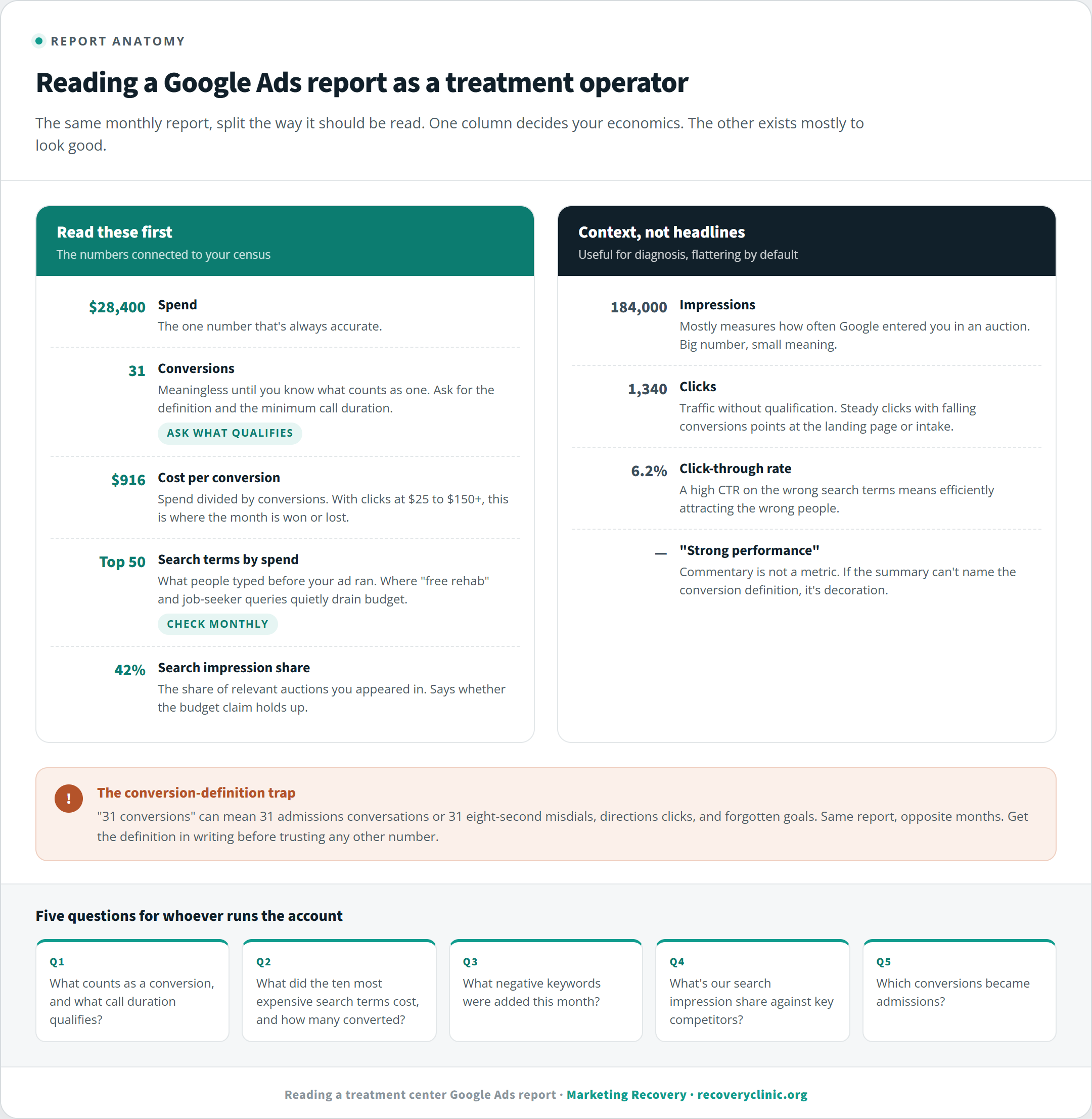
A treatment center Google Ads report, annotated. The left column is where your money is decided. The right column is where reports go to look impressive.
Pull the search terms, not just the keywords
The keywords tab shows what you bid on. The search terms report shows what people typed before your ad appeared, and that's where the waste hides. Accounts in this niche quietly pay for searches like "free rehab," "detox at home," AA meeting lookups, and job-seeker queries, because broad match stretched a reasonable keyword into an unreasonable one.
You don't need to read a thousand rows. Scan the top 50 by spend once a month. If a chunk of your budget went to searches that could never become an admission at your facility, the account needs negative keywords added, and the report should show that pruning happening month over month. We walked through which queries fill beds and which drain budgets in the keywords that fill beds, but the search terms report is where you verify it's happening in your account, not just in theory.
The flattering numbers on a Google Ads report
Impressions, clicks, and click-through rate sit at the top of most reports because they're big and they grow. None of them belongs in your first pass. A high CTR on the wrong search terms means you're efficiently attracting the wrong people. Impressions mostly measure how often Google entered you into an auction.
They do have a use: diagnosis. If conversions dropped, these numbers tell you where the funnel thinned. Impressions down usually points to budget, a suspension scare, or lost auction share. Clicks steady while conversions fell points at the landing page, the intake line, or conversion tracking itself breaking. Read them the way you'd read vitals, as context for a problem, never as the headline.
One number worth requesting if it's absent: search impression share, which says what percentage of the available auctions you actually appeared in. In a market where a few competitors with deep budgets dominate, it tells you whether "we maximized the budget" is true.
The report ends where your census begins
Even a clean report stops at the conversion. Your economics don't. The call that counted as a conversion still has to be answered well, verified, and admitted, and none of that appears in Google Ads. A report can be legitimately excellent while intake leaks everything it delivers.
That's why the last step of reading the report happens outside it: put the month's conversions next to the month's admissions that came from paid search. If 40 conversions turned into one admission, the problem is usually lead quality or what happens when the phone rings, and we broke down how to trace it in what cost per admission really means. For scale, one treatment center we worked with reached 1,740 conversions at a 13.46 percent conversion rate over the life of their campaigns, and the reason that number mattered is that it was built on a strict conversion definition and reconciled against real admissions. The figure is theirs, not a promise of yours, but the discipline transfers.
Five questions that expose the account's health
When you next meet whoever runs your ads, work from the report toward these: What counts as a conversion, and what call duration qualifies? What did the ten most expensive search terms cost me, and how many converted? What negative keywords were added this month? What's our search impression share against the competitors we care about? And which conversions became admissions?
An account being run well produces fast, specific answers, because the person running it asks themselves the same things weekly. Long pauses and talk of brand awareness usually mean the report you're getting is decoration.
If you'd like a second set of eyes on yours, our Google Ads management for treatment centers starts with exactly this kind of account read, and we'll tell you plainly what the report says and what it's hiding. Request a free audit and bring last month's report with you. It usually takes about twenty minutes to know whether your spend is working.
About the author
Zac Spencer is an online marketing specialist and the owner of Crave Media, based in Salt Lake City, Utah. Since 2013 he has managed hundreds of Google Ads accounts across dozens of industries, and founded Marketing Recovery, a specialized arm of Crave Media focused on marketing for licensed addiction treatment centers.