Compliance · September 15, 2026
The claims treatment marketing can't make

By Zac Spencer
The sentence that sinks the campaign
Most treatment marketing problems don't start with a bad campaign. They start with a sentence. Someone writes "92% success rate" on the homepage, or "we guarantee lasting recovery" in an ad, and from that moment the center is carrying a claim it can't prove and an ad platform will eventually flag.
Treatment center advertising rules aren't one rulebook. They're four layers stacked on top of each other: federal truth-in-advertising law, state statutes written specifically for addiction treatment marketing, HIPAA where patient information is involved, and the ad platforms' own policies, which are often stricter than the law. A claim has to clear all four. Miss one and the consequence might be a rejected ad, or it might be a letter from a state attorney general.
The good news is that the prohibited territory is well mapped. This post walks the map: what you can't say, why, and what to publish instead. One caveat before we start. We're marketers, not lawyers, and nothing in this piece replaces your counsel's review. It will, though, keep your marketing out of the sentences that cause most of the trouble.
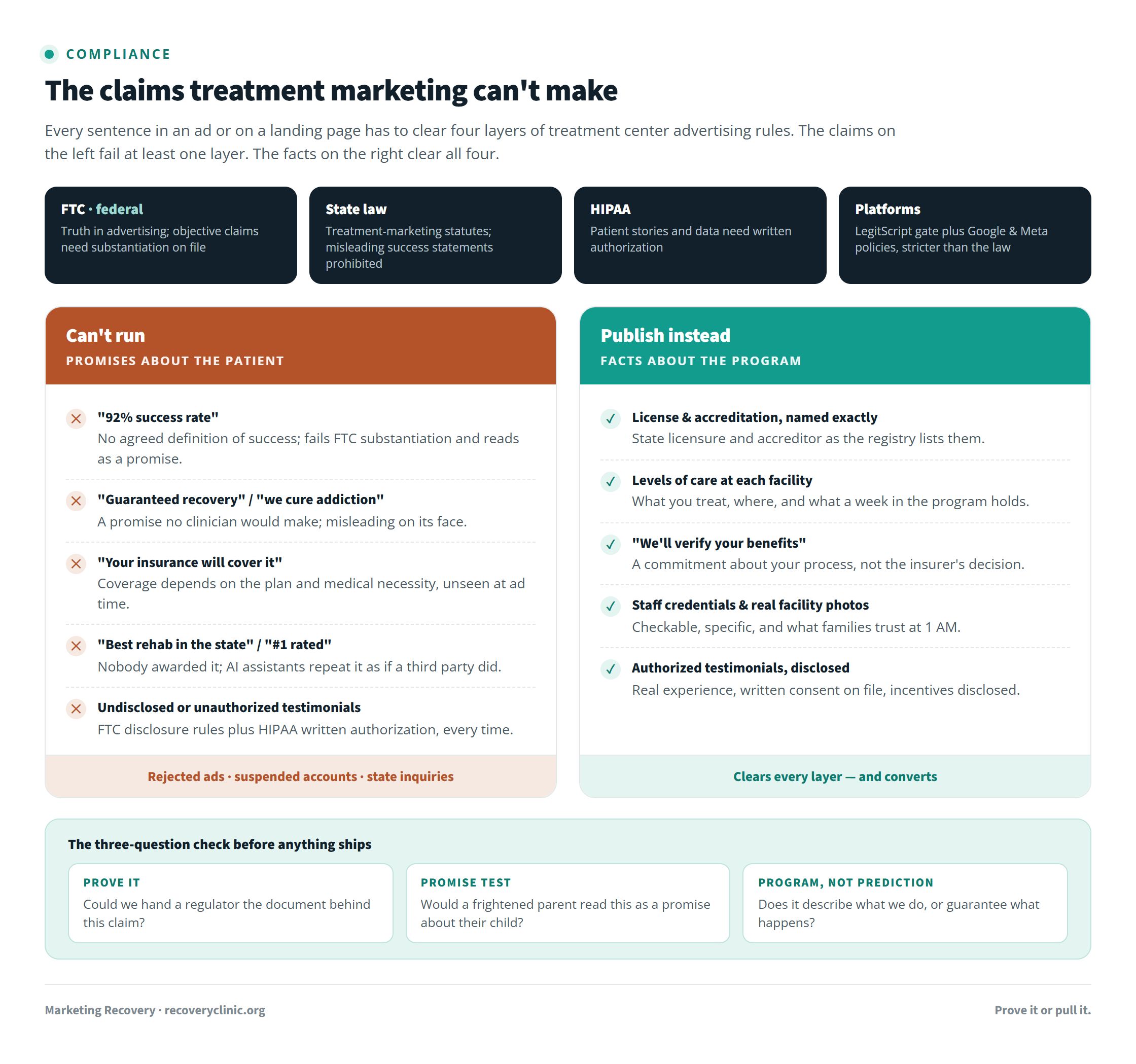
Every marketing claim has to clear four layers of rules. The left column gets ads rejected and centers investigated. The right column is what families and regulators can verify.
Success rates and outcome claims
Start with the claim that causes the most damage: the success rate. "92% of our clients stay sober." "Proven outcomes." "The most effective program in the region."
Part of the problem is that most of these numbers are unverifiable. The bigger part: "success" has no agreed definition in addiction treatment. Sober at discharge? At 30 days? At five years? Counting everyone who enrolled, or only the alumni who answered a survey two years later? A center can produce a 90%+ figure from almost any program by choosing the friendliest measurement, and regulators know it. The FTC requires advertisers to hold real substantiation for objective claims before making them, and a self-selected alumni survey doesn't clear that bar. Several states go further: California, for one, prohibits treatment providers from making false or misleading statements about program success in their marketing.
There's a second problem that matters even when a number is honestly measured. A family reading "92% success rate" at 1 AM doesn't process it as a research finding. They read it as a promise about their son. That's exactly the reading regulators are worried about, and it's why our advice is blunt: delete the number. If your program tracks outcomes through a legitimate research partnership, describe the study, name who ran it, and publish the methodology alongside it. If you can't do that, the statistic doesn't go on the site.
Guarantees, cures, and promises about coverage
Guarantees are the clearest line in all of treatment center advertising rules. "Guaranteed sobriety," "we will cure your addiction," "recovery that lasts" as a stated commitment. No credible clinician would promise this, and marketing can't either. Addiction is a chronic condition. Advertising that promises to end it is misleading on its face, and it's the kind of claim that shows up in state attorney general complaints.
The subtler version is the financial promise. "Your insurance will cover treatment" is a guarantee you can't keep, because coverage depends on the plan, the level of care, medical necessity review, and a dozen things nobody has seen at ad-click time. What you can promise is the verification: "we'll check your benefits and tell you what your plan covers." The first is a promise about an insurer's decision; the second is one you can keep.
Same logic for "immediate admission." If a bed check happens first, say "same-day admission is often available." The word "often" is doing legal work there. Use it.
Testimonial rules, briefly
Testimonials sit at the intersection of all four rule layers, which is why they go wrong so often. The short version: the FTC's endorsement rules require testimonials to reflect real, honest experience, and any compensation or incentive behind one has to be disclosed. HIPAA means a former client's story can only appear with written authorization, because publishing it confirms a treatment relationship. And the platforms restrict them further; testimonial content in ads for addiction services gets extra scrutiny, and Meta's personal-attributes rules make most first-person recovery stories unrunnable as ad copy.
None of that makes testimonials off limits. Used properly, they're some of the most persuasive material a center has. Getting them compliantly, from consent through placement, is its own process, and a longer topic than this post can hold. The rule that belongs here is narrower: never invent one, never pay for one without disclosure, and never publish one without written authorization on file.
Superlatives nobody awarded you
"The best rehab in Tennessee." "The #1 rated treatment center." "Top luxury facility in the Southeast." Ask who awarded that ranking and the room goes quiet.
Unsubstantiated superlatives are deceptive advertising in the FTC's view, and they've become riskier in a way most centers haven't noticed: AI assistants now summarize treatment centers to families, and they quote websites. A self-awarded "#1" can get repeated back as if a third party said it, which compounds the misrepresentation instead of burying it. We covered the flip side of this in the accreditation post: third-party credentials work in marketing precisely because someone else grants them. "Joint Commission accredited" is a claim with a registry behind it. "Best in the state" is a claim with nobody behind it.
If a phrase needs an invisible asterisk to be true, it doesn't belong in your marketing. That standard alone would clean up half the treatment sites we audit.
What the platforms add on top
Everything above is law. The platforms then layer their own policies over it, and this is where centers usually feel the rules first, because enforcement is automated and fast.
Google's addiction services policy requires LegitScript certification before a treatment center can run ads at all, and its misrepresentation policies apply to the landing pages behind those ads, too. An "our program works when others fail" line on your admissions page can cost you an ad account even though no regulator ever called. We've written about why Google suspends treatment center ad accounts, and unsupportable claims sit high on that trigger list. Meta is stricter still, with wording rules that prohibit implying knowledge of someone's condition; the Meta ads post covers how narrow that lane is.
The practical takeaway: platform review reads your whole funnel. Cleaning up ad copy while the site still promises outcomes just moves the violation one click downstream. When we build Google Ads campaigns for treatment centers, the claims audit covers landing pages before the first ad goes live, because that's where the automated reviews look.
What you can say
The compliant claim set is bigger than most operators think. Everything verifiable is available to you: your state license, named the way the state names it. Accreditation, named exactly. The levels of care you offer and where. Staff credentials. The insurance networks you're actually in-network with. Your facility, your visiting policy, what the first day looks like. How long the program runs and what a typical week holds.
That list can feel modest next to a competitor shouting about success rates. It converts anyway, for a reason that took us a while to appreciate: families in crisis have finely tuned radar for overpromising. A site full of checkable facts reads as trustworthy. A site full of promises reads like the ads they've already learned to distrust. The centers with the strongest admissions numbers we've seen are consistently the ones whose marketing a regulator could read without a highlighter.
Three questions before anything ships
A claims review doesn't need a committee. It needs three questions asked of every sentence in an ad, a landing page, or a Google Business Profile description.
Could we hand a regulator the document that proves this? Not an explanation. A document: the license, the accreditation certificate, the network agreement, the published study.
Would a frightened parent read this as a promise about their child? If yes, soften it until it's a statement about your program instead of a prediction about their family.
Does it describe what we do, or guarantee what happens? Describing is marketing. Guaranteeing is the part that's prohibited.
Prove it or pull it
That's the whole rulebook compressed to four words. Every claim in your marketing either has proof behind it or it's a liability waiting for its moment, and in this industry the moment tends to arrive as a suspended ad account or a state inquiry rather than a polite warning.
If you'd like a second set of eyes on what your site and ads are claiming right now, request a free audit and we'll flag the sentences we'd pull, and what we'd publish in their place.
About the author
Zac Spencer is an online marketing specialist and the owner of Crave Media, based in Salt Lake City, Utah. Since 2013 he has managed hundreds of Google Ads accounts across dozens of industries, and founded Marketing Recovery, a specialized arm of Crave Media focused on marketing for licensed addiction treatment centers.